
Telling the Time in German: Wie spät ist es? and halb drei
By Michael McGettrickUpdated 12 October 2026
Ask ? and answer . Minutes go (past) and (to) the hour, as in English. The one real trap is : is half way to three, so 2.30, not 3.30.
Quick check
Three quick questions on what you have just read. The full practice is further down.
Pick the right one
0/3What time is it? Tap the clock time. Remember that halb counts towards the next hour.
Es ist halb drei.
Es ist Viertel nach vier.
Es ist Viertel vor neun.
The whole system on one screen
Two colours carry the whole system: one for counting on from the hour just gone, one for counting towards the next.
| Clock | German | Literally |
|---|---|---|
| 3:00 | | three o'clock |
| 3:05 | | five after three |
| 3:15 | | quarter after three |
| 3:30 | | half way to four |
| 3:45 | | quarter before four |
| 3:50 | | ten before four |
| 15:30 | | timetable form |
| at 8 | | um = at |
Read the 3:30 row twice. It is the one place German and English point in opposite directions.
Asking the time
There are two everyday questions, and they mean exactly the same.
| German | English | Note |
|---|---|---|
? | What time is it? | literally how late |
? | What time is it? | literally how much clock |
. | It three o'clock. | the full answer |
. | It three. | just as common |
The answer always starts . Add in front when you ask a stranger: , ? - Excuse me, what time is it?
Uhr or Stunde?
English "hour" is two German words, and mixing them up is a classic slip.
.- It'sthree o'clock. (the time on the clock).- I'm waiting three hours. (a length of time).- I'm waiting ten minutes.
is also the clock or watch itself: . - The clock is new. is sixty minutes, and is one.
One o'clock: ein Uhr
With , one loses its -s. Without it keeps the counting form.
.- It'sone o'clock..- It'sone.
Both are correct; is not.
Halb drei is 2.30
English looks back at the hour that has passed: half past two. German looks forward to the hour that is coming: half way to three. So always takes the next hour.
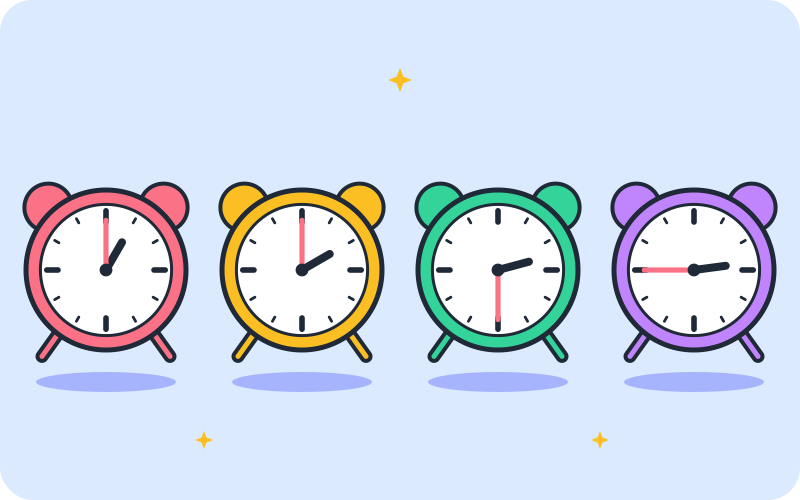
One o'clock (ein Uhr), two o'clock (zwei Uhr), then half past two: halb drei, half way to three.
| Clock | German | Not |
|---|---|---|
| 12:30 | | |
| 2:30 | | |
| 7:30 | | |
| 11:30 | |
.- We're meeting at half past seven.
Meet a German at , arrive at 8.30, and you are an hour late. When in doubt, add one to the English hour.
Viertel and the minutes: nach and vor
Minutes work the way they do in English: means past, means to. The first half of the hour counts on from the hour just gone; the second half counts towards the next one.
- :01-:30Counting on: fünf nach drei, Viertel nach drei
- :31-:59Counting towards four: halb vier, Viertel vor vier
| Clock | German | English |
|---|---|---|
| 4:05 | | five past four |
| 4:10 | | ten past four |
| 4:15 | | quarter past four |
| 4:20 | | twenty past four |
| 4:40 | | twenty to five |
| 4:45 | | quarter to five |
| 4:50 | | ten to five |
| 4:55 | | five to five |
Near the half hour
Many speakers count the minutes either side of the half hour from instead. Learn to understand these; at 4:20 and 4:40 the plain forms are never wrong.
| Clock | Counted from halb | Also said |
|---|---|---|
| 4:20 | | |
| 4:25 | | the usual form |
| 4:35 | | the usual form |
| 4:40 | | |
A regional variant
In parts of eastern and southern Germany and in Austria you will hear a quarter, or three quarters, of the way to the next hour. It is the same forward-looking logic as .
| Clock | Regional | Everywhere |
|---|---|---|
| 4:15 | | |
| 4:45 | | |
Both columns are correct German. The and forms are understood everywhere, so they are the ones to use yourself.
At what time? um
"At" with a clock time is , every time.
| German | English |
|---|---|
? | At what time? |
| at eight o'clock |
| at half past eight |
.- The film starts at eight..- I'll come at about eight.
means "around": use it when you are not promising the minute.
Early, late and on time
- zu früh
- pünktlich
- zu spät
.- You're early..- The train is on time..- I'm going to be late.
For an appointment in Germany, means on the minute. Arriving ten minutes late without a message is noticed, so send one: . - I'll be ten minutes late.
The 24-hour clock
Timetables, cinemas, shop doors, appointments and the radio use the 24-hour clock. Read it as plain numbers: the hours, then , then the minutes.
| Written | Said |
|---|---|
| 8.00 | |
| 14.30 | |
| 17.45 | fünfundvierzig |
| 20.15 | |
The words , , and do not mix with the 24-hour clock. 14.30 is , or in conversation , not " ". Germany writes the time with a dot (14.30 ) or a colon (14:30).
Parts of the day
Each part of the day has two forms: ... for one particular day, and a lower-case -s form for a habit.
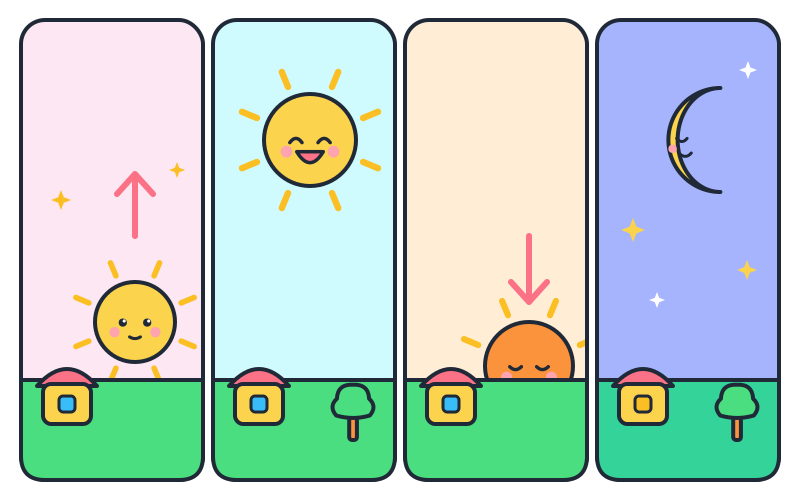
Morning (am Morgen), midday (am Mittag), evening (am Abend) and night, the odd one out: in der Nacht.
| One day | Every day | English |
|---|---|---|
| | in the morning |
| | late morning |
| | at midday |
| | in the afternoon |
| | in the evening |
| | at night |
.- Today I'm working in the evening..- I work in the evenings.
The night is , not " ": takes , not . has no English word; it is the stretch from about nine until noon.
These attach to a clock time to settle am or pm: is 8 pm. And watch : , with a capital, is the morning; , small, is tomorrow.
Common mistakes English speakers make
| Wrong | Right | Why |
|---|---|---|
| for 3:30 | | takes the next hour |
| no s before | |
| (hours) | | hours of time = |
| am | | um with clock times |
| am | | die takes in |
| no with 24-hour time |
What to do next
- Each time you look at a clock today, say the time in German,
included. - Read one German train time aloud in the 24-hour form.
- Do the drill below, then check the
table again.