
Ch 2 · Lesson 14Latin · Chapter 2 · Lesson 14 · Grammar primer
Commands: the imperative
, , : a Latin command is the infinitive with -re cut off, and -te makes it plural (). The short ones and are the next two lessons.
The short version
A Latin command is the verb with -re cut off
.
Why?Hide
Take the infinitive and drop -re for one person: gives , gives , gives . For a group, add -te: , , . Third-conjugation verbs switch to -ite, so and .
A Latin command is the verb with almost nothing on it. For one person you use the bare stem; for several you add -. For don't, you use or with the infinitive.
The rule on one screen
Drop the - from the infinitive for one person; add - for several.
| Infinitive | One person | Several | English |
|---|---|---|---|
| | | see! |
| | | have! |
| | | believe! |
| | | listen! |
| | | come! |
| | | give! |
In a sentence:
.- Come to me..- Give me water..- Come and see (all of you).
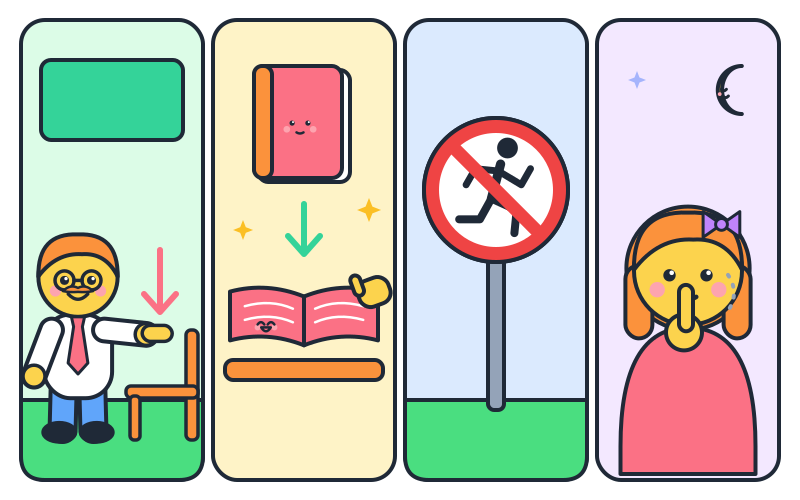
- currere
- Tace
Commands to one person: sede (sit down), aperi librum (open the book), tace (be quiet). Each is the infinitive minus -re. Don't run takes noli and the infinitive, below.
Third conjugation: -e, then -ite
Look at the row. The singular ends in -e, but the plural is -, not -ete:
.- Believe me..- Believe me (all of you).
That -- is the vowel of the you-all form. The plural command is simply that form with -tis swapped for -:
Commands you already know
A lot of the Latin that survives in English is in the imperative.
| Latin | English | Verb |
|---|---|---|
Carpe | seize the day | carpere |
| beware of the dog | |
| pray for us | |
Sapere | dare to know | |
| come here | |
The vowel in each command is the infinitive's vowel: carpere gives carpe, gives . The greetings are commands too. is literally be well!, so a group gets the plural:
, .- Hello, brothers..- Goodbye, everyone.
More on those in Latin greetings.
Going further: The four short ones: dic, duc, fac, fer and the rest of the guide, when you want them. This lesson does not need them.
Practice
Practise this lesson
10-question session
One question at a time, mixed across the exercises in this lesson. Miss one and it comes back round before the end.
Latin · Free printables
Worksheets for this lesson
Worksheets with answer keys built in. Open any one to view, print or save.
Lesson 14 of 39 in this chapter