
Translation
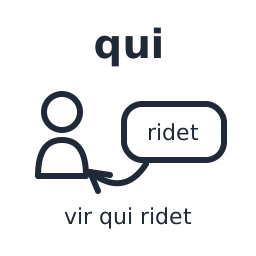
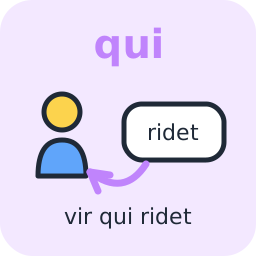
who; which
Test yourself on qui
Three quick questions. No account needed.
Know this word? Create a free account to track it.
Examples
.
The man who is coming is my brother.
.
The book which you are reading is mine.
.
The woman whom I saw is his mother.
.
The soldiers to whom he gave money were brave.
.
What he said is true.
The relative pronoun, and along with "sum" the thing that decides whether a page of Latin opens up or stays shut. The commonest forms are "qui" (masculine, doing the verb), "quae" (feminine, doing the verb), "quod" (neuter), "quem" (masculine, on the receiving end) and "cuius" (whose). Add "quibus" for "to whom" or "by whom" in the plural and you can read a great deal.
The rule that unlocks it is a split one. GENDER and NUMBER come from the noun it points back to, so a feminine singular antecedent forces "quae" or "quam". CASE comes from the job the pronoun does inside its own clause, which is why "vir quem vidi" (the man whom I saw) has an accusative even though "vir" is nominative.
Two traps worth flagging early. "quod" is also a conjunction meaning "because", and "quam" is also an adverb meaning "than". Context, and the noun it agrees with, settle both.
Where this fits
Used in
Stories
(11)Vinum bonum
1 min read · Core 1000
Carmina mea
2 min read · Core 1000
In principio creavit Deus
2 min read · Core 5000
In principio erat Verbum
2 min read · Core 5000
Pater noster
2 min read · Core 5000
Pro amica
2 min read · Core 1000
Venus
3 min read · Core 1000
Parvo pretio
3 min read · Core 1000
In parietibus Pompeianis
3 min read · Core 5000
Gallia est omnis divisa
5 min read · Core 5000
Lupus et agnus
5 min read · Core 5000
Grammar articles
(13)The Latin Ablative Absolute: urbe capta, signo dato
Church Latin Pronunciation: Every Rule vs Classical
Latin Demonstratives: Hic, Haec, Hoc and Ille Charts
The Latin Genitive and Dative in Practice
The Gloria and Sanctus in Latin, Word by Word
Latin Question Words: quis, quid, ubi, cur
Latin Mass Responses: The Full Text, With Literal English
Latin Tattoo Phrases: Grammatical Ones and Famous Mistakes
The Latin Passive and Deponent Verbs: amatur, locutus sum
The Pater Noster: the Our Father in Latin, Word by Word
Latin Pronouns Chart: ego, is, hic, ille and qui
Latin Purpose, Result and cum Clauses: ut, ne and cum
Latin Relative Pronoun: qui, quae, quod and How It Agrees
Add to review queue
Track this word in your spaced-repetition queue and be tested on it at the right interval.
Meet this word in a story
Every course has graded stories written only with words you have been taught, plus grammar drills, a games arcade and printable worksheets. Chapters 1 and 2 are free.
Chapters 1 and 2 free, forever. Plus: 7 days free, then $5 a month for all eleven languages.
Latin · Free printables
qui: worksheet, infographic and listicle
Free printable study downloads for the Latin word "qui" (who; which): a worksheet with the answer key built in, an infographic, and a sentence listicle. Open any one to view, print or save.
This word is taught in chapter 1, lesson 3: qui, et, in and 11 more words.