
Latin Demonstratives: Hic, Haec, Hoc and Ille Charts
By Michael McGettrickUpdated 11 October 2026
, , means this; , , means that. Each is one word in three genders, and it agrees with its noun in gender, number and case, all at once: , this god; , this land; , this name. English says this and that; Latin -inflects the pointer every time.
Quick check
Three quick questions on what you have just read. The full practice is further down.
Pick the right one
0/3Now the accusative singular: every noun here is the object of some verb. Pick the form of hic that agrees.
deum
terram
nomen

Hoc is the thing by me (ego), istud the thing by you (tu), illud the thing far off on the hill. The neuter is how Latin points at a thing with no noun: this thing, that thing.
The forms that matter
In real sentences the nominative and accusative do most of the pointing, so drill these first. Read each row as masculine, feminine, neuter:
| this | Masc. | Fem. | Neut. |
|---|---|---|---|
| Nom sg | | | |
| Acc sg | | | |
| Nom pl | | | |
| Acc pl | | | |
| that | Masc. | Fem. | Neut. |
|---|---|---|---|
| Nom sg | | | |
| Acc sg | | | |
| Nom pl | | illae | |
| Acc pl | | | |
In these four cases runs on the endings of with two exceptions: the masculine nominative is , not illus, and the neuter singular ends in -d. So it is , that name, never .
is craggier, with a -c welded onto most singular forms. Its accusative looks like an -um ending plus -c, with the m turned to n before it.
Agreement, worked
Take , masculine. As a subject it is ; as an object, . The demonstrative changes because the noun's case changes:
| Job | Latin | English |
|---|---|---|
| subject | . | This god sees. |
| object | . | I see this god. |
| subject | . | This land is large. |
| object | . | I see this land. |
| subject | . | This name is good. |
| object | . | I say this name. |
The last two rows show the neuter rule: every neuter uses one form for nominative and accusative, so never changes between subject and object.
Plurals run the same race:
Yes, is both feminine singular ( , this land) and neuter plural ( , these names). The noun beside it settles which.
The two traps
Agreement runs on a noun's grammatical gender, a fact from the dictionary, not something you can read off the ending. The nouns that punish guessing sit in your first hundred words:
| Noun | Gender | this | that |
|---|---|---|---|
| masculine | | |
| feminine | | |
| feminine | | |
| neuter | | |
looks like and is masculine anyway: . - This day is good. sits in the mostly masculine fourth declension and is feminine anyway. Learn a noun's gender with the noun and the demonstratives look after themselves.
The full tables: hic and ille in all five cases
The genitive and dative singular are the same for all three genders: and , and .
| hic | Singular | Plural |
|---|---|---|
| Nom | , , | , , |
| Acc | , , | , , |
| Gen | | , , |
| | |
| Abl | , , | |
| ille | Singular | Plural |
|---|---|---|
| Nom | , , | , illae, |
| Acc | , , | , , |
| Gen | | , , |
| | |
| Abl | , , | |
Watch the ablative singular: there is a different case from the neuter nominative, and exists nowhere else in the table.
What the two words mean in use
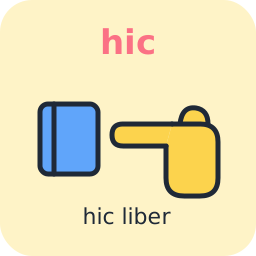 this one, near me
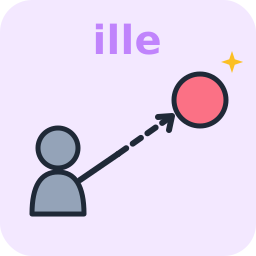 that one, over there
is the thing near the speaker, and by extension the one just mentioned. is the thing over there, and by extension the one everybody knows about:
As a contrasted pair they mean the latter (, the nearer, so the one mentioned last) and the former ():
: , .- Father and son: the son speaks, the father answers.
iste, ipse and idem
Three more words of the same family decline on the same - / -i pattern. They have their own page, ipse, idem and iste; in brief:
| Word | Meaning | Example | English |
|---|---|---|---|
| that of yours | | that business of yours |
| himself, very | | the king himself |
| the same | | at the same time |
Common mistakes
| Wrong | Right | Why |
|---|---|---|
| | |
(object) | | a neuter accusative = nominative |
| | the neuter of -d |
| | it is also neuter plural: these words |
The workhorse pronoun , , , the personal pronouns and the relative are in the Latin pronouns article; the agreement these words follow is in adjectives and agreement.
What to do next
- Say
, ,with,anduntil the match is instant. - Run the drill below: sort by gender, then mind the case.
- Learn every new noun's gender with the noun.