
Latin Numbers Grammar: Which Decline, Milia, and 18 and 19
By Michael McGettrickUpdated 11 October 2026
Latin is famous for its endings, and its numbers are where it quietly lets you off. Most of them never change. The whole grammar of Latin counting is three small words that decline, a subtraction at eighteen and nineteen, and one noun, , that wants a genitive after it.
Quick check
Three quick questions on what you have just read. The full practice is further down.
Pick the right one
0/3Pick the form of duo that agrees with the noun. Pars and res are feminine, dies is masculine, nomen is neuter.
partes (subject) (Pars is feminine, and this is the subject.)
dies (subject)
partes (object) (Feminine accusative, like bonas.)
One to ten: three that decline, the rest that never do
| Value | Word | Value | Word |
|---|---|---|---|
| 1 | | 6 | |
| 2 | | 7 | |
| 3 | | 8 | |
| 4 | | 9 | |
| 5 | | 10 | |
There is no zero. Classical Latin had no number word for nothing; a Roman said (no, not any) or (nothing): . - I have nothing.
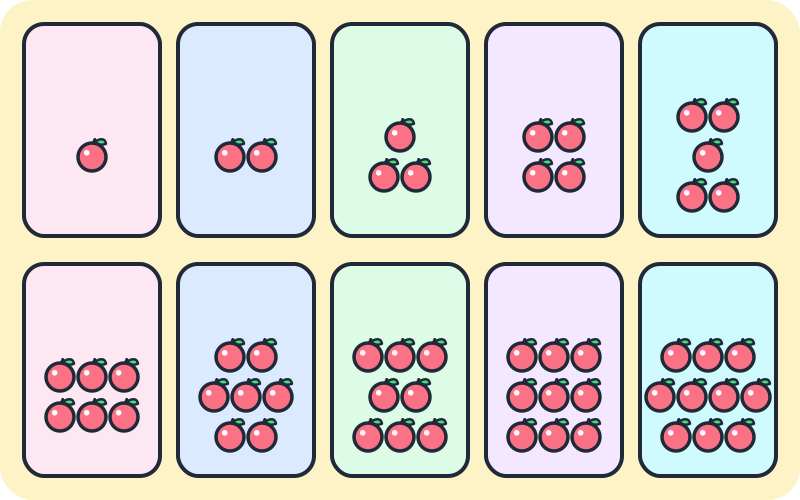
Count the apples from unus to decem. Only the first three change to agree with what they count.
The first three agree with what they count in case and gender. From four on, the number is indeclinable, and the noun carries the case on its own:
is feminine)
Unus: one, only, and a genitive of its own
declines like except in two places, which it shares with , and : the genitive singular is and the dative , for all three genders.
| Case | Masc. | Fem. | Neut. |
|---|---|---|---|
| Nom | | | |
| Acc | | | |
| Gen | | | |
| | | |
| Abl | | | |
often means a little more than one: a single one, or the only one, leaning towards (alone). is one out of many, singled out. It even has a plural for nouns that exist only in the plural: , a camp, is plural in form, so one camp is .
Duo and tres
keeps traces of an old dual number, which is why it looks like nothing else:
| Case | Masc. | Fem. | Neut. |
|---|---|---|---|
| Nom | | | |
| Acc | | | |
| Gen | | | |
| /Abl | | | |
The masculine accusative is sometimes as well, but is the form to learn. is a regular third-declension plural, with one form for masculine and feminine and one for neuter:
| Case | Masc. and fem. | Neut. |
|---|---|---|
| Nom/Acc | | |
| Gen | | |
| /Abl | | |
Get these two tables right and you have done nearly all the declining Latin numbers ask of you below two hundred.
The teens, and why eighteen counts backwards
Eleven to seventeen are a unit fused onto ten, with some wear at the join:
| Value | Word | Value | Word |
|---|---|---|---|
| 11 | | 15 | |
| 12 | | 16 | |
| 13 | | 17 | |
| 14 | |
Then Latin changes direction. Eighteen is two-from-twenty and nineteen is one-from-twenty, and the in the middle is the preposition from:
The pattern runs at the top of every ten:
| Value | Word | Literally |
|---|---|---|
| 18 | | two from twenty |
| 19 | | one from twenty |
| 28 | duodetriginta | two from thirty |
| 29 | undetriginta | one from thirty |
| 39 | undequadraginta | one from forty |
| 99 | undecentum | one from a hundred |
, ten and eight, does turn up for eighteen (the Vulgate uses it), but the subtractive forms are the classical norm.
The tens and a hundred
| Value | Word | Value | Word |
|---|---|---|---|
| 20 | | 70 | |
| 30 | | 80 | |
| 40 | | 90 | |
| 50 | | 100 | |
| 60 | |
All indeclinable. Watch the vowel before -ginta: has a u, an o, and starts like nonus (ninth) rather than . English kept one of them: the Greek Old Testament is the Septuagint, after the seventy translators of the legend (the story actually has seventy-two, rounded down).
Joining them: 21 to 99
Latin gives you two ways to build a compound under a hundred, and both are correct:
Above a hundred the bigger number leads: , 123. If the compound contains , or , that part still agrees with the noun, and the noun is plural:
Hundreds and thousands
From two hundred to nine hundred the hundreds are plural adjectives, declined like the plural of :
| Value | Word | Value | Word |
|---|---|---|---|
| 200 | ducenti | 600 | sescenti |
| 300 | trecenti | 700 | septingenti |
| 400 | quadringenti | 800 | octingenti |
| 500 | quingenti | 900 | nongenti |
So three hundred agrees with its noun: trecenti with men, trecentae with parts, trecenta with names.
A thousand is where Latin does something English does not. is an indeclinable adjective; its plural is a neuter noun, and what it counts goes into the genitive:
| English | Latin |
|---|---|
| a thousand men | |
| two thousand men | |
| three thousand men | |
| a mile (1,000 ) | passuum |
The number in front of agrees with it as a neuter plural, which is why it is , never . The Roman mile is the commonest place you will see itself with a genitive. There is no classical word for a million: a Roman multiplied, decies centena , ten times a hundred thousand.
For first, second and third, see Latin ordinal numbers.
Words are not numerals
The number words are the language; Roman numerals are a way of writing quantities with seven symbols, I, V, X, L, C, D and M. They are as different as the word seven and the digit 7.
| Value | Numeral | Word |
|---|---|---|
| 4 | IV or IIII | |
| 9 | IX or VIIII | |
| 19 | XIX or XVIIII | |
| 50 | L | |
| 100 | C | |
| 500 | D | quingenti |
| 1,000 | M | |
They do not follow the same logic either. Subtracting a smaller symbol before a larger one (IV, IX) is found in Roman inscriptions, but plain addition (IIII, VIIII) is common too; IV as the one correct four is a later tidying-up. And the words subtract in different places: is one-from-twenty, while XIX is ten plus one-from-ten.
If you meet a numeral in a Latin text, read it aloud as the word, in the right form for its noun: III is .
Mistakes English speakers make
| Wrong | Right | Why |
|---|---|---|
| | is feminine |
| | is neuter |
| quattuoris | | four to a hundred never change |
| | takes a genitive |
| | is neuter |
| | is the dative |
What to do next
- Say each number aloud with a noun attached:
- Run the drill below until the forms of
andcome without thinking. - Read every Roman numeral you meet aloud as the word.