
Latin Verb Endings Chart: -o, -s, -t, -mus, -tis, -nt
By Michael McGettrickUpdated 11 October 2026
is a complete Latin sentence. One word, two syllables, subject and verb both present: I love. The - on the end is the I. In the present tense every Latin verb ends in one of six such endings, and each one names who is acting.
| Ending | Person | Latin | English |
|---|---|---|---|
- | I | | I say |
-s | you (one) | | you say |
-t | he, she, it | | he, she says |
-mus | we | | we say |
-tis | you (pl) | | you (pl) say |
-nt | they | | they say |
Quick check
Now use it: three quick questions on the chart above. The full practice is further down.
Fill in the blank
0/3Complete the verb with the right personal ending.
dic (I say)
dici (we say)
habe (he has)
These six run through most of the active tenses with only small adjustments: the first person is sometimes -m instead of - (, I am), and the perfect has a set of its own. One table, years of use.
Why there are no pronouns
Because the ending has already done that job:
.- I say..- We say..- They say.
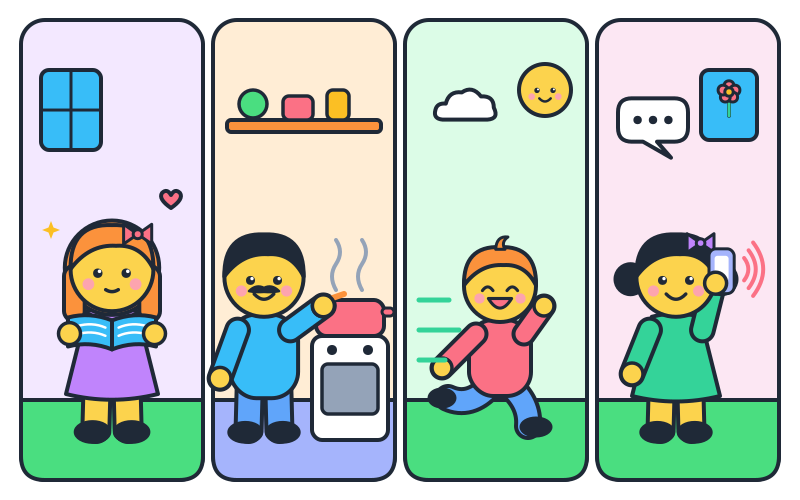
- .
- Coquit.
- Currit.
Legit, she reads; coquit, he cooks; currit, he runs. The -t says he or she, so Latin needs no pronoun: the picture shows who.
(I), (you) and (we) all exist. A Roman used them for contrast, not for basic information:
, taces.- I am the one speaking; you are keeping quiet.
Put the pronoun in by default and you have written the clearest sign of a beginner's Latin. If you would not stress the word in English, leave it out in Latin.
Spanish and Italian inherited this habit directly: Spanish hablo and Italian parlo are each a complete sentence, I speak. French wore its endings down until parle, parles and parlent sound alike, and its pronoun became compulsory.
Why dictionaries cite dico, not dicere
Every Latin dictionary lists a verb by its first person singular, I say, with the infinitive beside it:
| Headword | Infinitive | English |
|---|---|---|
| | I love, to love |
| | I have, to have |
| | I say, to say |
| | I hear, to hear |
This course follows the convention, so the vocabulary you learn here matches every other Latin resource. Learn the infinitive with the headword, though: and end the same way, and only and show that they belong to different families.
The four conjugations
Latin verbs come in four families, and what differs is the vowel before the ending, not the ending itself:
| Family | I | he, she | we |
|---|---|---|---|
| First | | | |
| Second | | | |
| Third | | | |
| Fourth | | | |
Look down the columns: -t and -mus sit in every row. Beginners hear "four conjugations" as four times the work; it is one set of endings and four vowels. (In the first conjugation the -- merges into the -: , not amao.)
The third and fourth conjugations put a -u- before -nt:
.- They say..- They hear.
One catch, because this course prints no macrons. and look alike, though the e of is long and the e of short. Tell them apart by the headword: the second conjugation keeps its -e- before the - and the third does not.
.- He has. (, second: the e stays).- He says. (, third: the vowel is i)
sum: irregular stem, nearly regular endings
The verb to be is irregular in Latin, as in almost every language. So is , I can, which is pot- welded onto :
| Person | sum (be) | possum (can) |
|---|---|---|
| I | | |
| you | | |
| he, she | | |
| we | | |
| you (pl) | | |
| they | | |
Look at the plural: -mus, -tis, -nt, the regular endings, all present. What is irregular is the stem flickering between su- and -, not the endings. Very little in Latin escapes them.
.- God exists..- We are at home..- I cannot.
Reading practice
Cover the English. Every I, we, you and they in the English comes from a verb ending, not a pronoun.
.- We say..- You see and you do not believe., .- I answer, but they do not listen..- I am the master's son.
Mistakes English speakers make
| Wrong | Right | Why |
|---|---|---|
. by default | . | the pronoun is only for contrast |
. | . | |
. for they | . | they ends in -nt |
Audint. | . | the fourth conjugation keeps the -i- |
What to do next
- Say the six endings aloud until
-, -s, -t, -mus, -tis, -ntruns like a rhyme. - Run the drill below: build the forms from stem and ending.
- Then meet this and that, and in chapter 2 the noun declensions.