
Latin Cases: What Each of the Six Cases Does (Chart)
By Michael McGettrickUpdated 11 October 2026
Latin has six cases, and each one is a set of endings that tells you a noun's job. English puts the grammar in the word order; Latin puts it on the end of the word. Here is the whole system on one noun, , the master.
| Case | Job | Latin | English |
|---|---|---|---|
| Nominative | subject | . | The master sees. |
| Accusative | direct object | . | I see the master. |
| Genitive | of, possession | | the master's son |
| Dative | to, for | . | I answer the master. |
| Ablative | by, with, from | | with the master |
| Vocative | calling someone | ! | Master! |
Quick check
Now use it: three quick questions on the chart above. The full practice is further down.
Pick the right one
0/3Which case does the job described?
The subject, the one doing the verb
The direct object, the one it is done to
Possession: of the master

Puer puellae librum dat: the boy gives the girl a book. The giver is nominative, the thing given accusative (-um), the person it goes to dative (-ae).
Three of those six jobs are done in English with a preposition: of (genitive), to or for (dative), by, with or from (ablative). Latin does them with an ending instead. Fewer small words, more information per word: that is the trade the whole language runs on.
Why the word order is free
English has almost no case endings left. They survive only on a few pronouns, which is why he sees him is fine and him sees he is not. Everywhere else English uses position, so the dog bit the man and the man bit the dog are different events.
Latin marks the job on the noun, so the words can move and the meaning stays:
| Stress | Latin | English |
|---|---|---|
| neutral | . | The master sees the slave. |
| the slave | . | It is the slave the master sees. |
| the seeing | . | The master does see the slave. |
The order changes the emphasis, not the facts: the word thrown to the front is the one being stressed. Swap the endings, though, and you swap the event:
.- The slave sees the master.
The words stand in the same places. The -us moved to the slave, so the slave is now the one doing the seeing.
The six cases on one noun
Take , god:
| Case | Form | Example | English |
|---|---|---|---|
| Nom | | . | God sees. |
| Acc | | . | I see God. |
| Gen | | | the word of God |
| . | Thanks be to God | |
| Abl | | | with God |
| Voc | | ! | My God! |
Six slots, four distinct forms. The dative and ablative look alike in a great many Latin nouns, as and show, and the sentence settles which is meant: here the preposition does it.
Which endings a noun uses for these six jobs depends on its family, or declension: makes , makes . That has its own chart: the five Latin declensions. The genitive and dative each do more than one job, and the ablative does a dozen; they have their own pages too: the genitive and dative and the uses of the ablative.
The vocative, and the locative
The vocative is usually the nominative again:
, !- Hello, girl! (does not change)
The one place it differs is the second declension. Nouns in -us switch to -e, and nouns in - shrink to -i:
, .- Lord, I am not worthy. (), Brute?- You too, Brutus? (Brutus), !- Hello, son! ()
is the exception and stays .
There is also a seventh case, the locative, for "at" a place. It survives on the names of towns and a couple of everyday words, so learn it as vocabulary:
Romae .- I am at Rome..- I am at home.
Reading Latin the right way round
An English speaker reads left to right and hands out roles by position. In Latin that instinct actively misleads. Read the endings in this order instead:
- Find the verb. It is often last, and its ending may give you the subject.
- Find the nominative. That is your subject, wherever it sits.
- Find the accusative. That is what the verb lands on.
- Fit the rest in. Genitives hang on a nearby noun; datives and ablatives colour the action.
Try it on .
| Step | In the sentence | What it gives you |
|---|---|---|
| Verb | | we see (the -mus is "we") |
| Nominative | none | the subject is in the verb |
| Accusative | | God, the thing seen |
| The rest | , | on earth; not |
We do not see God on earth. The order was object, phrase, negative, verb, and none of it mattered once the endings were read. What Roman writers did with that freedom is the subject of Latin word order.
Prepositions tell you which case is coming
Almost every Latin preposition takes a fixed case on the noun after it, so a preposition is a free clue:
| Preposition | Case | Example | English |
|---|---|---|---|
| ablative | | with God | |
| ablative | | without water | |
| ex | ablative | | out of the land |
| ablative | | down from the land | |
| pro | ablative | | for the fatherland |
| ad | accusative | | to the land |
| per | accusative | | through the lands |
| post | accusative | | after death |
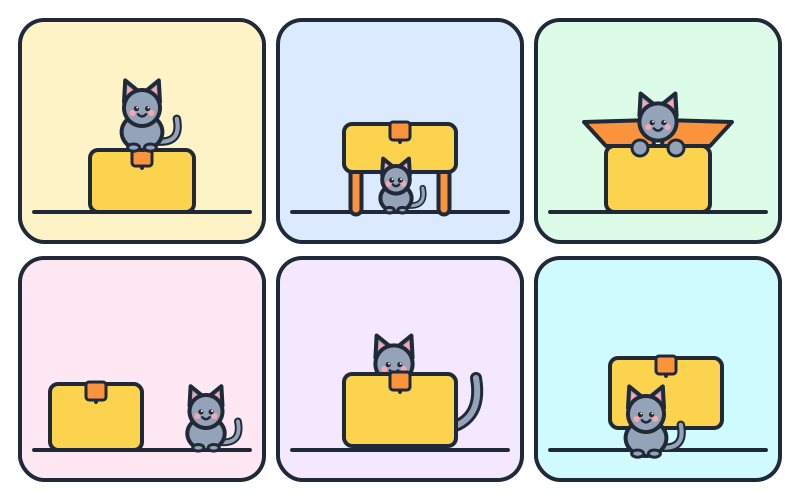
Where is the cat? Arca is the box. Super (on top of), iuxta (beside), post (behind) and ante (in front of) take the accusative; sub and in take the ablative when the cat is simply there.
and take either case, and the choice carries meaning: ablative for where something is, accusative for where it is going.
| Meaning | Latin | English |
|---|---|---|
| where it is | . | We are on land. |
| where it goes | . | We come onto land. |
| where it is | | under the earth |
| where it goes | | going below the earth |
Mistakes English speakers make
| Wrong | Right | Why |
|---|---|---|
| as subject | as object | -um marks the object, wherever it stands |
| | takes the ablative |
| | ad takes the accusative |
. | . | being somewhere is ablative |
! (calling) | ! | -us nouns change in the vocative |
What to do next
- Learn the six jobs from the first table until you can say them in order.
- Run the drill below, reading every ending before the word order.
- Then meet the verb endings, which explain why Latin so often leaves the subject out.