
Translation
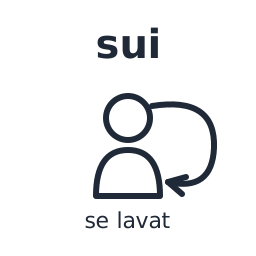
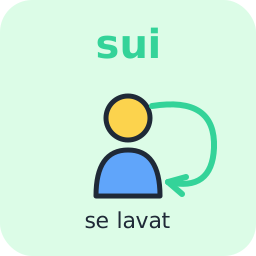
himself; herself; itself (reflexive)
Test yourself on sui
Three quick questions. No account needed.
Know this word? Create a free account to track it.
Examples
.
He withdrew into the city.
.
He lives for himself alone.
.
He took the soldiers with him.
.
He said that he would come the next day.
.
Nobody is sufficient for himself.
The reflexive pronoun, cited by its genitive "sui" because it has NO NOMINATIVE at all: a reflexive can never be the subject, since it exists only to point back at one. The forms you will meet are "se" (accusative and ablative), "sibi" (dative) and "sui" (genitive), and each covers singular and plural and all three genders at once, so "se" is himself, herself, itself and themselves alike.
It refers back to the SUBJECT of its own clause, which is what separates it from "eum" and "eam". "Se vidit" is he saw himself; "eum vidit" is he saw him, some other man. In indirect statement, "se" points back to the person doing the speaking, which is why "dixit se venturum esse" is "he said that HE would come".
With "cum" it goes on the back of the preposition: "secum", with him.
Where this fits
Used in
Add to review queue
Track this word in your spaced-repetition queue and be tested on it at the right interval.
Meet this word in a story
Every course has graded stories written only with words you have been taught, plus grammar drills, a games arcade and printable worksheets. Chapters 1 and 2 are free.
Chapters 1 and 2 free, forever. Plus: 7 days free, then $5 a month for all eleven languages.
Latin · Free printables
sui: worksheet, infographic and listicle
Free printable study downloads for the Latin word "sui" (himself; herself; itself (reflexive)): a worksheet with the answer key built in, an infographic, and a sentence listicle. Open any one to view, print or save.
This word is taught in chapter 1, lesson 4: sui, ex, per and 11 more words.