
(shuì) - to sleep in Mandarin
shuìTraditional: 睡
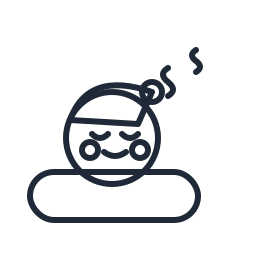

Translation
to sleep
Word origin
睡 (shuì) means 'to sleep'. It is a phono-semantic compound with 目 (eye) as the meaning radical, suggesting closing or drooping eyes, and 垂 (chuí) 'to droop' as the phonetic component.
- Origin
- phono-semantic compound
- Root
- 目 (eye radical) + 垂 (chuí, to droop, phonetic)
Stroke order

睡
Examples
。
I want to go to sleep.
。
I did not sleep well last night.
。
The baby has fallen asleep.
沙。
The cat is sleeping on the sofa.
。
I slept for an hour at noon.
睡 (shuì) - to sleep.
Where this fits
Appears in 2 words
Multi-character compounds in the corpus that contain 睡.
Used in
Grammar articles
(12)Mandarin 除了...以外: One Frame, Two Opposite Meanings
Concession in Mandarin: 虽然...还是/但是, 不过, and 还是 (Although, Even So, Nonetheless)
Mandarin Verb Conjugation: Why It Doesn't Exist and What Replaces It
The Double 了 Sentence in Mandarin: 我学了三年中文了 and the Continuing-Action Pattern
Duration Complements in Mandarin (时量补语): How to Say How Long an Action Lasts
就 (jiù) vs 才 (cái) in Mandarin: Sooner Than Expected, Later Than Expected
The Two 了 in Mandarin: Completion 了 After the Verb vs Change-of-State 了 at the End
Mandarin Modal Verbs: 会, 想, 要, 应该, 可以, 能 and the Future-Intent Words 打算, 准备
Mandarin Sentence-Final Particles: 吧, 呢, 啊, 嘛, 吗 and the Final 了
Serial Verb Constructions in Mandarin: 我去商店买东西 and Stacking Verbs in Sequence
Mandarin Verb-Object Verbs: Why 'To Eat' Is 吃饭 and How It Splits Apart
又 (yòu) vs 再 (zài) vs 还 (hái) in Mandarin: The Three Ways to Say 'Again'
Add to review queue
Track this word in your spaced-repetition queue and be tested on it at the right interval.
Go to my review queueMandarin · Free printables
睡: worksheet, infographic and listicle
Free printable study downloads for the Mandarin word "睡" (to sleep): a worksheet with the answer key built in, an infographic, and a sentence listicle. Open any one to view, print or save.
Free for members
The printable worksheets, infographics and PDFs are free with an account. Start a free week and download as many as you like.
Start your free weekThis word is part of lesson 9.