
Russian Greetings: здравствуйте, привет and Saying Goodbye
By Michael McGettrickUpdated 11 October 2026
Russian greets in two registers, and you choose before you open your mouth: (zdravstvuyte) for anyone you would call , (privet) for friends. The rest is a dozen fixed phrases you can learn today and use tomorrow.
Quick check
Three quick questions on what you have just read. The full practice is further down.
Pick the right one
0/3Pick what a Russian speaker would say.
Your friend's little brother is going to bed.
Someone thanks you. You reply.
You bump into a stranger on the metro.
The whole system on one screen
| Russian | say it | English | Who with |
|---|---|---|---|
! | zdravstvuyte | hello | anyone you call |
! | privet | hi | friends, family |
! | dobroe utro | good morning | anyone |
! | dobryy den | good afternoon, hello | anyone |
! | dobryy vecher | good evening | anyone |
? | kak dela | how are you? | people you know |
! | do svidaniya | goodbye | anyone |
! | poka | bye | friends |
. | spasibo | thank you | anyone |
. | pozhaluysta | please; you're welcome | anyone |
. | izvinite | excuse me, sorry | anyone you call |
А́нна. | menya zovut Anna | my name is Anna | anyone |
The Latin column is a reading aid, not a spelling to learn: it tells you roughly how each phrase sounds while the letters are still new.
- Привет!
- Добрый день!
- Здравствуйте!
Здравствуйте and привет: formal and friendly
Russian has two words for you: for one person you know well, for a stranger, an older person, anyone at work, or more than one person. The greeting follows the same line, and so do a handful of other phrases. This page colours the two sides.
!- Hi! (to a friend, a classmate, a child)!- Hello! (to the shop assistant, the teacher, your friend's mother)
- !
- !
- !
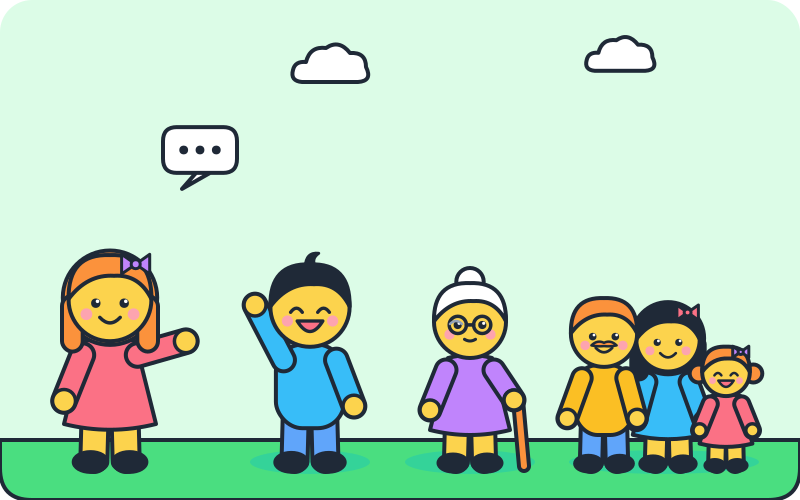
The woman on the left is greeting. Her friend gets привет; the older stranger gets здравствуйте, and so does a group, even of friends.
is shorter than it looks, because the first is silent:
!- Hello! (said ZDRAST-vooy-tye)
In quick speech people clip it further, to something like zdras'te. The word comes from the verb здравствовать, to be healthy, so you are wishing the other person health.
That -те on the end is the ending: polite to one person, or speaking to more than one. It comes and goes on other phrases too. Drop it and you are speaking to one friend (friends really do say ! too, though is far more common):
| Friendly (ты) | Polite (вы) | English |
|---|---|---|
! | ! | Sorry! |
! | ! | Sorry! (warmer) |
? | ? | What's your name? |
? | ? | And you? |
Доброе утро, добрый день, добрый вечер
These three are polite and safe with absolutely anyone, which makes them useful while you are still deciding between and .
- !
- !
- !
- !
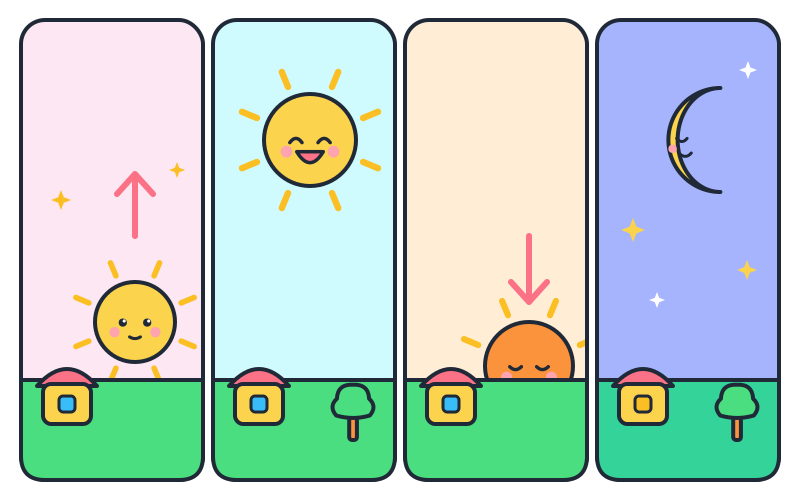
Morning until about midday, day until about six, evening after that. The last one is only for bedtime: it means sleep well, not hello.
| Russian | English | When |
|---|---|---|
! | good morning | until about midday |
! | good afternoon | the middle of the day |
! | good evening | from about six |
! | good night | only at bedtime |
is not a greeting at all. It means sleep well, so you say it to someone going to bed, never when you arrive at nine at night:
, !- Good night, Mum! (she is going to bed)!- Good evening! (you have just arrived)
Notice that the word for good changes its ending. It is matching the gender of the noun, the first agreement you will meet in Russian, and here you get it free as a fixed phrase:
!- Good morning! (is neuter)!- Good afternoon! (is masculine)
Noun gender explains where the gender comes from.
Как дела? and how to answer
? (kak dela) means how are you, literally how are things. It is friendly, and Russians mean it: ask it of people you know, and expect an honest answer.
| Answer | English |
|---|---|
! | great |
, . | fine, thanks |
. | OK, not bad |
. | so-so |
Then send it back. With a friend it is ?, and you? With someone you call , the question itself changes too:
?- How are you? (polite)?- How are you? (polite, shorter)
is the most Russian answer on the list. It is a shrug: things are fine, nothing to report. An enthusiastic every day can sound slightly suspicious.
Goodbye: до свидания and пока
!(do svidaniya) - Goodbye! Polite, for anyone.!(poka) - Bye! For friends.!(do zavtra) - See you tomorrow!
means until the meeting, the same idea as French au revoir. It is the goodbye for the shop, the office, the doctor and your neighbour. is the partner of : if you would say hi, you can say bye.
, Бори́с!- Bye, Boris! (a friend), !- Thank you, goodbye! (leaving a shop)
Спасибо, пожалуйста, извините
| Russian | English |
|---|---|
. | thank you |
. | thank you very much |
. | please; you're welcome |
. | don't mention it |
. | excuse me; sorry |
. | sorry; excuse me, warmer |
(pozhaluysta) does three jobs. Native speakers say it fast, closer to pa-ZHAL-sta.
| Job | Russian | English |
|---|---|---|
| asking | , . | Tea, please. |
| thanked | ! . | Thank you! You're welcome. |
| handing over | , . | Here you are. |
(izvinite) is excuse me before a question and sorry after a small accident. is a little warmer and more personal:
, ?- Excuse me, where is the metro?, !- Oh, sorry! (you trod on someone's foot)
Your name: меня зовут
Russian does not say my name is. It says me they call: А́нна (menya zovut Anna), literally me they-call Anna.
| Russian | English |
|---|---|
? | What is your name? (polite) |
? | What is your name? (to a friend) |
Бори́с. | My name is Boris. |
. | Nice to meet you. |
In formal settings Russians use the first name and the patronymic, a middle name made from the father's name. Teachers and older colleagues are addressed this way, with , and it is respectful rather than stiff:
Ири́на Петро́вна- Irina, daughter of Pyotr, Бори́с Ива́нович!- Hello, Boris Ivanovich! (Boris, son of Ivan)
A first conversation, start to finish
| Who | Russian | English |
|---|---|---|
| Anna | ! | Hello! |
| Boris | ! ? | Hello! What is your name? |
| Anna | А́нна. ? | My name is Anna. And yours? |
| Boris | Бори́с. . | My name is Boris. Nice to meet you. |
| Anna | . | Nice to meet you. |
| Boris | ! ! | Thank you! Goodbye! |
| Anna | ! | Goodbye! |
Every line is a fixed phrase. You need no grammar to say it, only the right choice of register.
Mistakes English speakers make
| Wrong | Right | Why |
|---|---|---|
! (shop) | ! | is for friends |
! | ! | on arrival; means sleep well |
? (stranger) | ! | is for people you know |
| zdravstvuyte | ZDRAST-vooy-tye | the first в is silent |
! (teacher) | ! | is the partner of |
What to do next
- Say
out loud five times until the silentfeels natural. - Decide who in your life gets
and who gets. - Do the drill below.