
Russian Subject Pronouns: я, ты, вы and он for Things
By Michael McGettrickUpdated 11 October 2026
Russian has eight subject pronouns, the words for I, you, he and the rest. Two choices make them different from English: or for you, and , or for it, chosen by the noun's gender.
| Russian | Latin letters | English |
|---|---|---|
| ya | I |
| ty | you (one person you know) |
| on | he, it |
| oná | she, it |
| onó | it |
| my | we |
| vy | you (polite or plural) |
| oní | they |
Quick check
Now use it: three quick questions on the chart above. The full practice is further down.
Spot the mistake
0/3Tap the mistake.
The eight pronouns
The Latin column spells each word letter for letter, the way you can type it in any exercise here, with the stress marked. The sound is not always the spelling: an unstressed is said as a short a, so (oná) sounds like aná.
.- I'm here..- We're at home..- They know.
, and follow grammatical gender, not life. A table, , is a masculine noun, so it is ; a book, , is feminine, so it is .
| Question | Answer | English |
|---|---|---|
? | . | Where is the table? Here it is. |
? | . | Where is the book? Here it is. |
? | . | Where is the window? Here it is. |
 - the table, so he
 - the book, so she
 - the window, so it
is only for neuter nouns. Noun gender shows how to read a noun's gender from its last letter.
has no gender at all. English speakers expect a Russian they to split like the singulars, and it does not:
? .- Mum and Dad? They're at home.? .- Where are the books? Here they are.
Ты and вы: the choice you make before you speak
is for one person you are close to. is for more than one person, and also for any single person you should be polite to.
| Ты (friendly) | Вы (polite) |
|---|---|
| a friend | a stranger, a shop assistant |
| a child | a teacher, a doctor |
| your family | anyone older or senior |
| a pet | two or more people |
The verb changes with it. always takes the plural form, even when you are talking to one person:
?- Do you know? (to a friend)?- Do you know? (to a stranger, or to two friends)?- What's your name? (to a child)?- What's your name? (polite)
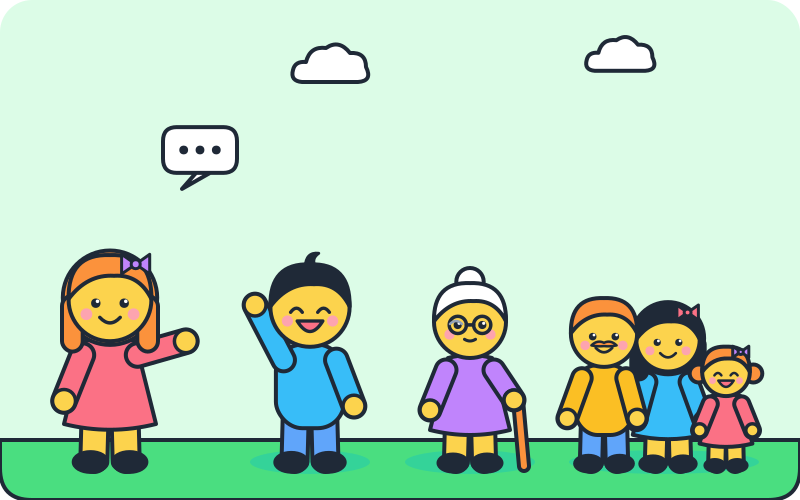
- ?
- ?
- ?
The woman on the left is asking. Her friend gets ты; the older stranger gets вы, and so does the group, with the same plural verb.
This is not optional politeness. Calling a stranger in Russian is rude in a way English has no equivalent for, since English lost its thou centuries ago. Default to until someone invites you to switch:
.- Let's sayto each other.
Do you need the subject pronoun at all?
More often than in Spanish or Italian. The present-tense verb ending does say who is acting, so a bare verb is a complete answer, and in quick speech Russians drop the pronoun freely:
? .- Do you know? I do.
But the past tense has no person endings, only gender (the Russian past tense explains why), so a past-tense verb without a pronoun leaves the listener guessing:
| Russian | English |
|---|---|
. | I knew, you knew or he knew? |
. | I knew. (a man speaking) |
. | He knew. |
The practical rule for a learner: keep the subject pronoun. It is never wrong, and dropping it is a stylistic choice you can make later.
Mistakes English speakers make
| Wrong | Right | Why |
|---|---|---|
? | ? | takes the plural verb |
? . | ? . | is feminine |
| to a stranger | ? | strangers get |
| said o-NA | said a-NA | unstressed о sounds like a |
What to do next
- Say
...? , ,for five things in the room. - Decide who in your life gets
and who gets. - Then learn how the pronouns change in the six cases:
becomes,and.