
Spanish Compound Prepositions: delante de, a pesar de
By Michael McGettrick and Sergio Linares-HernandesUpdated 12 October 2026
A compound preposition is a word plus or a working as one preposition. The is never optional, and a pronoun after it is the strong form:
Quick check
Three quick questions on what you have just read. The full practice is further down.
Pick the right one
0/3Choose the form that fits the English cue.
Hay un coche la casa. (in front of)
Llegamos las ocho. (before)
Te veo una hora. (an hour from now)
.- The car is in front of the house..- He/She sat in front of me.
Compound prepositions at a glance
The whole page on one screen. Most end in ; a handful end in a.
| Job | Spanish | English |
|---|---|---|
| place | | in front of the house |
| place | | under the table |
| place | | near here |
| place | | right by the window |
| idea | | despite the rain |
| idea | | instead of coffee |
| idea | | thanks to you |
| time | | before eight |
| time | | in an hour's time |
Two things the table cannot show: the strong pronoun after the ( ), and the a whole clause needs ( ). Both have their own section below.
Place: the de family
, and are adverbs. On their own they say where, with no noun:
.- The car is in front..- The car is in front of the house.
To name the thing, add . Drop it and the phrase is wrong: never .
| Spanish | English |
|---|---|
| in front of the door |
| behind the house |
| on top of the table |
| under the bed |
| inside the box |
| away from home |
| near the beach |
| far from the city |
| next to the house |
| around the table |
| opposite my house |
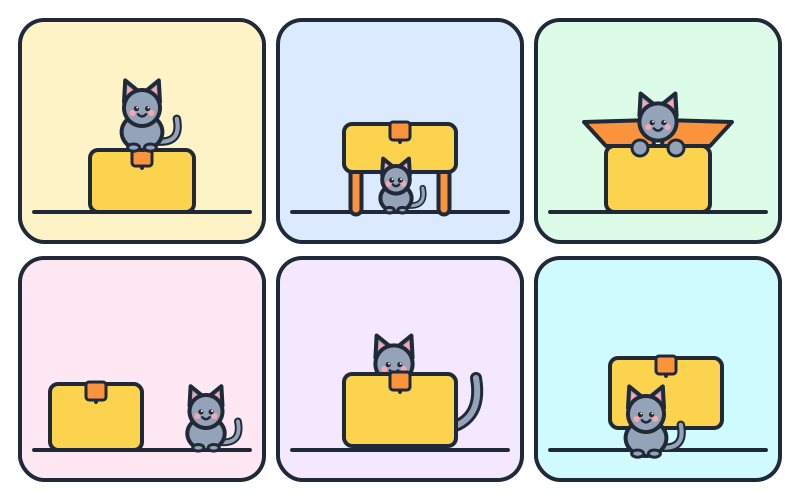
Encima de la caja (on top of the box), debajo de la caja (under the box), dentro de la caja (inside the box), al lado de la caja (next to the box), detrás de la caja (behind the box), delante de la caja (in front of the box).
and merge into , as they do everywhere:
.- I live near the centre.
Two that take a: junto a, frente a
.- He/She sat right by the window..- The hotel faces the sea.
With a pronoun: delante de mí
After the the strong pronoun, the same one as after any preposition. Only and differ from the subject pronouns:
| Person | Spanish | English |
|---|---|---|
| me | | in front of me |
| you | | behind you |
| him | | near him |
| her | | next to her |
| us | | far from us |
| them | | around them |
carries an accent; without it means my. In speech you will hear and , but the RAE advises against them in careful Spanish. Write .
The two that take a work the same way: - right next to me.
Under, on, behind: bajo, sobre, tras
Three short prepositions shadow the compounds. and are more formal ( is everyday too), and they also cover abstract cases where the compound would be wrong:
| Compound | One word | Example |
|---|---|---|
- under the table (formal) | ||
| (none) | - in the rain | |
| (none) | - under control | |
- on the table | ||
- a book about the war | ||
- behind the door (written) | ||
- after the meeting | ||
| (none) | - day after day |
For a cat under a table, say . After another preposition, only works:
.- The cat came out from under the bed.
, and can all mean on. is the everyday choice; stresses on top of it.
Delante de or enfrente de
is directly in front; is opposite, across a street or a room:
.- The taxi is outside the hotel..- The chemist's is opposite the hotel.
Ideas: a pesar de, en vez de, gracias a
A second family links ideas rather than places. Learn these whole, because the meaning does not fall out of the parts:
| Meaning | Spanish | English |
|---|---|---|
| despite | , . | Despite the rain, we went out. |
| instead of | , . | Instead of coffee, I had tea. |
| instead of | , . | Instead of that, come tomorrow. |
| besides | , . | Besides being dear, it is ugly. |
| about | . | A book about the war. |
| thanks to | , . | Thanks to you, I passed. |
| owing to | . | It was cancelled owing to the rain. |
| as for | , . | As for me, I'm not going. |
and mean the same. a is for a cause you are glad of; for one you blame, Spanish says :
.- We were late because of the rain.
Before a verb: antes de salir, antes de que salgas
A compound preposition can take a noun, an infinitive or a whole clause. The clause needs :
| Follows | Spanish | English |
|---|---|---|
| a noun | | before dinner |
| an infinitive | | before leaving |
| a clause | | before you leave |
Same subject in both halves: the infinitive. A new subject: and a conjugated verb.
, .- Before I go out, I shut the door..- I'll ring you before you leave., .- Although it was raining, we went out.
always takes the subjunctive. A depends on meaning: a known fact takes the indicative, as in above. The full set is on the subjunctive in adverbial clauses page.
Space or time: delante de or antes de
English "before" covers space and time. Spanish splits them:
| Job | Space | Time |
|---|---|---|
| before | | |
| after | | |
| inside, in | | |
counts from now: an hour from now. says how long something takes:
.- I'll be back in an hour..- I did it in an hour.
Much of Latin America also uses for an hour from now; is clear everywhere.
Mistakes English speakers make
| Wrong | Right | Why |
|---|---|---|
| the is compulsory | |
| the strong pronoun has an accent | |
| before eight, in time, is | |
| a clause needs | |
| takes the subjunctive |
What to do next
- Say the
out loud every time:. - Do the cat story and the sort below.
- Then the verbs with prepositions (