
Spanish Punctuation and Capitalisation: ¿, ¡ and Lowercase
By Michael McGettrick and Sergio Linares-HernandesUpdated 12 October 2026
Spanish punctuation differs from English in three ways you will meet daily: questions and exclamations open with a mark, many words English capitalises take a small letter, and numbers swap their comma and point.
Quick check
Three quick questions on what you have just read. The full practice is further down.
Spot the mistake
0/3Tap the word with the wrong capital letter.
¿ ?- Are you coming tomorrow?.- See you on Monday.
Spanish punctuation at a glance
| Feature | Spanish | English |
|---|---|---|
| Questions | ¿? | Are you coming? |
| Exclamations | ¡ ! | How cold! |
| Days, months | , | on Monday, in January |
| Languages | . | I speak English. |
| Nationalities | . | She's French. |
| Letters | Ana: | Dear Ana, |
| Decimals | 3,5 (Spain), 3.5 (Mexico) | 3.5 |
| Capitals | . | He's my father. |
The last row matters: a capital letter keeps its accent. Leaving it off was a typewriter habit, not a rule.
The opening ¿ and ¡
Every written question opens with ¿ and closes with ?; every exclamation opens with ¡ and closes with !. Spanish needs the opening mark because its word order often gives no warning:
.- You'coming tomorrow.¿ ?- Are you coming tomorrow?¡ !- It's so cold!
Only the marks and the tone of voice separate the first two. The ¿ tells the reader to start the question tone from the first word.
A sentence that is both a question and an exclamation opens and closes with both marks, in mirror order (¿¡ !? is also correct):
¡¿ ?!- What are you saying?!
Where the opening mark goes
The opening mark goes where the question or exclamation starts, which is not always the first word of the sentence. Whatever comes before it stays outside:
An if-clause, a name or a statement stays outside; the marks wrap only the question.
| Spanish | English |
|---|---|
, ¿? | If it rains, are you coming? |
Pedro, ¡ ! | Pedro, come here! |
, ¿? | You' coming tomorrow, aren't you? |
The word after the opening mark takes a small letter unless it starts the sentence: , ¿me ?, not ¿ ?.
Small letters: days, months and languages
Spanish keeps capitals for names of people and places and for the first word of a sentence. Many words English capitalises take a small letter:
| Type | Spanish | English |
|---|---|---|
| day | | on Monday |
| month | | in January |
| language | . | I speak Spanish. |
| nationality | . | She's English. |
| religion | . | He's Catholic. |
| country, city | Madrid. | I live in Madrid. |
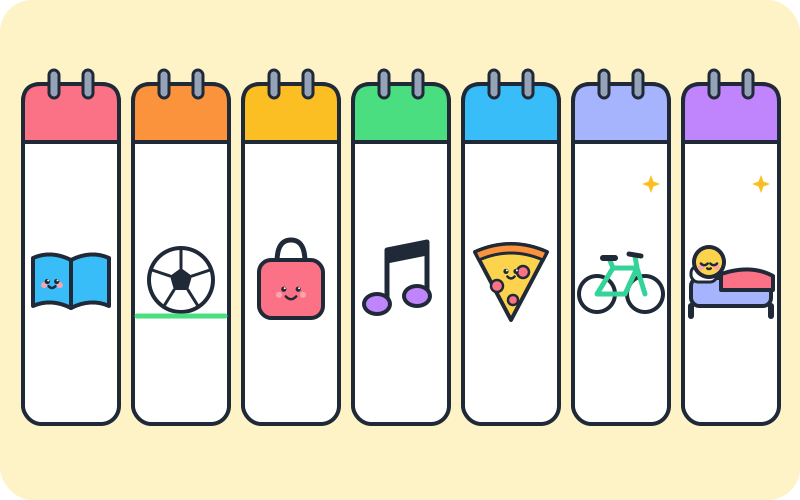
Lunes (Monday), martes (Tuesday), miércoles (Wednesday), jueves (Thursday), viernes (Friday), sábado (Saturday), domingo (Sunday): all with a small letter.
The country keeps its capital; the language and the nationality do not:
.- My French friend lives in France.
In a book or film title only the first word takes a capital, plus any names: (One Hundred Years of Solitude).
Numbers: the decimal comma
Spain and most of South America swap the English marks: a comma for decimals, a point or a space for thousands. Mexico, much of Central America, and the Dominican Republic write numbers as English does. The accepts both (its 2010 Ortografía even recommends the decimal point), but Spain writes the comma:
| Number | Spain | Mexico |
|---|---|---|
| three and a half | 3,5 | 3.5 |
| one thousand | 1.000, 1000 | 1,000, 1000 |
| a price | 1.250,75 € | $1,250.75 |
1,5 .- The bottle holds 1.5 litres. (written in Spain)
Read the number with the conventions of the country that wrote it: in Madrid, 2,5 is two and a half.
Letters, emails and abbreviations
A letter or an email opens with the greeting and a colon, not a comma. The text starts on the next line with a capital:
:- Dear Madam,Ana:- Dear Ana,
The common abbreviations take a capital and a full stop:
| Abbreviation | Full word | English |
|---|---|---|
. | | Mr |
. | | Mrs, Ms |
. | | you () |
Uds. | | you (plural, ) |
Dialogue: the raya and the comillas
Spanish novels open a line of speech with the , a long dash, rather than quotation marks. This site never prints a long dash, so the example below uses a hyphen where print would use the :
Mistakes English speakers make
| Wrong | Right | Why |
|---|---|---|
| ? | ¿ ? | the opening mark |
| ¿ , ? | , ¿? | the question starts later |
| days take a small letter | |
| . | . | languages too |
| . | . | nationalities too |
| Ana, | Ana: | a colon after the greeting |
| . | . | capitals keep the accent |
What to do next
- Write the ¿ at the moment the question starts, not when you reach the end.
- Do the letter and the spot-the-capital below.
- Then the Spanish accent rules, the other half of writing Spanish correctly.