
Meaning
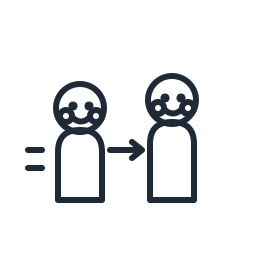
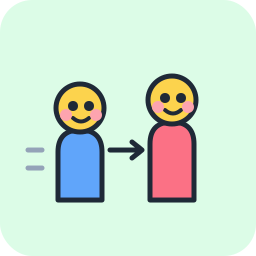
To go after someone; to do what a person or rule says.
Test yourself on follow
Three quick questions. No account needed.
Know this word? Create a free account to track it.
Word origin
From Old English folgian, meaning to go after or accompany, a word shared across the old Germanic languages.
- Origin
- Old English
- Root
- folgian
Grammar
Examples
.
.
.
Where this fits
Used in
Stories
(4)Grammar articles
(17)English adjective order: opinion, size, age, shape, colour
As vs like in English: the difference, with examples
British vs American English Grammar: got, gotten and more
Clothes in English: trousers, a shirt and a pair of shoes
Conditional sentences in English: zero, first, second, third
Do and does in English: questions and negatives
English Filler Words: um, well, so, like, you know
Gerund and infinitive in English: verb lists and rules
Modal verbs in English: rules, examples and how to use them
Ordinal numbers in English: first, second, third (chart)
Phrasal-prepositional verbs in English: 16 with examples
English phrasal verbs exercises with answers: 80 questions
Present simple in English: rules, -s ending and examples
Question tags in English: rules, examples and aren't I
Relative clauses in English: defining and non-defining
Separable and inseparable phrasal verbs in English: rules
Stative verbs in English: I know, not I'm knowing (list)
Add to review queue
Track this word in your spaced-repetition queue and be tested on it at the right interval.
Meet this word in a story
Every course has graded stories written only with words you have been taught, plus grammar drills, a games arcade and printable worksheets. Chapters 1 and 2 are free.
Chapters 1 and 2 free, forever. Plus: 7 days free, then $5 a month for all eleven languages.
English · Free printables
follow: worksheet, infographic and listicle
Free printable study downloads for the English word "follow" (To go after someone; to do what a person or rule says.): a worksheet with the answer key built in, an infographic, and a sentence listicle. Open any one to view, print or save.
Free for members
The printable worksheets, infographics and PDFs are free with an account. Start a free week and download as many as you like.
Start your free weekThis word is taught in chapter 4, lesson 11: follow, somebody, dream and 6 more words.