
/liːv/
Translation
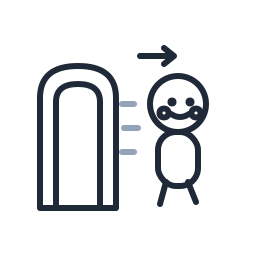
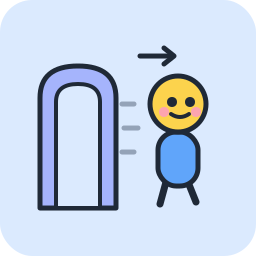
To go away from a place or person, or to let something stay where it is.
Word origin
From Old English læfan, meaning to let remain or leave behind.
- Origin
- Old English
- Root
- læfan
Grammar
Irregular verb. A full conjugation table for irregular verbs is coming soon. For now, use a reference like Wordreference or RAE.
Examples
o'.
"Leave" here means to go out of the house.
.
"Leaves" is the form used with he, she, or it.
.
"Left" is the past form of "leave".
Used in
Stories
(15)Lost in Town
3 min read · Core 1000
The Journey
3 min read · Core 1000
The Boat in the Garden
4 min read · Core 5000
The Broken Window
4 min read · Core 5000
The Letter She Never Sent
4 min read · Core 5000
The Long Way Home
4 min read · Core 1000
The First Letter
5 min read · Core 5000
The Midnight Piano
5 min read · Core 5000
The Night Route
5 min read · Core 5000
The Photograph
5 min read · Core 5000
The Register
5 min read · Core 5000
The Tuesday Visitor
5 min read · Core 5000
The Whale on the Beach
5 min read · Core 5000
Two Tickets to Paris
5 min read · Core 5000
The Last Light
8 min read · Core 5000
Grammar articles
(32)Advanced articles in English: the zero article, the with names and places, and go to school vs go to the school
Comparatives and superlatives in English: the complete guide
Conditional sentences in English: the four types explained
Discourse markers in English: well, anyway, actually, mind you and by the way
For, since, already, yet and still in English: which word, and where it goes in the sentence
Future continuous and future perfect in English: will be doing vs will have done
Future in the past: was going to, would, was about to, and the grammar of plans that failed
Future tense in English: will, going to and more explained
Gerund and infinitive: which verb form comes next?
Gradable and ungradable adjectives: why very furious sounds wrong, and which intensifier goes where
English grammar test: 30 questions with answers (A2-B2)
Hedging and vague language in English: sort of, a bit, -ish, stuff and or so
Indirect questions in English: Could you tell me where the station is, and the word order that goes with it
Irregular verbs in English: the full list by pattern
Linking words in English: however, although, despite, whereas and therefore
Mixed conditionals in English: past causes with present results, and present causes with past results
Modal verbs in English: rules, examples and how to use them
Modals of deduction in English: must be, might be, could be and can't be
Advanced passive structures in English: the get-passive, it is said that, and passives with two objects
Passive voice in English: rules, examples and when to use it
Past continuous tense: was and were plus -ing, and when to use it instead of the past simple
Past perfect tense: had plus past participle, and when English actually needs it
Phrasal verbs in English: rules, examples and how to use them
Present simple tense: rules, examples and when to use it
Reflexive and reciprocal pronouns in English: myself, yourself, each other, and when English does not bother
Relative clauses in English: defining, non-defining and when to drop the pronoun
Reported speech in English: backshift, questions and commands
Reporting verbs in English: admit, deny, suggest, promise, and the pattern welded to each one
The subjunctive and the unreal past in English: I suggest he go, if I were you, and it's time we left
Time clauses in English: when, while, as soon as, until, before and after
Verb patterns with objects in English: want somebody to do, make somebody do, and see somebody doing
Word formation with prefixes: un-, in-, im-, dis-, re-, over-, under- and mis-
Add to review queue
Track this word in your spaced-repetition queue and be tested on it at the right interval.
Go to my review queueThis word is part of lesson 3.