
/sʌm/ ES
/səm/ MX
Translation
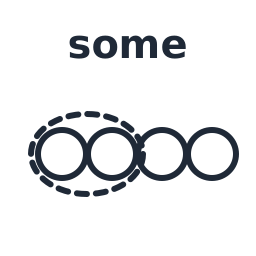
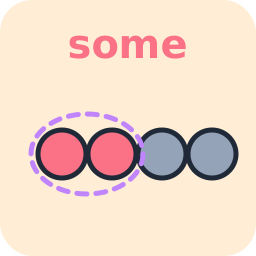
An amount or number that is not exact, a few or a little.
Examples
.
"Some" means a little water, not an exact amount.
.
Here "some" means a few of the people.
?
"Some" offers a part of the cake.
Used in
Stories
(15)A New Day
1 min read · Core 1000
A Day Together
2 min read · Core 1000
Cooking Together
3 min read · Core 1000
The First Day at Work
3 min read · Core 1000
Market Morning
3 min read · Core 1000
The New Neighbour
3 min read · Core 1000
The Phone Call
3 min read · Core 1000
The Boat in the Garden
4 min read · Core 5000
The Broken Window
4 min read · Core 5000
The First Letter
5 min read · Core 5000
The Midnight Piano
5 min read · Core 5000
The Register
5 min read · Core 5000
The Swimming Lesson
5 min read · Core 5000
The Whale on the Beach
5 min read · Core 5000
The Last Light
8 min read · Core 5000
Grammar articles
(25)Both, either and neither in English: the two-of-something words, agreement traps, and Me neither
Cleft sentences in English: it was X who, what I need is, and how to move the emphasis
Compound nouns in English: car park, coffee cup, and why GREENhouse is not green HOUSE
Countable and uncountable nouns in English: advice, information, news and the ones you simply have to learn
Dummy subjects in English: it's raining, there's a problem, and why the subject slot is never empty
Ellipsis and substitution in English: I think so, neither do I, and the words you are allowed to leave out
Gradable and ungradable adjectives: why very furious sounds wrong, and which intensifier goes where
English grammar test: 30 questions with answers (A2-B2)
Hedging and vague language in English: sort of, a bit, -ish, stuff and or so
Advanced passive structures in English: the get-passive, it is said that, and passives with two objects
Passive voice in English: rules, examples and when to use it
Past continuous tense: was and were plus -ing, and when to use it instead of the past simple
Phrasal verbs in English: rules, examples and how to use them
Prepositions in English: place, time and movement explained
Present continuous tense: form, spelling and uses
Present perfect continuous: have been doing, and how it differs from the present perfect
Present simple tense: rules, examples and when to use it
Quantifiers in English: some, any, much, many and more
Reflexive and reciprocal pronouns in English: myself, yourself, each other, and when English does not bother
Reporting verbs in English: admit, deny, suggest, promise, and the pattern welded to each one
So, such, too and enough in English: words of degree and result
Time clauses in English: when, while, as soon as, until, before and after
Verb patterns with objects in English: want somebody to do, make somebody do, and see somebody doing
Word formation with prefixes: un-, in-, im-, dis-, re-, over-, under- and mis-
Word formation in English: how suffixes build word families and give away the part of speech
Add to review queue
Track this word in your spaced-repetition queue and be tested on it at the right interval.
Go to my review queueThis word is part of lesson 2.