
Ch 24 · Lesson 15Esperanto · Chapter 24 · Lesson 15 · Grammar primer
Gender in Esperanto: male roots, -in- and vir-
No grammatical gender: most roots are neutral (, ), a short list is male (, ), -in- makes the female () and vir- the male ().
The short version
Most nouns have no gender at all
.
Why?Hide
An is a teacher of any sex; so is a , a or an . Only a short, fairly closed set of roots is male (, , , , ), and -in- derives the female from them. Everything else is neutral, and adjectives never change for sex: , never belina.
-in- makes the female, vir- the male
.
Why?Hide
Add -in- to a male root and you have the female, with no change to the root: , ; , . On a neutral animal root it specifies the female: , , a cow. Going the other way, the root vir- in front marks a male: , a bull.
has no grammatical gender: one article, no agreement, and most nouns are neutral. What it has is a short list of male roots, the suffix -- to make the female, and the prefix - for both sexes together. Around that sits a live about ri and -iĉ-.
| Form | Means | Status |
|---|---|---|
| a doctor, any sex | neutral: most roots |
| a father | a male root |
| a mother | standard |
| a bull | standard |
| parents, mother and father | standard |
| one parent, any sex | newer, spreading |
ri | he or she, any person | unofficial |
kuracistiĉo | a male doctor | unofficial |
No grammatical gender
There are no masculine and feminine nouns, and adjectives do not change for sex. The article is always :
A French or German learner spends years on noun gender. An Esperanto learner spends an afternoon on a word list, and -- never spreads to the rest of the sentence: , never a.
Neutral roots and male roots
Most roots are sex-neutral. PMEG says the neutral group is , without doubt the largest. It holds , and , and the profession nouns.

A doctor (here a woman), a teacher and a cook (here men): kuracisto, instruisto, kuiristo. Profession nouns say nothing about sex.
.- She is a doctor..- He is a doctor.
A short list of roots is male. PMEG calls this group much smaller and , more closed, and ends each group with k.a., and others:
| Group | Male roots |
|---|---|
| General | masklo |
| Family | |
| Family | vidvo |
| Titles | |
| on | |
| Animals | taŭro, and a few more male-animal roots |
The trap is assuming the list is longer: and are not on it. A handful of roots are female in themselves (, a lady), and they take no --.
-in- and vir-
-- makes the female of a male root. One suffix, no exceptions, no change to the root:
| Male | Female | English |
|---|---|---|
| | father, mother |
| | brother, sister |
| | king, queen |
| | Mr, Mrs |
| | boy, girl |
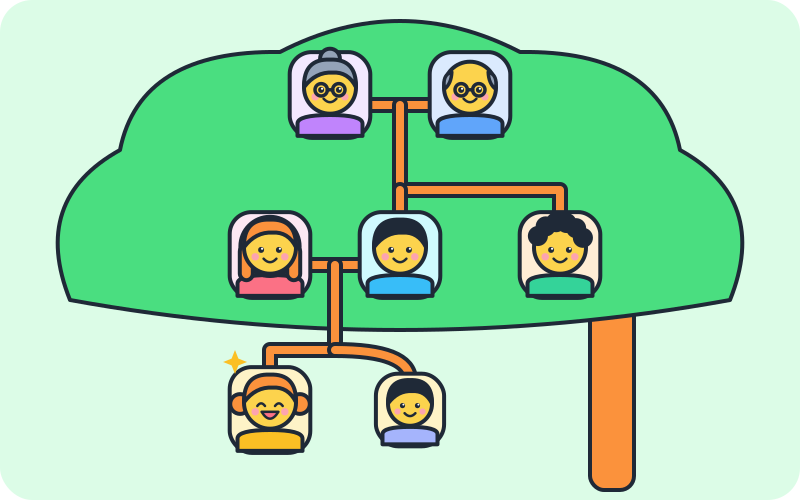
avino, avo: grandmother, grandfather; patrino, patro: mother, father; onklo: uncle; fratino, frato: sister, brother.
-- can also specify the female of a neutral root. PMEG calls this optional, though traditionally speakers add it routinely when they mean a woman or a female animal:
- a cow (, a bovine of either sex)- a female dog- a woman doctor (correct, and says more than)
Going the other way, the root - in front marks a male:
- a bull- a male dog
-- is also a word, as most affixes are: is a female, is female as an adjective.
Going further: Ge-: both sexes together and the rest of the guide, when you want them. This lesson does not need them.
Practice
Practise this lesson
10-question session
One question at a time, mixed across the exercises in this lesson. Miss one and it comes back round before the end.
Esperanto · Free printables
Worksheets for this lesson
Worksheets with answer keys built in. Open any one to view, print or save.
Free for members
The printable worksheets, infographics and PDFs are free with an account. Start a free week and download as many as you like.
Start your free weekLesson 15 of 25 in this chapter