
French Perception Verbs + Infinitive: voir, entendre
By Michael McGettrickUpdated 12 October 2026
, , , , and take an infinitive with nothing in front of it: . - I see him coming. English does the same (I saw him leave), so the infinitive is easy. The trouble is everything around it.
| Point | French | English |
|---|---|---|
| No linker | . | I see him coming. |
| Noun: either side | . | You can hear the birds singing. |
| Pronoun first | . | I can hear them singing. |
| Doer: agrees | . | I saw them leave. |
| Done to: no | . | The play I saw performed. |
. | I let him go. | |
. | I allow him to leave. |
Quick check
Now use it: three quick questions on the chart above. The full practice is further down.
Pick the right one
0/3Does the participle agree? Ask who does the second action.
Les enfants ? Je les ai partir. (voir: they left)
La chanson que j'ai chanter. (entendre)
La femme que j'ai chanter. (entendre)
The verbs, and no linker
Six verbs of seeing, hearing, feeling and letting take an infinitive straight after them, like , and .
| Verb | Meaning | Example |
|---|---|---|
| see | . |
| watch | . |
| hear | . |
| listen to | . |
| feel | . |
| let | ! |
The glosses: I can see the train coming. She is watching us play. I can hear my neighbour talking. I am listening to the rain falling. I can feel the cold coming. Let me go!
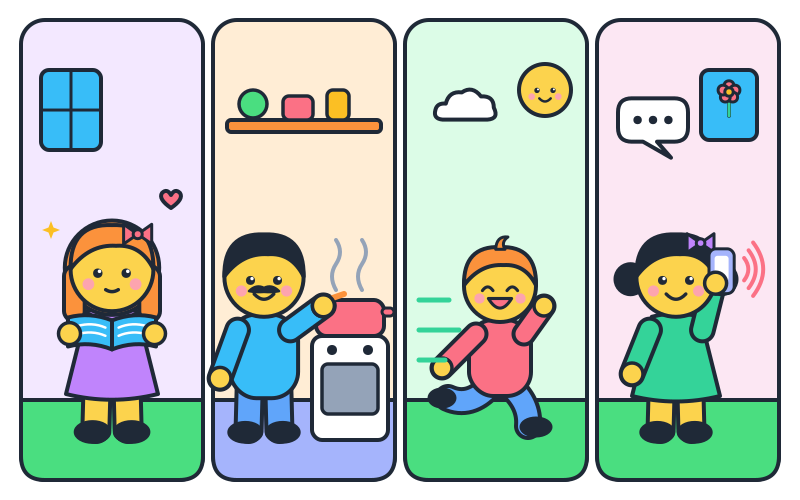
I see her reading. I watch him cooking. I see him running. I can hear her talking (on the phone).
Two English habits to drop. There is no or : not . And English -ing is a French infinitive here: I can hear her singing is .
Where a noun object goes
When the infinitive has no object of its own, a noun can go on either side of it. Both orders are correct and common.
./.- You can hear the birds singing.Marie./Marie .- I saw Marie leave.
When the infinitive has its own object, the doer normally goes first. Put it after both and the sentence turns to soup:
Marie .- I saw Marie close the door.
Where a pronoun goes
A pronoun for the one doing the action has one place: in front of the conjugated verb, as with .
| Tense | French | English |
|---|---|---|
| present | . | I see it coming. |
| present | . | I can hear them singing. |
. | I heard them singing. | |
| command | - ! | Let him go! |
Never . After a positive command the pronoun follows the verb, as always.
also means I can see what he is up to.
Does the participle agree?
In a compound tense, , and can agree with a direct object placed before them. Ask one question: does that object do the infinitive's action?
It does the action: agree.
| Object | French | English |
|---|---|---|
| they leave | . | I saw them leave. |
| she falls | . | I saw her fall. |
| she sings | . | The woman I heard sing. |
It has the action done to it: no agreement.
| Object | French | English |
|---|---|---|
| a song is sung | . | The song I heard sung. |
| a play is put on | . | The play I saw performed. |
| trees are cut | . | The trees I saw cut down. |
These endings are silent, so this is a rule for writing. An object after the verb never makes it agree: . - I saw the children leave.
never agrees at all: see faire causatif.
laisser or permettre
English let and allow meet two French verbs with different wiring.
| Verb | Person, linker | Example |
|---|---|---|
| direct, none | . |
| indirect, | . |
.- I let him go..- I allow him to leave.
often means not stopping rather than granting a right: - . - Let him sleep. is permission, and the formal end of the scale:
- Laisse-moi partir.
- Tu me permets de partir ?
- Permettez-moi de partir.
laisser tomber and laisser faire
is to drop, and from there to give up and to let someone down. Learn it as one verb.
| Phrase | French | English |
|---|---|---|
| drop | . | He dropped his glass. |
| give up | . | She gave up her studies. |
| let down | . | He let me down. |
| forget it | ! | Forget it! |
| don't interfere | , . | Leave it, it'll sort itself out. |
! is the everyday never mind. French uses the other one as a noun, -, and English borrowed the idea as -.
Mistakes English speakers make
| Wrong | Right | Why |
|---|---|---|
| . | no linker |
| . | pronoun before the verb |
| . | : direct object |
| . | à: |
What to do next
- Look out of a window and say what you can see and hear:
+ infinitive. - Write two sentences in the
agrees. - Then read verbs with à, de or nothing.