
/blɛ.se/
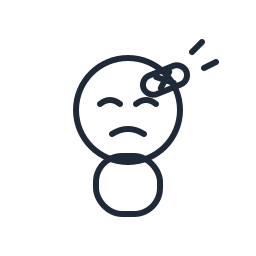

Translation
to hurt, to wound
Word origin
From Old French blecier ('to bruise, to wound'), most likely of Frankish origin from a root meaning 'to make pale' or 'to bruise'. The modern sense is 'to injure'.
- Origin
- Frankish
- Root
- *blettjan
Grammar
Conjugation
Regular -er conjugation. Pronouns: je, tu, il/elle, nous, vous, ils/elles.
Indicative
| Person | Present | Imperfect | Past historic | Future | Conditional |
|---|---|---|---|---|---|
| je | blesse | blessais | blessai | blesserai | blesserais |
| tu | blesses | blessais | blessas | blesseras | blesserais |
| il/elle | blesse | blessait | blessa | blessera | blesserait |
| nous | blessons | blessions | blessâmes | blesserons | blesserions |
| vous | blessez | blessiez | blessâtes | blesserez | blesseriez |
| ils/elles | blessent | blessaient | blessèrent | blesseront | blesseraient |
Subjunctive
| Person | Present | Imperfect |
|---|---|---|
| je | blesse | blessasse |
| tu | blesses | blessasses |
| il/elle | blesse | blessât |
| nous | blessions | blessassions |
| vous | blessiez | blessassiez |
| ils/elles | blessent | blessassent |
Imperative
| Person | Affirmative |
|---|---|
| tu | blesse |
| nous | blessons |
| vous | blessez |
Non-finite
- Gerund / present participle
- blessant
- Past participle
- blessé · blessée · blessés · blessées
Examples
' au au .
He hurt his foot playing football.
.
Your words can hurt more than you think.
l' .
She was injured in the car accident.
.
Be careful not to hurt yourself with this knife.
' barrière.
The dog hurt itself jumping over the fence.
Where this fits
Used in
Add to review queue
Track this word in your spaced-repetition queue and be tested on it at the right interval.
Go to my review queueFrench · Free printables
blesser: worksheet, infographic and listicle
Free printable study downloads for the French word "blesser" (to hurt, to wound): a worksheet with the answer key built in, an infographic, and a sentence listicle. Open any one to view, print or save.
Free for members
The printable worksheets, infographics and PDFs are free with an account. Start a free week and download as many as you like.
Start your free weekThis word is part of lesson 19.