
Italian Numbers and Dates: Cardinals, Ordinals, il Primo
By Michael McGettrickUpdated 11 October 2026
Italian numbers are built from about thirty words and a handful of joining rules: learn zero to nineteen, the tens and , and everything up to a million follows. Dates add one twist, a cardinal number for every day except the first. Numbers and dates are Foundation and Higher on the Pearson Edexcel GCSE Italian specification (1IN0).
Quick check
Three quick questions on what you have just read. The full practice is further down.
Pick the right one
0/3Choose the form of 'one' that goes with the noun.
zio (one uncle: masculine, starts with z)
casa (one house: feminine)
anno (one year: masculine, starts with a vowel)
The whole system on one screen
| Range | Rule | Example |
|---|---|---|
| 0-10 | ten words to learn | |
| 11-16 | unit first, then - | |
| 17-19 | - first, then the unit | |
| 21-99 | ten + unit, one word | trentadue, |
| hundreds | never changes | |
| thousands | , then - | |
| millions | a noun, joined with | |
| dates | + cardinal + month | |
| the 1st | + + month | |
Zero to ten
Every phone number, price and time is made of these. Learn them cold, in order and out of order.
| Digit | Italian | Example |
|---|---|---|
| 0 | | . - Nil-nil. |
| 1 | | . - I've got one. |
| 2 | | . - I have two uncles. |
| 3 | | . - It's three o'clock. |
| 4 | | . - There are four of us. |
| 5 | | . - Five minutes. |
| 6 | | . - Six years. |
| 7 | | . - Seven days. |
| 8 | | . - At eight. |
| 9 | | . - Nine times. |
| 10 | | . - Ten euros. |
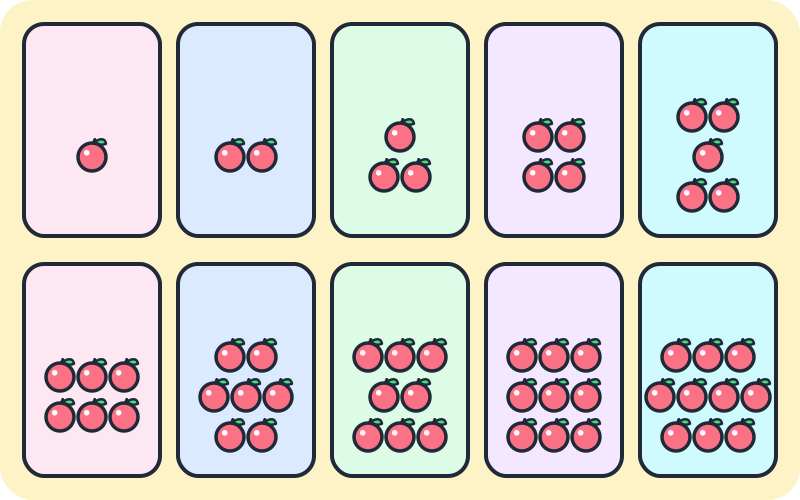
Count the apples: one to ten, each a word of its own.
is the one to watch in reading: the same spelling is six and you are. ? is are you here?, and is six years. A number sits next to a noun, the verb next to a subject.
The teens: the order flips at seventeen
| Number | Italian | Built from |
|---|---|---|
| 11 | | one + ten |
| 12 | | two + ten |
| 13 | | three + ten |
| 14 | | four + ten |
| 15 | | five + ten |
| 16 | | six + ten |
| 17 | | ten + seven |
| 18 | | ten + eight |
| 19 | | ten + nine |
Eleven to sixteen put the unit first and end in -dici, a worn-down . The units are worn down too, so learn these six as words. From seventeen the ten comes first. and add an a and double the consonant at the join; simply runs the vowels together.
.- I'm sixteen..- I'm seventeen.
Twenty to ninety-nine: glue the unit on
| Number | Italian | Number | Italian |
|---|---|---|---|
| 20 | | 60 | |
| 30 | | 70 | |
| 40 | | 80 | |
| 50 | | 90 | |
and are the pair that gets swapped at speed. Anchor each to its unit: , ; , .
Between the tens, Italian glues the ten onto the unit, with no space and no hyphen: trentadue , I'm thirty-two. Three spelling rules run through the result.
The ten drops its vowel before uno and otto
and are the two units that start with a vowel, so the ten loses its last vowel:
| Ten | + 1 | + 2 | + 8 |
|---|---|---|---|
| | | |
| | trentadue | trentotto |
| quarantuno | quarantadue | quarantotto |
Every other unit keeps the vowel: , , .
Tre takes an accent at the end
On its own, has no accent. At the end of a compound it gains one, because the stress falls there: , trentatré. trentatré is I'm thirty-three.
Ventun anni or ventuno anni
Before a noun, the compounds ending in -uno usually lose their final o: , twenty-one years; , thirty-one days. The full is also correct. Either way the noun is plural.
Uno is also the indefinite article
In front of a noun, one is the indefinite article and follows the article rule:
| Italian | English | Why |
|---|---|---|
| one year | masculine |
| one uncle | masculine, before z |
| one house | feminine |
| one hour | feminine, before a vowel |
Standing alone as an answer, it agrees with what it counts: ? . - How many houses do you have? One.
Hundreds, thousands, a million
| Number | Italian | Example |
|---|---|---|
| 100 | | . - A hundred years. |
| 200 | | . - Two hundred euros. |
| 1,000 | | . - A thousand times. |
| 2,000 | | . - Two thousand people. |
| 1,000,000 | | . - A million euros. |
Three rules hold this together:
andtake no word for a: never.has a plural of its own,-:,tremila.is a noun, so it takesand joins its noun with.
Italian also writes the decimal with a comma: 2,50 € is two euros fifty. Big numbers covers prices, years, millions and billions in full.
Ordinal numbers: primo to decimo, then -esimo
First to tenth are words of their own, and they agree like any -o adjective:
| English | Italian | English | Italian |
|---|---|---|---|
| 1st | | 6th | |
| 2nd | | 7th | |
| 3rd | | 8th | |
| 4th | | 9th | |
| 5th | | 10th | |
Past tenth, ordinals are built: drop the cardinal's final vowel and add -esimo.
| Cardinal | Ordinal | English |
|---|---|---|
| | 11th |
| ventesimo | 20th |
| | 100th |
| ventitreesimo | 23rd |
Numbers ending in -tré and -sei keep the final vowel, and -tré loses its accent. Built ordinals agree too: ventesima , the twentieth time.
Age: avere, not essere
Age is something Italian has, not something it is:
.- I'm twenty-three. (literally: I have twenty-three years)?- How old are you?

- !
- ?
Count the candles: the birthday child has five years, ho cinque anni.
Never use : is wrong. Essere and avere has the other things Italian has where English is.
Dates: cardinal, except for the first
Italian says the date as plus a cardinal number plus the month:
| Italian | English | Why |
|---|---|---|
| the 3rd of March | cardinal |
| the 20th of April | cardinal |
| the 1st of May | the first takes |
.- My birthday is the third of March..- Today is the first of May.
Months stay lowercase. Days, months and seasons covers the rest of the calendar.
Mistakes English speakers make
| Wrong | Right | Why |
|---|---|---|
| ventiuno | | the ten drops its vowel before |
| ventiotto | | and before |
| the accent is part of the spelling | |
| dicisette | | a and a doubled s at the join |
| , | | no word for a before either |
| duemille | | the plural of is |
| is a noun, so it takes | |
| the first is the one ordinal date | |
| age takes | |
| ventiesimo | ventesimo | drop the vowel before -esimo |
| months are lowercase |
What to practise
- Say zero to nineteen aloud, then the tens, until
andnever swap. - Count 18 to 41 and back, watching
,,. - Say today's date, your age and your birth year in full.