
Days, Months and Seasons in Italian: lunedì, il lunedì, a maggio
By Michael McGettrickUpdated 11 October 2026
Seven days, twelve months and four seasons, all written with a small letter. The one rule that changes meaning is the article in front of a day: is one Monday, is every Monday.
Quick check
Three quick questions on what you have just read. The full practice is further down.
Pick the right one
0/3One Monday or every Monday? Tap the English that matches.
Lunedì vado a Roma.
Il sabato non lavoro.
La domenica mangiamo dalla nonna.
The whole system on one screen
| Italian | English | Note |
|---|---|---|
| (on) Monday | one Monday |
| on Mondays | a habit |
| on Sundays | the one feminine day |
| in May | also right |
| in summer | seasons take in |
| the third of March | the plain number |
| the first of May | the first keeps |
| last Saturday | , last |
| next Saturday | , next |
Days of the week
| Italian | English | Gender |
|---|---|---|
| Monday | masculine |
| Tuesday | masculine |
| Wednesday | masculine |
| Thursday | masculine |
| Friday | masculine |
| Saturday | masculine |
| Sunday | feminine |

The Italian week starts on Monday and ends with a Sunday lie-in.
The week starts on Monday, and the days are written with a small letter: . Today is Monday. The accent on the first five is part of the spelling, and it puts the stress on the last syllable: .
The gender shows in the article: , on Saturdays, but , on Sundays.
The names keep their old gods and festivals:
| Day | Named after |
|---|---|
| the moon |
| Mars |
| Mercury |
| Jupiter |
| Venus |
| the Sabbath |
| the Lord's day |
Lunedì or il lunedì?
No word for on is ever needed. The article does all the work:
.- I'm going to the doctor on Monday..- I go to the gym on Mondays..- On Sundays I sleep in..- See you on Saturday.
(every) says the same as the article: . I go to the gym every Monday.
The weekend is , or just : . At the weekend I stay at home.
Months of the year
| Italian | English | Italian | English |
|---|---|---|---|
| January | | July |
| February | | August |
| March | | September |
| April | | October |
| May | | November |
| June | | December |
All twelve are masculine and written with a small letter. In a month is or , and both are correct; is what you will hear most:
.- In January it's cold..- In August I go to the seaside.
August is the month Italy goes on holiday. The fifteenth, Ferragosto, is a public holiday, and around it cities empty and many shops close.
The four seasons
| Italian | English | In the season |
|---|---|---|
| spring | |
| summer | , |
| autumn | |
| winter | , |
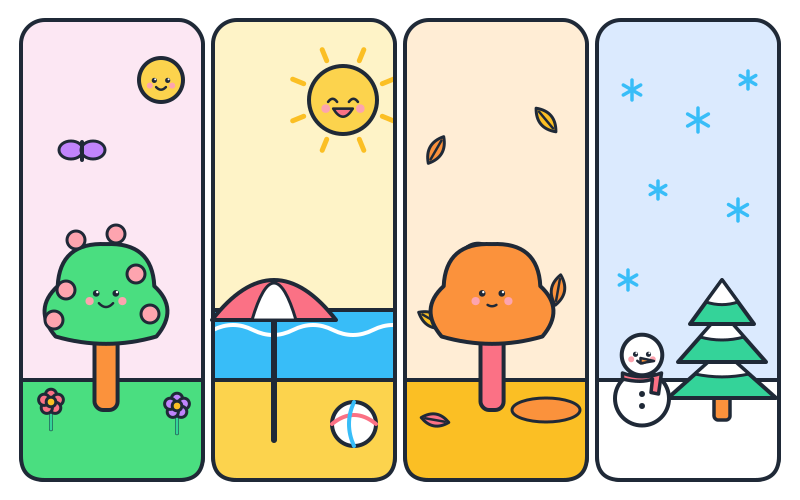
Spring and summer are feminine, autumn and winter masculine.
Spring and summer are feminine, autumn and winter masculine, and an adjective shows it:
.- Spring is lovely..- Winter is cold.
A season is : . My favourite season is summer.
Weather by season
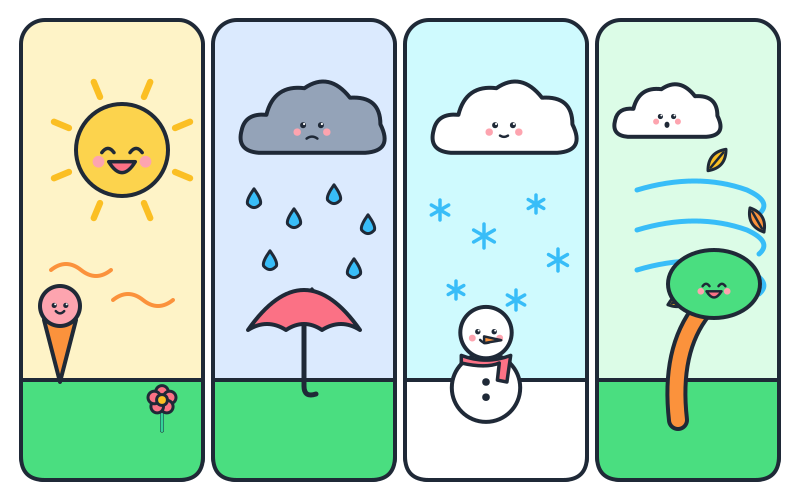
Hot and cold weather take , not . Rain and snow need no subject at all:
.- In summer it's hot..- In winter it's cold..- In autumn it often rains..- In January it sometimes snows.
- .
- .
- .
Heat and cold take fare; rain and snow are a verb on their own, with no subject.
Dates: il tre marzo, il primo maggio
A date is , the plain number and the month. English reaches for an ordinal, the third; Italian does not, with one exception, the first.
| Italian | English |
|---|---|
| the third of March |
| the twentieth of April |
| the first of May |
| the eighth of August |
| the eleventh of September |
and start with a vowel, so shortens:
On a date needs no word for on either: . I'm leaving on the third of March. The numbers themselves are in Italian numbers and dates.
Asking the day and the date
?- What day is it today?.- Today is Tuesday..- Today is the third of March.?- When is your birthday?.- My birthday is the fifth of June.
Written down, the day comes before the month, as in Britain: 3/5 is the third of May.
Week, month, year: scorso and prossimo
(last) and (next) agree like any adjective, so the ending follows the noun:
| Noun | Last | Next |
|---|---|---|
| | |
| | |
| | |
| | |
Milano.- Next week I'm going to Milan..- Last month I worked a lot.
Either word can also go before the noun: means the same as , next year.
Around today: , . Yesterday was Friday, today is Saturday and tomorrow is Sunday.
How often: sempre, spesso, raramente, mai
A habit on a day of the week usually comes with a word for how often:
| Italian | English | Example |
|---|---|---|
| always | . |
| often | . |
| sometimes | . |
| rarely | . |
... | never | . |
after the verb needs in front of the verb: . I never work on Sundays.
Mistakes English speakers make
| Wrong | Right | Why |
|---|---|---|
| , | | no capital letters |
| no word for on | |
| is feminine | |
| the first keeps the ordinal | |
| in | | a season takes a bare in |
| è (weather) | | hot and cold take |
What to do next
- Say today's day and date aloud:
.... - Say three things you do every week with
and a day:.... - Do the drill below.