
Portuguese · Chapter 1 · Lesson 23 · Themed review
E, mas, ou
The connectives and time words that carry most of a Brazilian sentence, grouped by the job they do rather than by their dictionary glosses.
Practise this lesson
16-word session
A quick mix of exercises - recognise, recall, type and build each word. Miss one and it comes back round until it sticks.
Worth knowing
The small Brazilian words that carry the sentence
is the word that best explains why this session exists. A dictionary offers same, even, really, self, right. All five are correct, and which one applies depends entirely on where the word sits in the sentence and what it is leaning on.
These are the words a hundred-word course is made of, because they are the words Portuguese is made of.
The joiners
e is and. is or. is but. is because, and in Brazilian writing you will also meet it as por que in a question, which is the same word doing the interrogative job.
is so or then, and it does an enormous amount of conversational work: starting a sentence, resuming one, signalling a conclusion, filling a pause. It is one of the first words that makes a learner sound like a speaker rather than a reader.
Already, still, and the pair that does the heavy lifting
and are worth learning together. is already, and it also carries a sense of now or right away that English has to spell out. is still or yet.
Between them they handle a great deal of what English does with its perfect tenses, which is one reason Portuguese can be comfortable with simpler verb forms than a textbook suggests.
The ones that shade the sentence
is also. so is only. is like this, or thus. is perhaps, and it drags a subjunctive along behind it when it comes first in the sentence, which is a beginner's earliest encounter with that mood.
is never and is always. behaves the way Italian and Spanish negatives do: Portuguese is comfortable with more than one negative element in a sentence, and stacking them intensifies rather than cancels.
None of this is learned from a list. It is learned by meeting the words often enough that the wrong one starts to sound wrong.
Words in this theme
 eiand
eiand masmasbut
 ouowor
 porquepuʁˈkibecause
 quandoˈkwɐ̃duwhen
 comoˈkomuas, like; how
 entãoẽˈtɐ̃w̃then, so
 tambémtɐ̃ˈbẽj̃also, too, as well
 aindaaˈĩdɐstill, yet; even
 jáʒaalready; right now; ever
 sósɔonly, just; alone
 nuncaˈnũkɐnever
 sempreˈsẽpɾialways
 assimaˈsĩlike this, like that; so
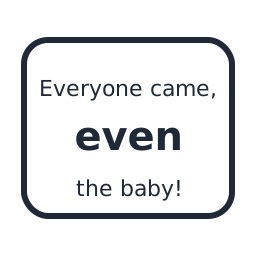 mesmoˈmezmueven; really, exactly; same
 talveztawˈvesperhaps, maybe