
Ch 1 · Lesson 18Portuguese · Chapter 1 · Lesson 18 · Grammar primer
Three verb families: falo, fala, falamos
Nearly every verb ends in -ar, -er or -ir ( is the famous odd one out), and each family takes a predictable set of present-tense endings: drop the ending, add the person's.
The short version
Brazilian Portuguese needs fewer endings
.
Why?Hide
Brazil has largely standardised on for everyday address, and takes the same verb form as and . So one ending covers three pronouns, and the present tense a learner actually needs has four forms rather than the six most textbooks print. That is a real saving; take it.
Every Portuguese verb belongs to one of three families, named for the ending of its infinitive: -ar, -er or -ir. Learn three sets of endings once, and most verbs you meet can be conjugated on sight.
The three families
| Family | Example | English | Size |
|---|---|---|---|
| - | | to speak | the largest, still growing |
| -er | | to eat | far smaller, closed |
| - | | to leave | far smaller, closed |
New verbs join the -ar family: Brazil turned English delete into deletar, and deleto . is I delete the file.
To conjugate, drop the family ending and add the person ending:
.- I speak Portuguese.
The Portuguese conjugation chart: present tense
All three families side by side, in the forms Brazil uses:
| Person | -ar: | -er: | -ir: |
|---|---|---|---|
| | | |
| / / | | | |
| | | |
| / | | | |
Three things to notice in the colour:
- is -o in every family.
.- I eat bread. - -er and - share their endings except with .
- One form covers , and .
.- You speak well.
- .
- .
- .
- .
- .
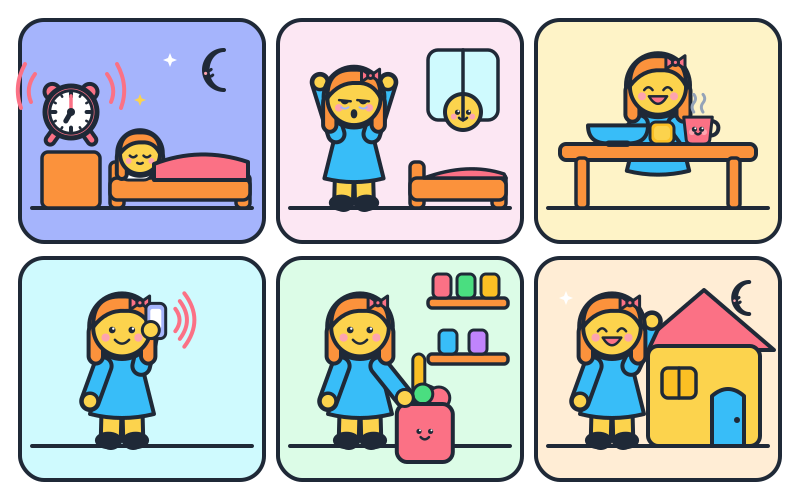
Her day in the present tense: the -ar verbs end in -a (acorda, liga, volta), the -er and -ir verbs in -e (come, dorme).
EP: also uses , with its own ending: ?, do you speak Portuguese? Most textbooks print six rows including and vós; Brazil needs four.
Going further: The simple past and the rest of the guide, when you want them. This lesson does not need them.
Practice
Practise this lesson
9-question session
One question at a time, mixed across the exercises in this lesson. Miss one and it comes back round before the end.
New words in this lesson

Portuguese · Free printables
Worksheets for this lesson
Worksheets with answer keys built in. Open any one to view, print or save.
Lesson 18 of 40 in this chapter