
Ch 30 · Lesson 8Spanish · Chapter 30 · Lesson 8 · Grammar primer
Demonstrative pronouns
, , standing in for the noun - this one, that one, that one over there - plus the neuter / / for unnamed things.
The short version
Use the neuter when there is no noun to agree with
.
Why?Hide
, and point at an idea, a whole situation or a thing you cannot yet name, and they never change for gender or number. Asking about an unidentified object is ¿ ?, never ¿ ? They never take a written accent either, because there is no adjective form to tell them apart from.
This one is just
¿ ? .
Why?Hide
Drop the noun and the demonstrative stands alone, agreeing with the noun you mean: ¿ ? . There is . That one is by the listener and over there; the one that is , not a demonstrative.
The pronouns at a glance
The pronouns are the same words that go before a noun. Pick the row by distance, then the column by the gender and number of the noun you mean:
| Distance | Masc. | Fem. | Neuter |
|---|---|---|---|
| near me, one | | | |
| near me, more | | | none |
| near you, one | | | |
| near you, more | | | none |
| far, one | | | |
| far, more | | | none |
Blue is masculine, rose feminine, green the neuter. The pronoun copies the noun it stands for:
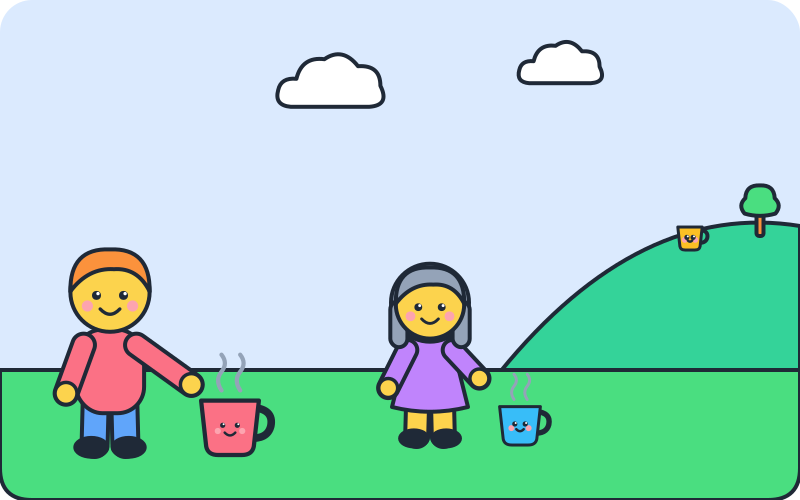
Which cup? Esta (this one) is by me, esa (that one) by you, aquella (that one over there) on the hill. Yo is me, the speaker; tú is you, the listener. Taza is feminine, so all three are feminine.
, .- I don't like that shirt, I prefer that one over there.
This one, that one: no word for one
English adds "one"; Spanish drops it with the noun:
| Means | Spanish | English |
|---|---|---|
| this one | . | I want this one. |
| that one, by you | . | I prefer that one. |
| that one over there | . | I like that one over there. |
| these ones | . | I'll take these. |
The distances work for time too: is far back. . - Those days were happy.
The one that is not a demonstrative at all. It is or : . (the one on the corner is my house). More on the advanced relative pronouns page.
Esto, eso, aquello: the neuter
, and stand for no noun at all: an object you cannot name, something just said, a whole situation. They never change for gender or number:
| Points at | Spanish | English |
|---|---|---|
| an unknown thing | ¿ ? | What is this? |
| what was said | . | That isn't true. |
| a situation | . | This is a disaster. |
| the far past | . | That was a mistake. |
| a topic | . | I don't want to talk about that. |
| a reason | . | That's why I didn't go. |
The neuter never goes before a noun. Before a noun it is always , or : , never " ".
Mistakes English speakers make
| Wrong | Right | Why |
|---|---|---|
| ¿ ? | ¿ ? | an unnamed thing: neuter |
| no word for one | |
| never goes before a noun | |
| is masculine | |
| () | | is feminine |
Going further: What to do next and the rest of the guide, when you want them. This lesson does not need them.
Practice
Practise this lesson
10-question session
One question at a time, mixed across the exercises in this lesson. Miss one and it comes back round before the end.
Spanish · Free printables
Worksheets for this lesson
Worksheets with answer keys built in. Open any one to view, print or save.
Free for members
The printable worksheets, infographics and PDFs are free with an account. Start a free week and download as many as you like.
Start your free weekLesson 8 of 25 in this chapter