
Therefore, So, Because in Spanish: por lo tanto, así que
By Michael McGettrick and Sergio Linares-HernandesUpdated 12 October 2026
Spanish joins a reason, a result and an aim with three families of connectors, and each family has its own mood:
Quick check
Three quick questions on what you have just read. The full practice is further down.
Spot the mistake
0/3Each sentence has one mistake. Tap it.
.- We didn't go out because it was raining., .- It was raining, so we didn't go out..- I'm ringing you so that you help me.
Connectors at a glance
The whole page on one screen. Each family keeps its own box colour all the way down.
| Job | Spanish | English |
|---|---|---|
| cause | . | I'm staying in because it's raining. |
| cause | , . | As it's raining, I'm staying in. |
| cause | , . | Since you' here, help me. |
| cause | . | I'm staying in because of the rain. |
| result | , . | It's raining, so I'm staying in. |
| result | , . | It's raining; that's why I'm in. |
| result | ; , . | No money; therefore, I'm waiting. |
| purpose | . | I'm going out to buy bread. |
| purpose | . | I'm ringing so that you come. |
Cause and result state facts, so the verb after them is indicative ( , below, is the one exception). Purpose points at something that has not happened yet, so takes the subjunctive: , never " ".
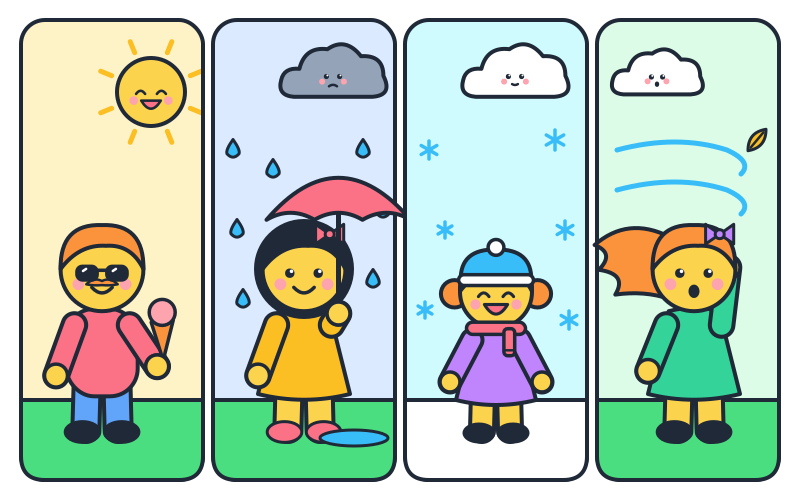
- .
- , .
- , .
Come un helado porque hace sol: he is eating an ice cream because it is sunny. Llueve, así que lleva paraguas: it is raining, so she has an umbrella. Hace frío, por eso lleva bufanda: it is cold, which is why she is wearing a scarf.
Cause: porque, como, ya que
All of them take the indicative when they give the real reason. What differs is where they sit:
| Connector | Where it goes | Example |
|---|---|---|
| after the result | . | |
| at the front only | , . | |
| either end | , . | |
| either end | , . | |
| either end | , . |
, .- We'not going, since there's no car., .- Given that there's no time, we'll start.
, and sound more careful than , and is mostly written.
The one with a rule is . As "because" it must open the sentence, with the reason first. Put the reason second and you need :
, .- As it was raining, we didn't go out..- We didn't go out because it was raining.
After the main clause, reads as "how" or "like", so " " is not standard Spanish.
One twist: a denied reason, no , takes the subjunctive, because you are saying it is not the cause:
, .- I do it, but not because I like it.
Because of: por, a causa de, gracias a
needs a whole clause with a verb. Before a noun, "because of" is , a or a:
| Before a noun | Spanish | English |
|---|---|---|
. | We stayed in because of the rain. | |
| a | . | They closed because of the snow. |
| a | . | The train's late owing to snow. |
| a | . | I passed thanks to you. |
a is for a cause you are glad of. also takes an infinitive, for what someone did:
.- They sacked him for arriving late.
Result: así que, por eso, por lo tanto
The result family says what followed. All of it takes the indicative; the choice is how formal you want to sound:
- así queso
- por esothat’s why
- por lo tantotherefore
- por consiguienteconsequently
| Connector | Spanish | English |
|---|---|---|
, . | I was late, so I missed the train. | |
, . | I was tired; that's why I left. | |
; , . | No money; therefore, we wait. | |
| consiguiente | ; consiguiente, . | Nobody came; consequently, it was cancelled. |
is everywhere in speech and fine in an email; in an essay, reads better. sits in the middle and works almost anywhere.
Result can also be built into the sentence with ... (so... that):
.- I was so tired that I fell asleep.
Hence: de ahí que + subjunctive
One result connector breaks the indicative rule. (hence, which is why) takes the subjunctive in standard Spanish, and it belongs to formal Spanish:
; .- He's ill; hence he isn't coming.; .- He doesn't sleep well; hence he's tired.
Purpose: para and para que
Purpose says what something is for. The question is who does the second action:
| Who does it? | Spanish | English |
|---|---|---|
| the same person | . | I study (in order) to pass. |
| someone else | . | I'm explaining so you get it. |
| someone else | . | I'm ringing so you'll help me. |
. | I repeat it so they remember it. |
The same person: + infinitive. Someone else: + subjunctive, always, because the aim has not happened yet. After a past verb, usually takes the past subjunctive:
.- I explained it so that you would understand it.
and do both jobs, and the mood tells you which. With the indicative they give a result; with the subjunctive, an aim:
, .- He/she wasn't answering, so I left..- Speak slowly so that they understand you.
Saying it another way: es decir, o sea
Not cause or result, but they travel with them: (that is to say) works in any register, (I mean) is spoken.
, , .- He/she arrives on Monday, that is, in three days., , .- It's complicated, I mean, I don't get it.
Mistakes English speakers make
| Wrong | Right | Why |
|---|---|---|
| Me . | , . | causal goes first |
| because of + noun | |
| takes the subjunctive | |
| yo . | . | I study, I pass: infinitive |
| takes the subjunctive | |
| ¿ no ? | ¿ ? | asking why: , two words |
The last one is spelling: (two words, accent) asks why, (one word) answers it.
What to do next
- Do the story and the sort below.
- Then the subjunctive in adverbial clauses for
- And connectors of addition and contrast:
,.