
The Spanish Gerund (-ndo): Uses and the -ing Traps
By Michael McGettrick and Sergio Linares-HernandesUpdated 12 October 2026
The Spanish gerund (-, -iendo) is an adverb: it says how, by what means or while what else an action happens. It is never a noun, so most English -ing words that name an activity become an infinitive:
Quick check
Three quick questions on what you have just read. The full practice is further down.
Spot the mistake
0/3Each sentence has one wrong verb form. Tap it.
.- He/She ran out..- Smoking is bad.
The gerund at a glance
The whole page on one screen. The first four rows are the gerund's real jobs; the last three are English -ing jobs it cannot do.
| Job | Spanish | English |
|---|---|---|
| how (manner) | . | He/She ran out. |
| by what means | . | I learn by listening to music. |
| at the same time | . | I have breakfast reading the news. |
| still, gradually | . | It's still raining. |
| a subject | . | Smoking is bad. |
| after a preposition | | before leaving |
| describing a noun | | a box containing books |
One test covers most cases: if the English -ing means "by doing" or "while doing", use the gerund. If you could put "the" in front of it, or a preposition sits before it, use the infinitive.
Forming the gerund
Add - to -ar verbs and -iendo to -er and -ir verbs. Two groups change:
| Verb | Gerund | Why |
|---|---|---|
| | -ar: - |
| | -er: -iendo |
| | -: -iendo |
| | a vowel before: - |
| | a vowel before: - |
| | -: e becomes i |
| | -: e becomes i |
| | -: o becomes u |
| | irregular |
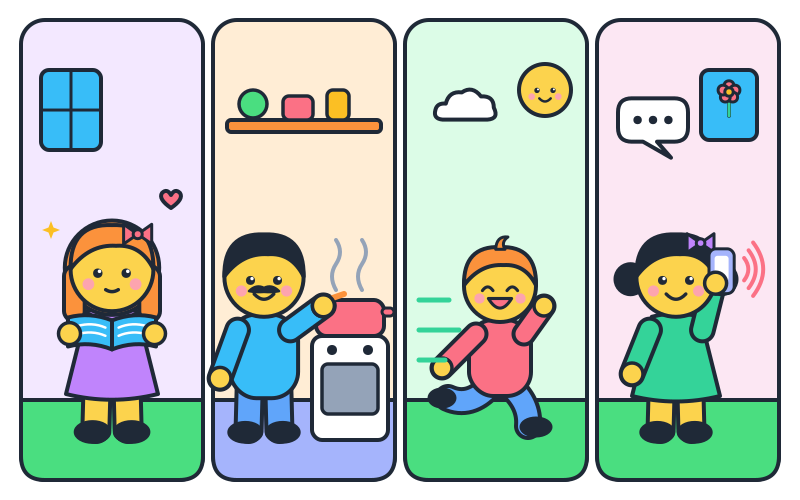
Leyendo (reading), cocinando (cooking), corriendo (running), hablando por teléfono (talking on the phone). The gerund never changes for gender or number.
The gerund never agrees: , . Pronouns join its end, with an accent to keep the stress: . - He/She left saying goodbye.
How: the gerund of manner
After a verb of movement or speaking, the gerund says how it happened:
| Verb | Spanish | English |
|---|---|---|
| go out | . | He/She ran out. |
| arrive | . | He/She arrived singing. |
| come in | . | He/She came in shouting. |
| answer | . | He/She answered with a smile. |
| cross | . | He/She swam across the river. |
| go up | . | He/She ran upstairs. |
English puts the manner in the verb and the direction in a little word: ran out, swam across. Spanish usually does the opposite. The direction is the verb (, , ) and the manner is the gerund.
By what means, and at the same time
The gerund also answers by what means?, where English says "by doing":
.- I learn by listening to music..- He got rich by working hard..- He/She passed the exam by studying every night.
And it adds a second action going on at the same time, by the same person:
.- I have breakfast reading the news..- The baby fell asleep crying., Ana.- Walking through the park, I saw Ana.
At the start of a sentence it can also mean "if": , . - If we leave now, we'll get there in time.
Still and gradually: seguir and ir
A few helper verbs take the gerund to say an action is still going or building up slowly:
.- It's still raining..- It's gradually getting better..- He/She's going around looking for work.
These are verbal periphrases; the whole set, with for "have been doing", is on the verbal periphrases page. + gerund, the present progressive, has its own page.
Trap 1: a subject or an activity is the infinitive
When English -ing names an activity, it is acting as a noun. Spanish uses the infinitive for that, never the gerund:
| Job | Spanish | English |
|---|---|---|
| subject | . | Smoking is bad. |
| saying | . | Seeing is believing. |
| what you like | . | I like cooking. |
| subject | . | Swimming is good exercise. |
| a sign | . | No smoking. |
The test: if you could put "the" in front of the English word (the smoking, the cooking), it is a noun, so Spanish wants the infinitive. More on that form on the uses of the infinitive.
Trap 2: after a preposition, the infinitive
After any preposition, single words and longer ones like alike, the verb is an infinitive:
| Preposition | Spanish | English |
|---|---|---|
| before leaving | |
| after eating | |
| sin | . | He/She left without saying anything. |
. | Thanks for coming. | |
. | I'm tired of waiting. | |
, . | On arriving, I rang my mother. |
English puts -ing after a preposition in all of these, which is why this is such a common gerund mistake. The old + gerund ( , as soon as he/she arrives) survives only in old-fashioned writing and some regional speech: do not copy it.
Trap 3: -ing describing a noun is que + verb
English lets -ing describe a noun directly: a box containing books. A Spanish gerund cannot, so rewrite with and a conjugated verb:
| Noun | Spanish | English |
|---|---|---|
| box | | a box containing books |
| man | | a man carrying a suitcase |
| letter | | a letter explaining everything |
Mistakes English speakers make
| Wrong | Right | Why |
|---|---|---|
| . | . | a subject: infinitive |
| after a preposition | |
| sin | | after a preposition |
| Me . | . | what you like is a noun |
| pan | | a gerund cannot describe a noun |
| leiendo, pediendo | , | -; e becomes i |
One trap catches good writers too: the gerund means "at the same time" or just before (at most an immediate result: , , he/she fell and broke a leg), not a later event. "He fled and was arrested later" needs :
.- He/She fled and was arrested later. Not ",
What to do next
- Before every -ing, ask: how or by what means? Gerund. A noun, or after a preposition? Infinitive.
- Do the story and spot-the-
drills below. - Then verbal periphrases for
,and