
Tú vs Usted in Spanish: Register, vosotros and ustedes
By Michael McGettrick and Sergio Linares-HernandesUpdated 12 October 2026
Spanish has two words for you to one person. is for people you are close to; is for strangers, elders and officials:
Quick check
Three quick questions on what you have just read. The full practice is further down.
Spot the mistake
0/3Each sentence mixes registers or persons. Tap the wrong word.
¿ ?- How are you? (to a friend)¿ ?- How are you? (to an older stranger)
What usted actually signals
signals distance and respect: you and this person are not close, or they are older, senior or someone you are serving. signals closeness. The same greeting climbs from one to the other:
- Hola, ¿qué tal?
- Buenos días, ¿cómo estás?
- Buenos días, ¿cómo está usted?
is grammatically third person, so it takes the form of the verb and the pronouns:
| tú | usted | |
|---|---|---|
| verb | | |
| your | | |
| (to) you | | |
| name | ¿ ? | ¿ ? |
¿ ?- Would you like a coffee? (to a friend)¿ ?- Would you like a coffee? (to a customer).- You'right.
Like any subject pronoun, is often left out once the context is clear: ¿ ? Keep it when the verb alone could mean he or she:
¿ ?- Do you speak English?
When to use which
| Talking to | Form | Example |
|---|---|---|
| a friend, a sibling | ¿? | |
| a child | ¿ ? | |
| your parents | , ¿ ? | |
| an older stranger | ¿ ? | |
| a police officer | ¿ ? | |
| a customer | ¿ ? | |
| a new colleague | depends | Spain: ; elsewhere often |
Spain has moved a long way towards , and young Spaniards use it with most people their age, shop staff included. Latin America is on the whole more formal, and in some families children say to their parents.
The plural split: vosotros or ustedes
For more than one person, geography decides. Spain keeps the informal ; Latin America uses for every group:
| Spain | Latin America | |
|---|---|---|
| to friends | | |
| to strangers | | |
takes the form of the verb, just as takes the form:
.- You'right. (to friends, in Spain).- You'right. (to any group in Latin America, or strangers in Spain)
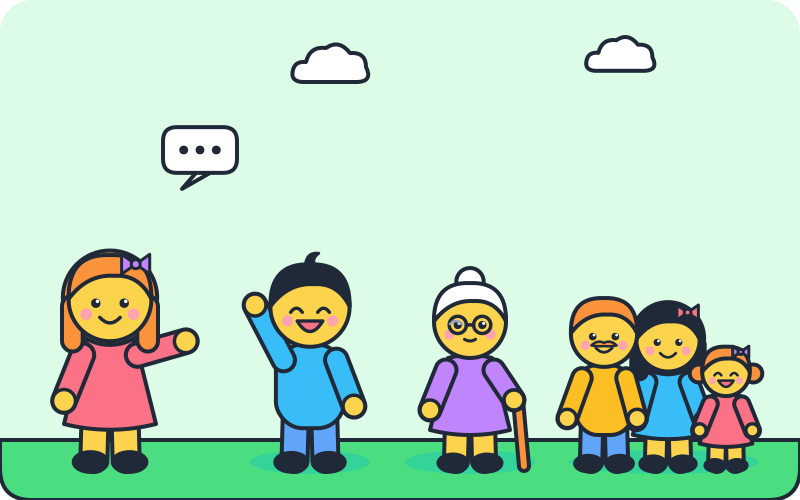
A friend gets tú, an older stranger usted, and a family she does not know ustedes. To a group of friends, Spain would say vosotros.
The possessives split the same way:
| Spain (friends) | Everywhere else | English |
|---|---|---|
| | your house |
| | I'll write to you |
Learners of Latin American Spanish can leave out of their own speech, but should still recognise it: Spanish films, books and songs are full of it. Parts of Latin America, among them, also replace with ( ); that is on regional grammar.
Tutear: moving from usted to tú
Two people often start with and move to . Spanish has a verb for it: tutear, to call someone . The invitation sounds like this:
tutearme.- You can call., .- Please call.¿ tuteamos?- Shall we use?
Take the offer. Carrying on with after it sounds cold rather than polite. Moving back from to is rare and pointed: it puts distance back on purpose.
Getting it wrong
Both directions cost something:
| Form | Used with | How it sounds |
|---|---|---|
| an older stranger | over-familiar, sometimes rude | |
| an official | disrespectful | |
| a friend your age | cold, stiff, even sarcastic | |
| someone who offered | distant, as if you said no |
, ¿ ?- Excuse me, have you got the time? (to an older stranger, not¿ ?)¿ ?- Have you got the time? (to someone your age)
Register in writing
An email picks a register in its first word. Keep the greeting, the verbs and the sign-off in the same one:
| Formal (usted) | Informal (tú) | |
|---|---|---|
| Opening | : | , Juan: |
| Body | ... | ... |
| Closing | cordial | |
A formal Spanish letter opens with a colon, not a comma: :. An email that opens with : and signs off jars as much as switching from to mid-sentence.
Mistakes English speakers make
| Wrong | Right | Why |
|---|---|---|
| . | . | takes the form |
| , | , | usted's possessive is |
| ¿ ? | ¿ ? | takes the form |
| . | . | has its own form |
| , | : | a colon after the greeting |
What to do next
- Start with
for adults you do not know. - Learn each
form with itspair:,. - Then formal commands, where
gives instructions, and object pronouns forand.