
Telling the Time in Spanish: ¿Qué hora es? Son las tres
By Michael McGettrick and Sergio Linares-HernandesUpdated 11 October 2026
Ask ¿ ? and answer . Minutes go on with y (and) up to the half hour, and come off the next hour with (minus) after it. Two things catch English speakers: the plural, and its one exception:
Quick check
Three quick questions on what you have just read. The full practice is further down.
Pick the right one
0/3What time is it? Tap the clock time.
Son las tres y cuarto.
Son las cuatro menos cuarto.
Son las siete y media.
.- It's three o'clock..- It's one o'clock.
The whole system on one screen
| Clock | Spanish | Literally |
|---|---|---|
| 1:00 | . | It is the one |
| 3:00 | . | They are the three |
| 3:10 | | three and ten |
| 3:15 | | three and a quarter |
| 3:30 | | three and a half |
| 3:45 | | four minus a quarter |
| 3:50 | | four minus ten |
| 15:30 | | timetable form |
| at 8 | | at the eight |
Blue adds minutes, orange takes them away. Everything else is a number you already know.
Asking the time
| Use | Spanish | English |
|---|---|---|
| everywhere | ¿ ? | What time is it? |
| Latin America | ¿ ? | What time is it? |
| to a stranger | , ¿ ? | Excuse me, what time is it? |
| for an event | ¿ ? | At what time? |
| on the dot | . | It's exactly three. |
There is no word for o'clock. is the whole answer, and stands for the hidden .
is the time on the clock. Time in general is , and an occasion is :
¿ ?- What time is it?.- I haven't got time..- It's the first time.
Es la una, son las dos
Every hour from two to twelve is plural, because you are counting hours. One o'clock is a single hour, so the verb and article are singular:
| Clock | Spanish | English |
|---|---|---|
| 1:00 | . | It's one o'clock. |
| 1:30 | . | It's half past one. |
| 2:00 | . | It's two o'clock. |
| 12:00 | . | It's twelve o'clock. |
| 12:45 | . | It's quarter to one. |
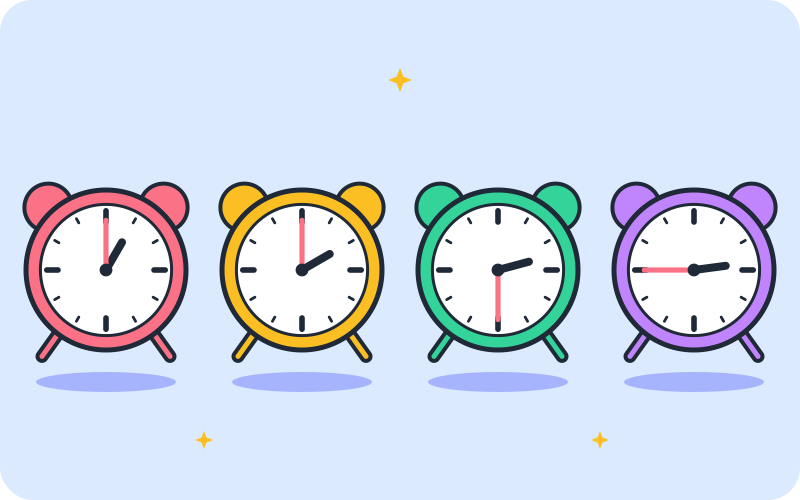
- .
- .
- .
- .
One o'clock is singular, es la una; every other hour is plural, son las dos. Quarter to three already names las tres.
The hour you name decides the verb. Quarter to one names , so it is singular even though the clock still shows twelve.
Y and menos: the minutes
Up to the half hour, add the minutes to the hour with . After it, go to the next hour and take the minutes away with , just as English moves from past to to.
- :01-:30Add to the hour with y: las cuatro y cinco, y cuarto, y veinte
- :31-:59Take from the next hour with menos: las cinco menos veinte, menos cuarto, menos cinco
| Clock | Spanish | English |
|---|---|---|
| 4:05 | | five past four |
| 4:15 | | quarter past four |
| 4:25 | | twenty-five past four |
| 4:30 | | half past four |
| 4:40 | | twenty to five |
| 4:45 | | quarter to five |
| 4:55 | | five to five |
Two variants you will hear:
.- It's 4:40. Counting on past the half is never wrong, and it is how aclock reads..- It's ten to five. Common in Latin America: ten are missing until five.
For a rough time, means a bit after: . - It's just gone three.
At what time? a las
At a clock time is plus the article:
| English | Spanish |
|---|---|
| At what time? | ¿ ? |
| at eight o'clock | |
| at half past eight | |
| at one o'clock | |
| at about eight | |
| from nine to five | |
| The class is at ten. | . |
never contracts with or . (It contracts only with , as in .)
Morning, afternoon and night
Add a part of the day to settle a.m. or p.m.:
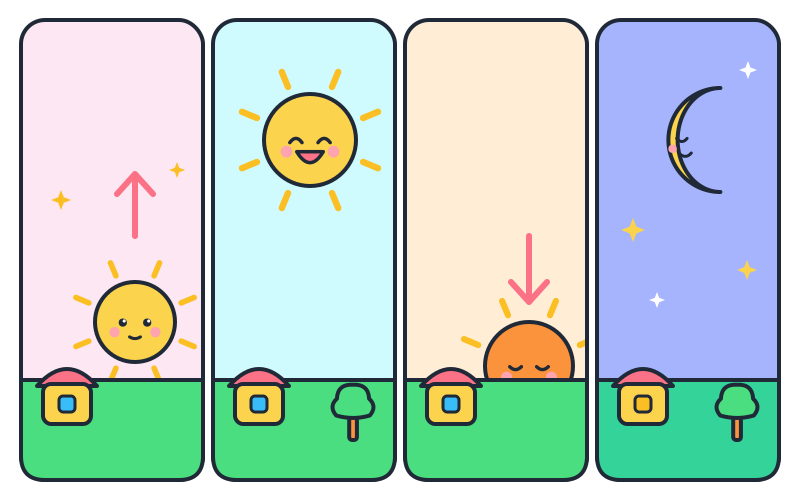
Follow the sun: la mañana as it rises, mediodía when it is highest, la tarde as it sinks, la noche once it is dark.
| Clock | Spanish | English |
|---|---|---|
| 8 a.m. | | eight in the morning |
| 5 p.m. | | five in the afternoon |
| 10 p.m. | | ten at night |
| 3 a.m. | | three in the morning |
| 12 noon | . | It's midday. |
| 12 midnight | . | It's midnight. |
runs from lunch until it gets dark, so is normal on a summer evening. is the small hours, where English says in the morning.
Without a clock time, use : . - I work in the morning.
The 24-hour clock
Timetables, shop doors and appointments use the 24-hour clock. Read it as plain numbers, hours then minutes:
| Written | Said |
|---|---|
| 8:00 | |
| 13:00 | |
| 15:30 | |
| 20:10 | |
, and do not mix with the 24-hour clock: 15:30 is , or in conversation . Some speakers put a y in the middle:
.- The train leaves at 15:30.
Mistakes English speakers make
| Wrong | Right | Why |
|---|---|---|
| . | . | the hours are plural |
| Son . | . | one o'clock is singular |
| Son . | . | the time takes the article |
| at a time is a | |
| half past takes y |
What to do next
- Say the time aloud every time you look at a clock today.
- Do the sort and word-order drills below.
- Next: the numbers page, for the minutes past twenty.