
Tener Expressions in Spanish: Tengo Hambre, Tengo Frío
By Michael McGettrick and Sergio Linares-HernandesUpdated 12 October 2026
Where English says I am hungry, Spanish says I have hunger:
Quick check
Three quick questions on what you have just read. The full practice is further down.
Spot the mistake
0/3Each sentence has one mistake. Tap it.
.- I'm hungry.¿ ?- Are you cold?.- I'm twenty.
The ten tener expressions
The whole set on one screen. Each one is plus a noun:
| Spanish | Literally | English |
|---|---|---|
| to have hunger | to be hungry |
| to have thirst | to be thirsty |
| to have cold | to be cold |
| to have heat | to be hot |
| to have sleepiness | to be sleepy |
| to have fear | to be afraid |
| to have haste | to be in a hurry |
| to have reason | to be right |
| to have luck | to be lucky |
| to have 20 years | to be twenty |
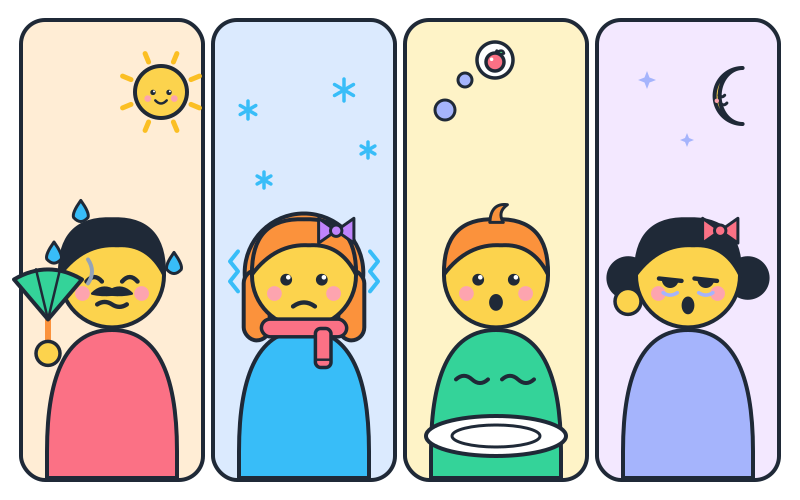
- .
- .
- .
- .
Hot, cold, hungry, sleepy: each person has it, so tener.
is irregular in the present:
| Person | Singular | Plural |
|---|---|---|
| 1st | | |
| 2nd | | |
| 3rd | | |
.- We'in a hurry..- My sister is afraid of dogs..- You'right.
and are both wrong: is a noun, and a feeling after has to be an adjective, as in - I'm tired.
Your age: tener años
Age is something you have, counted in years:
.- I'm twenty..- My grandmother is eighty.¿ ?- How old are you?
Keep : alone is heard, but the full form is never wrong. always is.
Very: mucho or mucha
The word after is a noun, so very is , never . And agrees with the noun:
| Noun gender | Spanish | English |
|---|---|---|
| masculine | . | I'm very cold. |
| masculine | . | I'm very sleepy. |
| feminine | . | I'm very hungry. |
| feminine | . | I'm very thirsty. |
| feminine | . | I'm in a real hurry. |
is feminine even though it takes ( ), the same rule as el agua. So it is .
is the odd one out: is fine, but the usual way to stress it is :
.- You'absolutely right..- You'
Tener, estar or hacer?
Cold and heat can take three verbs, depending on what is cold:
| What is cold | Spanish | English |
|---|---|---|
| a person | . | I'm cold. |
| the weather | . | It's cold out. |
| a thing | . | The soup is cold. |
| a person | . | I'm hot. |
| the weather | . | It's hot out. |
| a thing | . | The coffee is hot. |
With and the word is a noun, or . With it is an adjective, which agrees with the thing: . The weather has its own page: impersonal verbs.
Miedo de, ganas de: adding what
Two of these phrases take to say what of:
.- I'm afraid of the dark..- I feel like sleeping.
plus an infinitive is how Spanish says to feel like doing something. More phrases built the same way ( , ) are on Spanish set phrases, and have to is tener que.
Mistakes English speakers make
| Wrong | Right | Why |
|---|---|---|
| . | . | is a noun |
| . | . | age takes |
| . | . | very with a noun is |
| . | . | is feminine |
| . | . | feeling cold takes |
| . | . | the weather takes |
What to do next
- Do the
-or-sort and the spot-the-mistake drill below. - Say how you feel right now, in one
sentence. - Then Spanish set phrases for
.