
/paɾˈtiɾ/
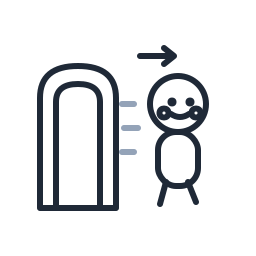

Translation
to leave, to split, to depart
Word origin
From Latin partire ('to divide, to share out'), from pars ('a part'). The same root gives English part, partition and depart.
- Origin
- Latin
- Root
- partire
- English cognates
- part, partition, depart
Grammar
Conjugation
Regular -ir conjugation. Pronouns: yo, tú, él/ella/ud., nos., vos., ellos/uds..
Indicative
| Person | Present | Preterite | Imperfect | Future | Conditional |
|---|---|---|---|---|---|
| yo | parto | partí | partía | partiré | partiría |
| tú | partes | partiste | partías | partirás | partirías |
| él/ella/ud. | parte | partió | partía | partirá | partiría |
| nos. | partimos | partimos | partíamos | partiremos | partiríamos |
| vos. | partís | partisteis | partíais | partiréis | partiríais |
| ellos/uds. | parten | partieron | partían | partirán | partirían |
Subjunctive
| Person | Present | Imperfect (-ra) | Imperfect (-se) |
|---|---|---|---|
| yo | parta | partiera | partiese |
| tú | partas | partieras | partieses |
| él/ella/ud. | parta | partiera | partiese |
| nos. | partamos | partiéramos | partiésemos |
| vos. | partáis | partierais | partieseis |
| ellos/uds. | partan | partieran | partiesen |
Imperative
| Person | Affirmative |
|---|---|
| tú | parte |
| ud. | parta |
| nosotros | partamos |
| vosotros | partid |
| uds. | partan |
Non-finite
- Gerund / present participle
- partiendo
- Past participle
- partido
Examples
.
We leave first thing tomorrow.
, .
From today onwards, I will not smoke any more.
.
I split the apple in half.
.
The boat departs from the harbour every three hours.
.
I am going to break the bread into small pieces.
.
I am going to cut the cake for the children.
Where this fits
Used in
Add to review queue
Track this word in your spaced-repetition queue and be tested on it at the right interval.
Go to my review queueSpanish · Free printables
partir: worksheet, infographic and listicle
Free printable study downloads for the Spanish word "partir" (to leave, to split, to depart): a worksheet with the answer key built in, an infographic, and a sentence listicle. Open any one to view, print or save.
Free for members
The printable worksheets, infographics and PDFs are free with an account. Start a free week and download as many as you like.
Start your free weekThis word is part of lesson 22.