
/fɑː/

Translation
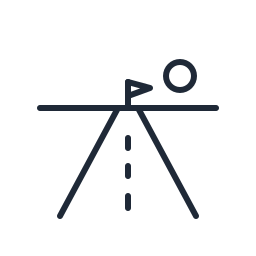
A long way from here, or a long way from another place.
Word origin
From Old English feorr, meaning distant or a long way off.
- Origin
- Old English
- Root
- feorr
Examples
.
"Far" tells you the distance is long.
?
"How far" asks about distance.
.
Before a comparison, "far" means much.
Used in
Stories
(8)The Journey
3 min read · Core 1000
One Sheep Short
4 min read · Core 5000
The Long Way Home
4 min read · Core 1000
The Night Route
5 min read · Core 5000
The Suggestion Box
5 min read · Core 5000
The Swimming Lesson
5 min read · Core 5000
The Whale on the Beach
5 min read · Core 5000
The Last Light
8 min read · Core 5000
Grammar articles
(21)Adverb position in English: before the verb, after be, and the just, still and already traps
As vs like in English: swims like a fish, works as a waiter, and the truth about like I said
British vs American grammar: have got, gotten, the team are, and the other quiet differences
Causative have and get in English: have something done, get something done and having someone do it
Comparatives and superlatives in English: the complete guide
Discourse markers in English: well, anyway, actually, mind you and by the way
Dummy subjects in English: it's raining, there's a problem, and why the subject slot is never empty
Ellipsis and substitution in English: I think so, neither do I, and the words you are allowed to leave out
For, since, already, yet and still in English: which word, and where it goes in the sentence
Future in the past: was going to, would, was about to, and the grammar of plans that failed
Gradable and ungradable adjectives: why very furious sounds wrong, and which intensifier goes where
Indirect questions in English: Could you tell me where the station is, and the word order that goes with it
Mixed conditionals in English: past causes with present results, and present causes with past results
Past perfect tense: had plus past participle, and when English actually needs it
Phrasal verbs in English: rules, examples and how to use them
Present perfect tense: rules, examples and when to use it
Reflexive and reciprocal pronouns in English: myself, yourself, each other, and when English does not bother
The subjunctive and the unreal past in English: I suggest he go, if I were you, and it's time we left
Time clauses in English: when, while, as soon as, until, before and after
Wish and if only in English: wish + past, wish + past perfect, wish + would, and why I wish I would is wrong
Word formation in English: how suffixes build word families and give away the part of speech
Add to review queue
Track this word in your spaced-repetition queue and be tested on it at the right interval.
Go to my review queueThis word is part of lesson 7.