
Translation
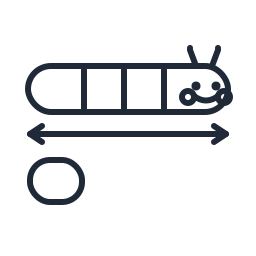
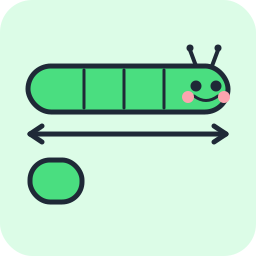
Measuring a large amount from one end to the other, or lasting a great deal of time.
Know this word? Create a free account to track it.
Word origin
From Old English lang, meaning long in space or time, a word shared across the old Germanic languages.
- Origin
- Old English
- Root
- lang
Examples
.
"Long" shows the hair goes down a great distance.
.
"Long" shows the film lasted a great deal of time.
.
"Long" tells us the road went a great distance.
Where this fits
Used in
Stories
(28)The New House
2 min read · Core 1000
A Day at the Farm
3 min read · Core 1000
A Rainy Afternoon
3 min read · Core 1000
Lost in Town
3 min read · Core 1000
The Journey
3 min read · Core 1000
The Phone Call
3 min read · Core 1000
The Surprise Party
3 min read · Core 1000
Before the Doors Open
4 min read · Core 5000
One Sheep Short
4 min read · Core 5000
The Boat in the Garden
4 min read · Core 5000
The Broken Window
4 min read · Core 5000
The Clock in the Hall
4 min read · Core 5000
The Long Way Home
4 min read · Core 1000
The Passenger
4 min read · Core 5000
Two Gardens
4 min read · Core 5000
Not in Front of Them
5 min read · Core 1000
The Box in the Wood
5 min read · Core 5000
The First Letter
5 min read · Core 5000
The Midnight Piano
5 min read · Core 5000
The Night Route
5 min read · Core 5000
The Photograph
5 min read · Core 5000
The Register
5 min read · Core 5000
The Suggestion Box
5 min read · Core 5000
The Swimming Lesson
5 min read · Core 5000
The Tuesday Visitor
5 min read · Core 5000
The Whale on the Beach
5 min read · Core 5000
Two Tickets to Paris
5 min read · Core 5000
The Last Light
8 min read · Core 5000
Grammar articles
(30)English adjective order: opinion, size, age, shape, colour
Adverb position in English: before or after the verb?
As vs like in English: the difference, with examples
British vs American English Grammar: got, gotten and more
Have something done and get something done in English
Compound nouns in English: is car park one word or two?
Conditional sentences in English: zero, first, second, third
Countable and uncountable nouns in English: rules and list
Discourse Markers in English: well, anyway, actually
Ellipsis and substitution in English: I think so, so do I
For, since, already, yet and still in English, with examples
Future continuous and future perfect in English: examples
Hedging and vague language in English: sort of, a bit, -ish
Linking Words in English: although, despite, however
Nominalisation in English: turning verbs into nouns
Numbers in English: how to say, write and spell them
Past continuous in English: was/were + -ing, with examples
100 Common Phrasal Verbs in English, with Examples
Phrasal verbs with get in English: 16 meanings, examples
Prepositions in English: in, on, at and more, with examples
Present perfect continuous in English: have been + -ing
Present perfect in English: rules, for and since, examples
Relative clauses in English: defining and non-defining
Separable and inseparable phrasal verbs in English: rules
The subjunctive in English: if I were you, I suggest he go
The 12 English tenses: one chart with forms and examples
There is and there are in English: rules and examples
To be in English: am, is and are (chart and examples)
Used to, would and be used to in English: past habits
Prefixes in English: un-, in-, im-, ir-, dis-, mis- rules
Add to review queue
Track this word in your spaced-repetition queue and be tested on it at the right interval.
English · Free printables
long: worksheet, infographic and listicle
Free printable study downloads for the English word "long" (Measuring a large amount from one end to the other, or lasting a great deal of time.): a worksheet with the answer key built in, an infographic, and a sentence listicle. Open any one to view, print or save.
This word is taught in chapter 2, lesson 6: Words 141-150.