
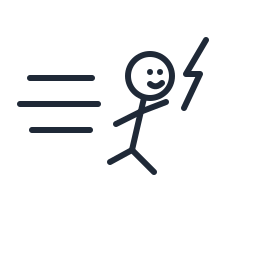

Meaning
Moving or doing things very quickly.
Test yourself on fast
Three quick questions. No account needed.
Know this word? Create a free account to track it.
Word origin
From Old English faest, meaning firm or fixed; the sense of quick grew from running firmly and hard.
- Origin
- Old English
- Root
- faest
- English cognates
- fasten, steadfast
Examples
.
.
, .
Where this fits
Used in
Stories
(5)Grammar articles
(9)Adverb position in English: before or after the verb?
For, since, already, yet and still in English, with examples
Future tense in English: will vs going to, with examples
English greetings and survival phrases for beginners
English Question Words and Interrogative Pronouns
English Slang and Informal Words: What Real People Say
So, such, too and enough in English: rules and examples
There is and there are in English: rules and examples
Suffixes in English: word building with -ness, -ful, -ly
Add to review queue
Track this word in your spaced-repetition queue and be tested on it at the right interval.
Meet this word in a story
Every course has graded stories written only with words you have been taught, plus grammar drills, a games arcade and printable worksheets. Chapters 1 and 2 are free.
Chapters 1 and 2 free, forever. Plus: 7 days free, then $5 a month for all eleven languages.
English · Free printables
fast: worksheet, infographic and listicle
Free printable study downloads for the English word "fast" (Moving or doing things very quickly.): a worksheet with the answer key built in, an infographic, and a sentence listicle. Open any one to view, print or save.
Free for members
The printable worksheets, infographics and PDFs are free with an account. Start a free week and download as many as you like.
Start your free weekThis word is taught in chapter 5, lesson 6: fast, yours, dance and 7 more words.