
Ch 26 · Lesson 17Esperanto · Chapter 26 · Lesson 17 · Grammar primer
Ĝojan feston! Wishes, birthdays and festo or ferio
Every wish ends in -n because it is the object of . for a person, for an event, and the two Esperanto words for a holiday.
The short version
Every wish ends in -n: it is an object
!
Why?Hide
! is short for , I wish you a good morning. The wish is the object of a verb left unsaid, so the adjective and the noun both take -n. The pattern is open: any adjective and noun with -n make a wish.
.
Why?Hide
A ( + ) is the day somebody was born. A ( + ) is any anniversary, the date coming round again. A birthday is one kind of anniversary, but is the word to use for a person. And English holiday splits in two: a is a celebration, a a day off.
Festo or ferio?
English holiday covers two Esperanto words. A is the celebration; a is a day off work.
| Word | Means | Example |
|---|---|---|
| a celebration, party | . |
| a day free of work | . |
| the holidays, a break | ? |
The verb and adjective come from the same root:
.- We celebrated his birthday..- She wore a party dress.
Birthdays: naskiĝtago and datreveno
A is a birthday, the day somebody was born. A is any anniversary: the date coming round again.
| Word | Use it for | Example |
|---|---|---|
| a person | . |
| an event, a society | |
A birthday is one kind of anniversary, but the notes that is the better-understood word for it. To a person, say .
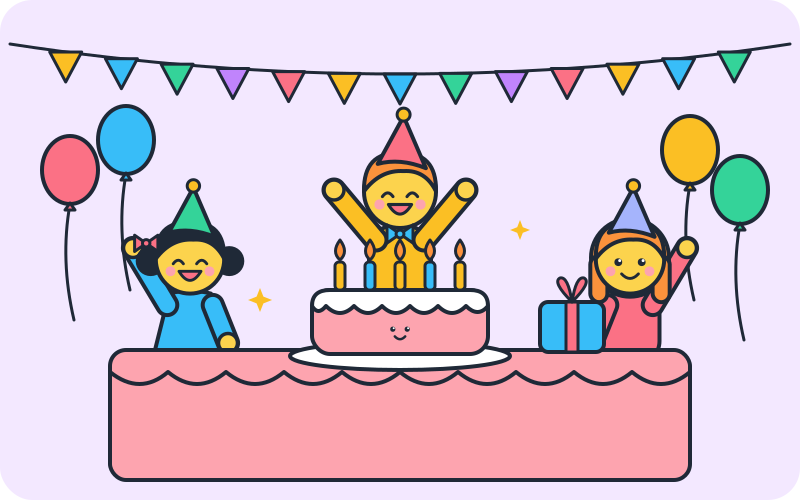
A naskiĝtago: the knabo (boy) has his birthday, the kuko (cake) has five candles, an amikino (friend, a girl) is at the party, and there is a donaco (present).
.- He is five today.
The wishes, and why they end in -n
Every wish is a sentence with the verb left out, and the full sentence is hardly ever said. PMEG explains it this way: ! is short for !, I wish you a good morning. The wish is the object of , so the adjective and the noun both take -n.
| Wish | When |
|---|---|
! | any festival |
! | Christmas |
! | the new year |
! | a birthday |
! | a departure |
The pattern is open: any adjective and noun, both with -n, make a wish, whether or not anyone has said it before.
!- Have a good weekend!!- Have a nice holiday!
Thanks and greetings work the same way with a different verb left out. PMEG gives ! as short for !, I give you thanks, and ! as !.
Mistakes English speakers make
| Wrong | Right | Why |
|---|---|---|
! | ! | the adjective takes -n too |
! | ! | the noun takes -n too |
15-a. | 15-. | -n makes the date mean on |
Going further: Zamenhofa Tago: 15 December and the rest of the guide, when you want them. This lesson does not need them.
Practice
Practise this lesson
10-question session
One question at a time, mixed across the exercises in this lesson. Miss one and it comes back round before the end.
Esperanto · Free printables
Worksheets for this lesson
Worksheets with answer keys built in. Open any one to view, print or save.
Free for members
The printable worksheets, infographics and PDFs are free with an account. Start a free week and download as many as you like.
Start your free weekLesson 17 of 27 in this chapter