
Esperanto Body Parts: La Korpo, Head to Foot
By Michael McGettrickUpdated 12 October 2026
Esperanto's body words are mostly international roots, and one rule matters more than the list: where the owner is obvious, Esperanto says where English says my or his.
Quick check
Three quick questions on what you have just read. The full practice is further down.
Pick the right one
0/3Pick the sentence that says what the English says.
(he raised his own head) (Lian is another man's head.)
(she washed her own feet) (Al ŝi points at another woman.)
(he broke his own arm)
.- I washed my hands..- He broke his arm..- The doctor examined my hands (mine, not yours).
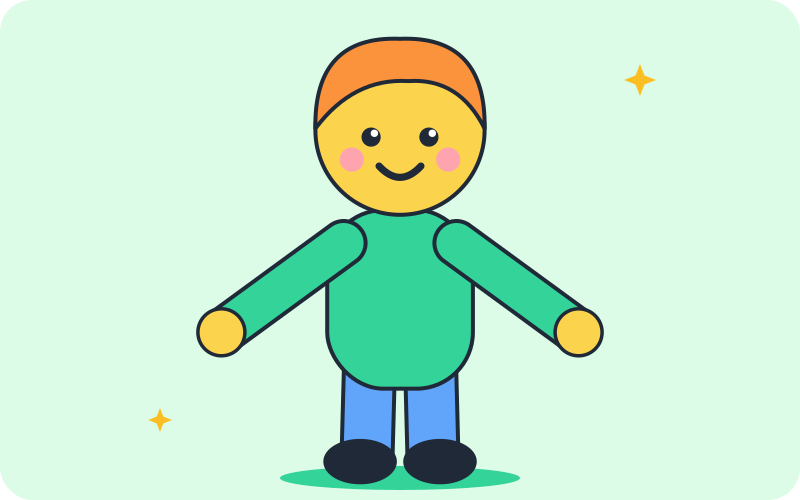
La kapo the head, la okuloj the eyes, la buŝo the mouth, la mano the hand, la brako the arm, la kruro the leg, la piedo the foot.
The head and the face
| Word | English | Note |
|---|---|---|
| head | |
| a single hair | the hair on your head: |
| forehead | |
| face | |
| eye | , the eyes |
| eyebrow | |
| ear | |
| nose | |
| cheek | |
| beard |
One hair is , so the hair on your head is plural:
.- She has long hair.
The mouth and the jaw
| Word | English | Note |
|---|---|---|
| mouth | |
| lip | |
| tooth | |
| tongue | the organ; a language is |
| chin | |
| jaw |
English tongue is both the muscle and the language. Esperanto keeps them apart:
is .- The coffee burnt my tongue..- My mother tongue is English.
The neck and the trunk
| Word | English | Note |
|---|---|---|
| neck | the whole neck |
| nape | only the back of the neck |
| throat | where a sore throat is |
| shoulder | |
| chest, breast | the front of the trunk |
| back | |
| waist | |
| belly | the everyday English stomach |
| heart | |
| lung | |
| stomach (the organ) | where digestion begins |
| kidney | |
| body | |
| limb; member of a group | one root for both |
.- The heart beats in the chest..- My back hurts.
The arms and the legs
| Word | English | Note |
|---|---|---|
| arm | |
| elbow | |
| hand | |
| finger | |
| nail | a claw is o |
| fist |
| Word | English | Note |
|---|---|---|
| leg | the commoner word, and Zamenhof's |
| leg | always the whole limb |
| thigh | |
| knee | |
| foot | |
| toe | a foot-finger: |
A toe has no root of its own. It is built, like many body words, from two you already have:
.- I broke a toe.
The rule: la, not mia
English marks the owner of every body part: my hands, his head. Esperanto usually does not. PMEG, the standard reference grammar:
, , . , , oj .Often one uses
instead of a possessive pronoun if the context clearly shows who the owner is. That happens especially often with body parts, clothing and relatives.
PMEG's examples cover all three:
.- He raised his head..- He often touches the brim of his hat with his hand., .- Tell Father I am diligent.
there is the speaker's father. PMEG glosses as = : the same meaning.
It is a preference, not a law. . is correct, only heavier than it needs to be.
Al si: making the owner explicit
When the bare could leave a doubt, put the owner after . With he, she and they that is the reflexive :
.- She washed her feet. (PMEG's example).- He broke his arm.
or there would mean another woman's feet, another s arm. The reflexive explains why.
When the possessive comes back
When whose it is matters, the possessive does real work:
, .- The doctor examined my hands, not yours..- She held my hand. Two people, two sets of hands.
The test: if you could drop the English my and lose nothing, use . If dropping it raises the question "whose?", keep the possessive.
Saying that something hurts
Three forms are standard. With the verb (to hurt), the body part is the subject:
| Form | Example | Note |
|---|---|---|
| possessive | . | the usual form today |
| + person | . | also standard |
| compound noun | . | I have a headache |
The (), the main online dictionary, remarks that modern usage seems to prefer to the older , which you will meet in early texts.
The body part is the subject, so it takes no -n, and is the same for one bone or many (Esperanto verbs never change for person or number):
.- My bones ached after the long journey.
The compound noun works for any body part: (headache), (toothache), (stomach ache). This is ordinary compounding.
Mistakes English speakers make
| Wrong | Right | Why |
|---|---|---|
| | |
(her own feet) | | her own feet: |
. | . | the body part is the subject |
| | the object of |
| | |
Inside, and what it is made of
| Word | English | Note |
|---|---|---|
| brain | |
| skull | the bone around the |
| skin | |
| bone | |
| muscle | |
| blood | |
| vein | an artery is arterio |
| nerve | |
| tear | the drop from your eye |
| voice |
.- The blood flows through the veins to the heart.
Three fences
Three pairs where English has one word, or Esperanto has two that look alike.
 a leg
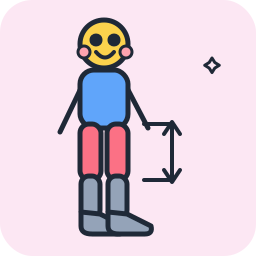 the thigh
 the belly
 the stomach, the organ
| Pair | One | The other |
|---|---|---|
| | |
| | |
| | |
and . Both mean leg. notes that Zamenhof used almost always for the whole limb, and that in anatomy it can also mean only the part from the knee to the foot. is always the whole limb, and lists it as a synonym of :
.- My legs are tired..- My legs are tired.
and . defines as the part of the body between the chest and the pelvis, and as the organ where digestion begins:
.- He hit me in the stomach.
and . The five senses are ; the meaning of a word is its . So (without meaning) means meaningless:
.- That is meaningless.
False friends has more pairs like this.
The body in idiom
All of these are in , and most of them take rather than a possessive:
| Esperanto | English |
|---|---|
| from head to foot |
| to lose one's head |
| to rack one's brains |
| to shake one's head (no) |
| to nod (yes): |
| to be clever |
| to have something to hand |
propramane | with one's own hand |
manenmane | hand in hand with |
Two proverbs:
, .- So many heads, so many opinions., .- Out of sight, out of mind.
is with the article shortened, which Rule 16 allows.
What to do next
- Point at ten parts of your body and name them, with
. - Say what hurts three ways:
dorsdoloron. - Read the reflexive for
and, and the article la for its other uses.