

Translation
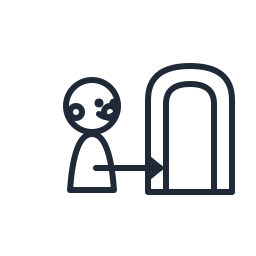
to enter, to go in
Test yourself on eniri
Three quick questions. No account needed.
Know this word? Create a free account to track it.
Examples
.
He entered the room without knocking.
, .
Do not go in, the door is closed.
.
I want to enter the house.
.
The boy came in and greeted everyone.
.
She will come into the room in a minute.
is plus , and it keeps both parents' habits. You can treat it as transitive and give the place a plain accusative ( ), or keep the preposition and put the -n on the noun after it ( ). Both are correct; the second is the older, more Zamenhofian shape. What you cannot do is write , because without the -n there is no movement and the sentence says you are already inside. Its opposite is , and the pair enir- / elir- gives you and , the entrance and the exit on every Esperanto congress signpost.
Where this fits
Used in
Add to review queue
Track this word in your spaced-repetition queue and be tested on it at the right interval.
Meet this word in a story
Every course has graded stories written only with words you have been taught, plus grammar drills, a games arcade and printable worksheets. Chapters 1 and 2 are free.
Chapters 1 and 2 free, forever. Plus: 7 days free, then $5 a month for all eleven languages.
Esperanto · Free printables
eniri: worksheet, infographic and listicle
Free printable study downloads for the Esperanto word "eniri" (to enter, to go in): a worksheet with the answer key built in, an infographic, and a sentence listicle. Open any one to view, print or save.
Free for members
The printable worksheets, infographics and PDFs are free with an account. Start a free week and download as many as you like.
Start your free weekThis word is taught in chapter 3, lesson 1: eniri, vojo, juna and 7 more words.