

Translation
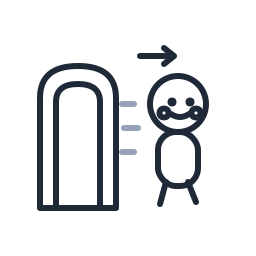
to leave, to go away, to depart
Test yourself on foriri
Three quick questions. No account needed.
Know this word? Create a free account to track it.
Examples
.
He left without saying a word.
?
When will you leave?
.
She left the house early in the morning.
.
They went away and never came back.
.
I must go now.
For means away, and it prefixes freely: , , , . is intransitive, so the place you left takes and never a bare accusative. If you want to leave a thing or a person behind, that is , which is transitive: . English uses "leave" for both jobs and the two verbs are not swappable, so reads as broken Esperanto rather than as a stylistic choice.
Where this fits
Used in
Stories
(3)Add to review queue
Track this word in your spaced-repetition queue and be tested on it at the right interval.
Meet this word in a story
Every course has graded stories written only with words you have been taught, plus grammar drills, a games arcade and printable worksheets. Chapters 1 and 2 are free.
Chapters 1 and 2 free, forever. Plus: 7 days free, then $5 a month for all eleven languages.
Esperanto · Free printables
foriri: worksheet, infographic and listicle
Free printable study downloads for the Esperanto word "foriri" (to leave, to go away, to depart): a worksheet with the answer key built in, an infographic, and a sentence listicle. Open any one to view, print or save.
Free for members
The printable worksheets, infographics and PDFs are free with an account. Start a free week and download as many as you like.
Start your free weekThis word is taught in chapter 3, lesson 2: foriri, lasta, denove and 6 more words.