
Ch 21 · Lesson 10French · Chapter 21 · Lesson 10 · Grammar primer
On m'a donné un livre: when French avoids the passive
Where English hides the doer, French says on (on 'a ) or uses ( ). And I was given a book can never be a French passive.
The short version
I was given a book cannot be a French passive
.
Why?Hide
French can only promote a direct object to passive subject, never an indirect one. In someone gave a book to me, the book is direct and I am indirect, so the English passive has no French equivalent. Use on plus an active verb, and the same fix covers I was told and we were asked.
French often says on instead
English uses the passive to hide who did something. French prefers an active verb with (someone, people):
.- My bag was stolen (literally, someone stole my bag from me)., .- French is spoken here..- The concert has been cancelled.
For general truths, French also turns the verb reflexive with :
.- That is not said..- White wine is drunk chilled.
Keep the passive for when you name the doer, or for formal writing. More ways round it are on avoiding the passive.
I was given a book: no passive
Only a direct object can become the subject of a French passive. In , the book is the direct object; the person, after , is the indirect one.
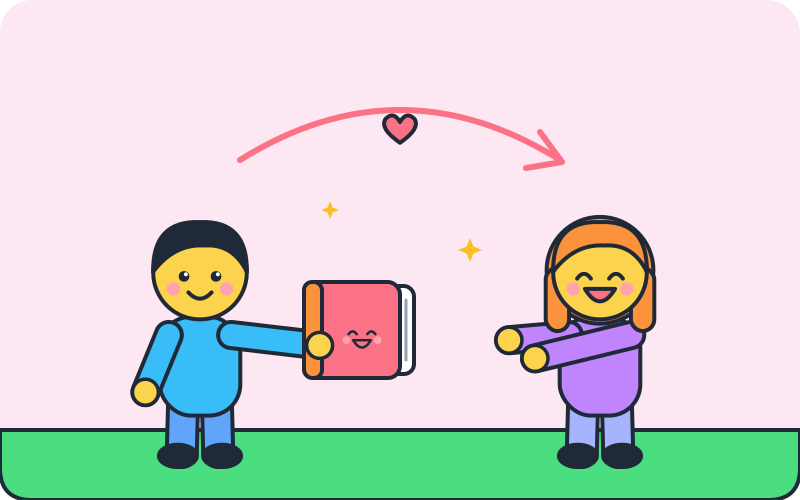
On m'a donné un livre (I was given a book): on (1) gives, un livre (2) is the direct object, and me (3) receives it, the indirect object. Only the book could become a passive subject.
English makes the receiver the subject (I was given a book). French cannot, so use :
| Verb | Everyday French | English |
|---|---|---|
| . | I was given a book. |
| . | They were told the news. |
| . | We were asked to wait. |
The book itself can be the subject, in a formal register: . - A book was given to me.
Mistakes English speakers make
| Wrong | Right | Why |
|---|---|---|
| . | the participle agrees |
| . | plural subject: -s |
| . | être's is a |
| . | the person is indirect: on |
| | an action takes |
Going further: How to build it: être + past participle and the rest of the guide, when you want them. This lesson does not need them.
Practice
Practise this lesson
7-question session
One question at a time, mixed across the exercises in this lesson. Miss one and it comes back round before the end.
French · Free printables
Worksheets for this lesson
Worksheets with answer keys built in. Open any one to view, print or save.
Free for members
The printable worksheets, infographics and PDFs are free with an account. Start a free week and download as many as you like.
Start your free weekLesson 10 of 28 in this chapter