
Ordering in French: je voudrais, c'est combien and prices
By Michael McGettrickUpdated 12 October 2026
To order in French, say (I would like), the thing, and . Not , which is I want and sounds blunt. To ask the price, say ? Prices come euros first, then cents. And the bill is .
That is the whole lesson on one screen:
| You want to... | Say | English |
|---|---|---|
| ask for something | , . | I'd like a coffee, please. |
| order in a hurry | , . | A coffee, please. |
| ask the price | ? | How much is it? |
| ask for the total | ? | How much is that? |
| understand a price | . | €2.50 |
| pay at a table | , . | The bill, please. |
Quick check
Now use it: three quick questions on the chart above. The full practice is further down.
Pick the right one
0/3Pick what you would say in each situation.
You ask a waiter for a coffee, politely.
You point at a cake in a shop window and want the price.
You have finished your meal and want to pay.
And before any of it: . Ordering at a counter without a hello is the one thing that reliably earns you a cold look in France.
Je voudrais: the polite way to ask
means I would like. Learn it as one block that you put in front of whatever you want. Add a noun and , and you have a complete, polite order.
, .- I'd like a coffee, please., .- I'd like a, please., .- I'd like some water, please.
Notice , some water: French puts a word for "some" in front of things you cannot count, the partitive.
also takes a verb in the infinitive, the dictionary form:
.- I'd like to pay..- I'd like to eat.
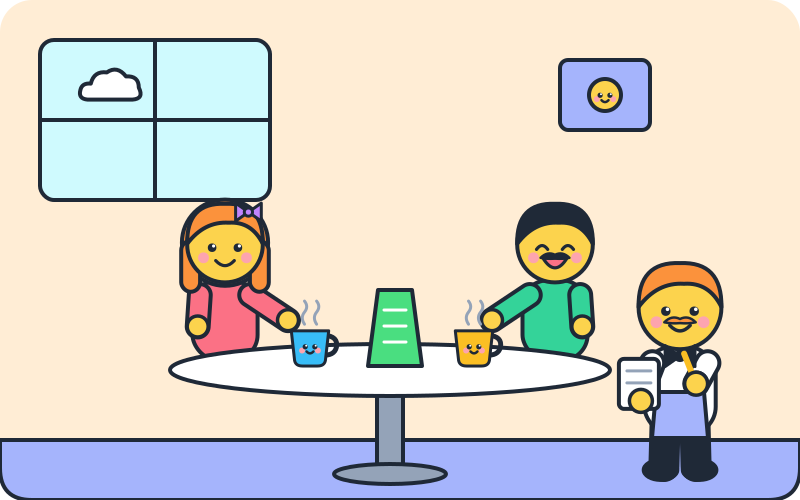
At the table: la cliente and le client (the customers), le serveur (the waiter), la carte (the menu) and deux cafés (two coffees). Each customer orders with je voudrais.
Why not je veux?
is I want. It is correct French, and with friends it is fine:
.- I want a coffee. (blunt to a waiter).- I'd like a coffee. (polite)
Said to a waiter, lands the way "I want a coffee" lands in English: the grammar is right and the manners are not.
Strictly, is (to want) in the conditional, but you do not need the tense to use the chunk. is on the AQA GCSE French specification at Foundation and Higher tier.
Other ways to ask
is the safe default, but it is not the only way. Here is what you will hear at a table, from blunt to careful:
- Je veux un café.fine with friends only
- Je prends un café.choosing from the menu
- Un café, s’il vous plaît.after bonjour, perfectly polite
- Je voudrais un café.safe everywhere
| Register | Phrase | English |
|---|---|---|
| everyday | , . | A coffee, please. |
| everyday | , . | A tea for me. |
| everyday | . | I'll have a beer. |
| polite | . | I'd like a glass of wine. |
| blunt | . | I want a coffee. |
is what you say when the waiter goes round the table: each person names their order with "for me" in front. , I'll have, is what the French very often say when choosing from a menu:
.- I'll have the fish.
The bare noun plus is not rude. At a busy counter it is exactly what everyone says, provided the came first.
C'est combien ? Asking the price
There are three common questions, and they do slightly different jobs.
| Use it for | Question | English |
|---|---|---|
| one item, pointing | ? | How much is it? |
| total at the till | ? | How much does that come to? |
| naming the item | ? | How much is the wine? |
means to cost. You can also hang the item on the end of the first question:
, ?- How much is the bread??- How much does it cost?
The answer usually comes back with , and at the end of a meal you ask for the bill instead:
.- That's five euros., .- The bill, please.
Prices in euros
Euro is a masculine noun and takes an s in the plural: , . The s is silent, but the number links into the vowel, and that link makes a price sound French.
| Price | Say | Sounds like |
|---|---|---|
| 1 € | | /œ̃..ʁo/ |
| 2 € | | /.zø.ʁo/ |
| 3 € | | /tʁwa.zø.ʁo/ |
| 6 € | | /.zø.ʁo/ |
| 10 € | | /di.zø.ʁo/ |
The highlighted letter is the one you carry over into euros. is the odd one: most people keep the f (/nœ.fø.ʁo/), and some say it with a v, as in (nine years). Nobody will misunderstand either.
Euros and centimes
French writes the euro sign after the number and uses a comma, not a point, for the cents: 3,50 €, not €3.50. Say the euros, then the cents number, and leave out the word for cents:
- 3,50 € -
- 1,20 € -
- 0,50 € -
A hundredth of a euro is . In everyday speech you only say the word when there are no whole euros in the price.
A café exchange, start to finish
Here is the whole thing at a counter. Read it aloud twice and you have a script that works.
| Who | French | English |
|---|---|---|
| You | , . | Hello. |
| Waiter | . ? | Hello. What would you like? |
| You | , . | I'd like a coffee, please. |
| Waiter | . ? | A coffee. Anything else? |
| You | croissant, . | A croissant, please. |
| Waiter | ? | Anything else? |
| You | , . ? | That's all, thanks. How much? |
| Waiter | . | Two fifty. |
| You | . , . | Here you are. Thanks, bye. |
? is literally "and with that?", meaning anything else? In a bakery you will often hear the slightly more formal ?, which asks the same thing. The answer that ends it is , .
Common mistakes English speakers make
| Wrong | Right | Why |
|---|---|---|
. | . | Correct, but blunt to a waiter. |
| | takes a plural s. |
? | ? | Grammatical, but stiff and rare. |
. | . | is a , not the bill. |
! | , ! | Dated, and rude to most waiters. |
| €3.50 | 3,50 € | Comma for cents, sign after. |
The is the one mistake you cannot see on paper: said with a gap sounds foreign. Run the x into the vowel as a z.
What to do next
- Say the
exchange above aloud, playing both parts, until - Read any receipt aloud in French, euros then cents.
- Learn French numbers so no price can surprise you.