
Lequel, Auquel, Duquel: French Relatives After a Preposition
By Michael McGettrickUpdated 12 October 2026
is the relative pronoun French uses after a preposition: , the table I write on. It agrees with the noun it points back to, and it fuses with à and the way the article does.
Quick check
Three quick questions on what you have just read. The full practice is further down.
Fill in the blank
0/3Complete each relative clause with the right form of lequel, fused with à or de where the rule requires it. The gender and number come from the noun before the preposition.
La table sur j'ai posé mes clés est en bois. (la table, feminine singular)
Le livre avec j'apprends le français est excellent. (le livre, masculine singular)
Le projet je pense est très important. (penser à, le projet)
The lequel forms on one screen
Read down for the noun's gender and number, across for the preposition in front.
| Noun before it | After sur, avec | After à | After de |
|---|---|---|---|
| auquel | duquel | |
| | | |
| masc. plural | lesquels | auxquels | desquels |
| fem. plural | lesquelles | auxquelles | desquelles |
is one of four answers after a preposition. Which one depends on what the clause points back to:
| Pointing back to | Use | Example |
|---|---|---|
| a thing | | |
| a person | | |
| a place or time | | |
| a plain | | |
The basic set, , , and , is on the relative pronouns page.
French never strands a preposition
English ends the clause on its preposition: the chair I am sitting on. French cannot. The preposition moves to the front of the clause, and follows it.
| English order | French order |
|---|---|
| chair I'm sitting on | |
| book I learn with | |
| reasons he left | lesquelles |
lequel agrees with the noun before it
The form matches the noun the clause describes. Nothing inside the clause changes it.
| Noun | With lequel | English |
|---|---|---|
| | the book I learn with |
| | the box I keep my keys in |
| lesquels | the trees we were sitting under |
| lesquelles | the reasons he left |
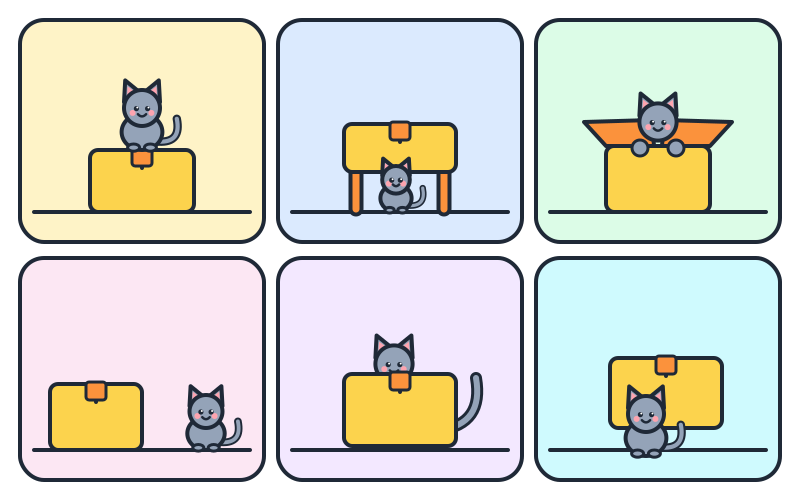
La boîte sur laquelle le chat est assis: the box the cat is sitting on. 1 sur laquelle, on which; 2 sous laquelle, under which; 3 dans laquelle, in which; 4 à côté de laquelle, beside which; 5 derrière laquelle, behind which; 6 devant laquelle, in front of which. Always laquelle, because la boîte is feminine.
The everyday prepositions all take plain : , , , , , pour, , , , , , , .
lesquels- the tools I cannot work without
à + lequel: auquel
When the verb takes , the à fuses with , just as à + gives . The feminine singular stays apart.
| Pieces | Example | English |
|---|---|---|
| à + | auquel | the project I think about |
| à + | | the question I am answering |
| à + lesquels | auxquels | the problems we face |
| à + lesquelles | auxquelles | the letters I answered |
The à comes from the verb, not from the English. Learn these verbs with their à:
| Verb | English | Example |
|---|---|---|
| think about | auquel |
| answer | |
| take part in | auquel |
| attend | auxquels |
| be interested in | auxquelles |
de + lequel: duquel
With the pattern is the same: duquel, desquels, desquelles, and stays apart. But a plain takes dont, not duquel:
Duquel does its real work after a longer preposition that ends in , because can never follow another preposition:
| Preposition | Example | English |
|---|---|---|
| duquel | the bridge with the church at its end |
| duquel | the village we live near |
| | the house I live opposite |
| desquels | the trees with a lake in the middle |
| duquel | the problem I am late because of |
People: qui after a preposition
For a person, French normally uses after a preposition. It does not agree and it does not fuse.
| Preposition | With qui | English |
|---|---|---|
| | the man I work with |
| | the woman I spoke to |
| | the colleagues I work for |
| | the man I sat next to |
is also correct for people, just more formal: reads as written French.
After (among) and (between), French uses lesquels or lesquelles, even for people ( is not used, and is rare):
lesquels- the students I work amonglesquels- the two friends I was sitting between
Place and time: où
Before you reach for , ask whether the clause is about a place or a time. If it is, is the natural choice.
| English | Correct but heavy | What people say |
|---|---|---|
| the town I live in | | |
| the box for my keys | | |
| my childhood home | | |
For a point in time, is the normal choice, and English speakers keep trying :
For a stretch of time, also works: lesquelles - the holidays during which it rained.
cannot replace when the preposition is not about place or time: and have no .
lequel as a subject, in formal writing
Legal and official French sometimes uses as the subject of a clause, where would be ambiguous. Because agrees, it shows which noun is meant.
, , .- My neighbour's son, who is a lawyer, helped me.
is masculine, so the lawyer is the son, not the neighbour. Recognise this in a text; in your own French, use or rephrase.
Mistakes English speakers make
| Wrong | Right | Why |
|---|---|---|
| | the preposition goes first |
| auquel | à + fuses |
lesquels | lesquelles | : plural |
| duquel | never follows a preposition |
| | time nouns take |
What to do next
- Learn each à verb with its à:
- Describe three objects around you with
,or+. - Go on to dont in depth for the
relative.