
/se/
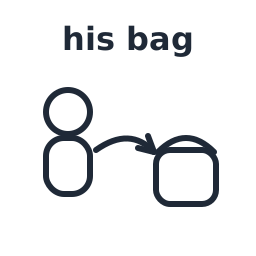

Translation
his, her, its (plural)
Word origin
Plural possessive adjective, from Latin suos and suas, the plural forms of suus ('his, her, its own').
- Origin
- Latin
- Root
- suus
Examples
, ' .
He really likes his office colleagues, they get on well.
week-end .
She invited her cousins to spend the weekend at her place.
remue ' .
The dog wags its tail as soon as it sees its toys come out of the basket.
vendu .
My brother sold all his old comic books on the Internet.
alphabétique l'étagère.
Marie arranges her books in alphabetical order on the shelf.
is the plural third-person possessive adjective in French, covering "his", "her" and "its" before any plural noun, masculine or feminine: ses cousins (his/her cousins), ses idées (his/her ideas). Like every French possessive, it agrees with the thing possessed, not the owner; the gender of the person who owns the cousins is invisible in the form, and context has to do that work.
In the plural the masculine/feminine distinction collapses, so son and sa both become ses. The final s is silent on its own but links as a /z/ when the next word starts with a vowel: ses amis sounds like sez-amis. The parallel plural forms are mes (my) and tes (your, informal); the longer-distance set is nos, vos, leurs. See the French possessives guide for the full nine-form table.
Where this fits
Used in
Stories
(4)Grammar articles
(9)How to Say However, Although, Even Though and Despite in French
Faire causatif: Having Things Done in French
Infinitive or Subjunctive: The French Same-Subject Rule
The French Present Participle and Gerund (le participe présent et le gérondif)
laisser, voir and entendre + Infinitive in French
French Possessive Pronouns: le mien, le tien, le sien, le nôtre, le vôtre, le leur
French Possessives: mon, ma, mes and the mon-Before-Vowel Trap
The French Subjunctive After Doubt, Emotion and Opinion
The French Passive Voice (la voix passive)
Add to review queue
Track this word in your spaced-repetition queue and be tested on it at the right interval.
Go to my review queueFrench · Free printables
ses: worksheet, infographic and listicle
Free printable study downloads for the French word "ses" (his, her, its (plural)): a worksheet with the answer key built in, an infographic, and a sentence listicle. Open any one to view, print or save.
Free for members
The printable worksheets, infographics and PDFs are free with an account. Start a free week and download as many as you like.
Start your free weekThis word is part of lesson 3.