
/sa/
Translation
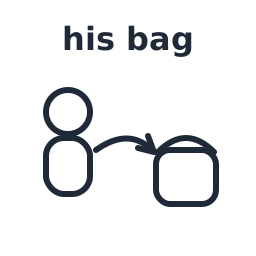
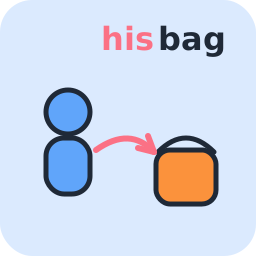
his, her, its (feminine singular)
Word origin
Feminine possessive adjective, from Latin sua, the feminine of suus ('his, her, its, one's own').
- Origin
- Latin
- Root
- sua (suus)
Examples
.
He lost his watch somewhere in the park.
.
She really likes her new school and her classmates.
.
The cat is sleeping on its favourite blanket near the window.
vendu .
My friend sold his house to go and live in the countryside.
, l' .
Marie is looking for her car, she can't remember where she parked it.
is the feminine singular third-person possessive adjective in French, covering "his", "her" and "its" in one form: sa voiture can be his car, her car or the car of an organisation. Unlike English, French possessives agree with the thing possessed, not the possessor; the gender of the owner is invisible in sa. Context, not grammar, tells you whose car it is.
Like ma and ta, sa swaps to the masculine form son before a vowel or mute h, even when the noun is feminine: son amie (his/her friend), son histoire (his/her story). This is purely phonetic, to avoid the hiatus of sa amie. The plural counterpart for any gender is ses. See the French possessives guide for how the full nine-cell table (three persons by three forms) lines up.
Where this fits
Used in
Stories
(7)Grammar articles
(7)How to Say Therefore, So, Thus and Hence in French
Reported Speech in French: Tense Backshift (dit que, a dit que)
dont in Depth: The French de Relative Pronoun
The French Present Participle and Gerund (le participe présent et le gérondif)
French Possessive Pronouns: le mien, le tien, le sien, le nôtre, le vôtre, le leur
French Possessives: mon, ma, mes and the mon-Before-Vowel Trap
The French Subjunctive After Superlatives and Exclusives
Add to review queue
Track this word in your spaced-repetition queue and be tested on it at the right interval.
Go to my review queueFrench · Free printables
sa: worksheet, infographic and listicle
Free printable study downloads for the French word "sa" (his, her, its (feminine singular)): a worksheet with the answer key built in, an infographic, and a sentence listicle. Open any one to view, print or save.
Free for members
The printable worksheets, infographics and PDFs are free with an account. Start a free week and download as many as you like.
Start your free weekThis word is part of lesson 2.