
Ordering in Italian: Vorrei, Quanto costa? and Il conto, per favore
By Michael McGettrickUpdated 12 October 2026
Ordering in Italian needs four phrases: ... to ask, ? to check the price, ? at the till and , at a table. Add and , and the rest is the names of things.
Quick check
Three quick questions on what you have just read. The full practice is further down.
Spot the mistake
0/3Tap the mistake.
The whole exchange on one screen
| When | You say | It means |
|---|---|---|
| ordering | , . | I'd like a coffee, please. |
| at the counter | , . | A , please. |
| the waiter asks | . | A pizza for me. |
| one thing | ? | How much is it? |
| several things | ? | How much are they? |
| at the till | ? | How much is that? |
| at a table | , . | The bill, please. |
| You hear | It means |
|---|---|
? | Yes? What can I get you? |
. | What can I get you? |
? | Anything else? |
. | That's three euros. |
To ? the answer is , , : no, that's all, thanks.
Vorrei: the polite way to ask
is the conditional of : I would like. It is the word for ordering, booking and asking for anything in a shop. , I want, is the present tense, and said to a waiter or a shop assistant it sounds like a demand:
- Voglio un caffè.what a child says
- Un caffè.brisk, but normal at a busy counter
- Un caffè, per favore.normal at a bar
- Vorrei un caffè, per favore.polite anywhere
.- I'd like a coffee..- I'd like to pay.!- I want an ice cream! (a child)
Per me, prendo
When a waiter takes a table's order, each person says what they will have:
.- A still water for me..- I'll have the..- The same for me.
(to take) is the everyday verb for having food and drink: ?, what are you having?
At the bar
An Italian is a café: coffee all day, a (croissant) at breakfast, a sandwich at lunch, a drink in the evening.
| Italian | English |
|---|---|
| an : in Italy, means this |
| a , mostly a morning drink |
| a freshly squeezed juice, usually orange |
| a croissant |
| a filled roll |
| a still water |
| a sparkling water |
Ask for a and you get a glass of milk: is milk. Many Italians stop drinking after the morning; nobody will refuse you one, but now you know why the barista smiles.
Pay first: la cassa and lo scontrino
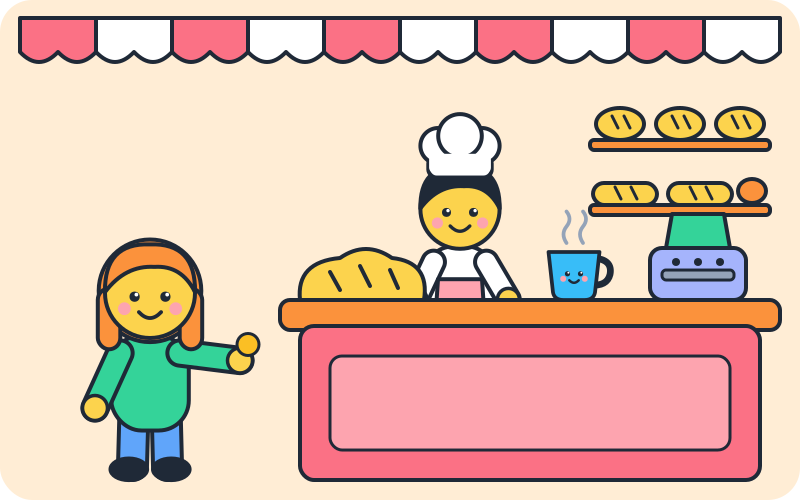
Il pane, the bread; il caffè, the coffee; la cassa, the till, where you often pay before you order.
In a busy bar, the order is the other way round from Britain:
- At the
(till), say what you want:, . - Pay, and take the
(receipt). - Put the receipt on the
(counter) and order again:, .
Standing is usually cheaper than sitting , where a waiter serves you and the price goes up.
Food and drink to start with
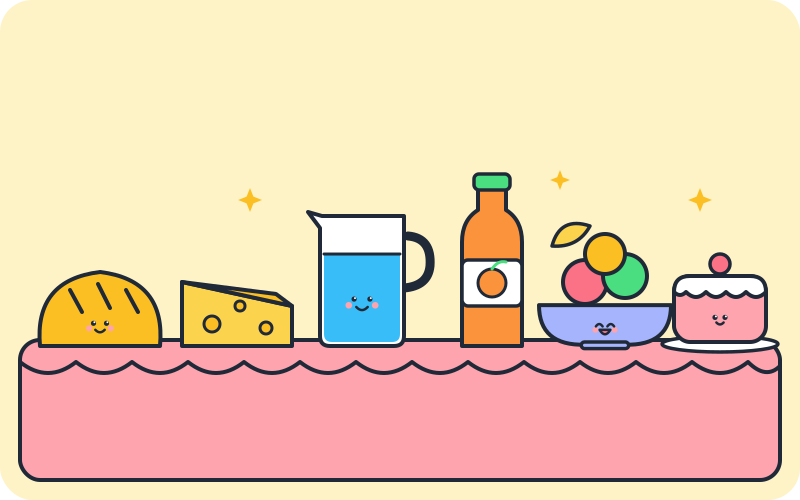
Il pane, bread; il formaggio, cheese; l'acqua, water; il succo, juice; la frutta, fruit; la torta, cake.
| Food | English | Drink | English |
|---|---|---|---|
| bread | | water |
| | wine | |
| pizza | | beer |
| cheese | | milk |
| salad | | juice |
| soup | | tea |
| egg | | sugar |
Two you need straight away take , not :
.- I'm hungry. (literally: I have hunger).- I'm thirsty.
Tired is the other way round, with as in English: , or for a woman.
Quanto costa? Prices in euro
The verb agrees with what you are pricing: one thing, ; more than one, .
?- How much is the bread??- How much are the apples?.- It's expensive.
never changes, but the cents are regular:
| Price | Italian |
|---|---|
| 1,00 € | |
| 2,00 € | |
| 0,01 € | |
| 0,50 € | |
| 3,50 € | |
Prices are written with a comma, 3,50 €, and said as euro then cents. In a hurry people drop the word: .
At the market: un chilo di mele
At a market or a shop counter you ask by weight, always with :
, .- A kilo of apples, please..- Half a kilo of tomatoes.etti .- Two hundred grams of cheese.
An etto is a hundred grams, and it is how Italians buy cheese and ham at a counter. A market stall, in a few lines:
| Who | Italian | English |
|---|---|---|
| You | ? | How much are the strawberries? |
| Seller | . ? | Three euros a kilo. Want a taste? |
| You | ! , . | Delicious! A kilo, please. |
| Seller | ? , ? | Anything else? Potatoes, lettuce? |
| You | , , . | No, that's all, thanks. |
Fruit and vegetables are and , both singular: . Have your (wallet) ready: many stalls still prefer cash.
Paying: il conto, per favore
| English | Italian |
|---|---|
| The bill, please. | , . |
| Can I pay by card? | ? |
| I'll pay cash. | . |
| Keep the change. | . |
In a restaurant the bill comes only when you ask: bringing it unasked would hurry you out. Tipping is not the duty it is in Britain or . A , a small charge per person for bread and the table, is often already on the bill, and leaving the coins of the change is plenty.
A bar exchange, start to finish
| Who | Italian | English |
|---|---|---|
| You | ! , . | Good morning! A coffee and a croissant, please. |
| Barista | ? | Anything else? |
| You | , . ? | No, that's all. How much is it? |
| Barista | . | That's two euros fifty. |
| You | . ! | Here you are. Thanks! |
| Barista | . . | Thank you. Here's your receipt. |
Mistakes English speakers make
| Wrong | Right | Why |
|---|---|---|
| . | . | sounds like a demand |
| due euri | | never changes |
| the verb agrees with | |
| (a ) | macchiato | alone is milk |
| a quantity takes | |
| . | . | hunger takes |
What to do next
- Say your usual coffee order in Italian, with
and with - Price three things in your kitchen in euro, aloud.
- Do the drill below.