
Ch 1 · Lesson 5Mandarin · Chapter 1 · Lesson 5 · Grammar primer
Say something today: greetings and courtesies
Hello, goodbye, thank you and sorry - nǐ hǎo, zàijiàn, xièxie, duìbuqǐ - so you can greet a real Mandarin speaker before you have learned any grammar.
The short version
Learn greetings whole, not word by word
!。Nǐ hǎo! Xièxie nǐ.
Why?Hide
(nǐ hǎo) is hello, (xièxie) is thank you and (zàijiàn) is goodbye. Learn each one as a single thing to say: there is no grammar to work out yet. Note the light second syllable in (xièxie), and that (nǐ hǎo) is said ní hǎo, because two third tones in a row turn the first into a rise.
。Bù hǎoyìsi.
Why?Hide
(duìbuqǐ) is a real apology, for treading on a foot or being late. For squeezing past someone or catching a waiter's eye, people say (bù hǎoyìsi), excuse me. When someone apologises to you, (méi guānxi) is it's fine.
You can hold your first Mandarin exchange before you have learned a single character or a single point of grammar. Greetings and courtesies are fixed phrases: learn the dozen below as whole things to say, in pinyin, and you can greet a real Mandarin speaker this afternoon.
| Hanzi | Pinyin | English |
|---|---|---|
| nǐ hǎo | hello | |
| nín hǎo | hello (polite) | |
| zàijiàn | goodbye | |
| ? | nǐ hǎo ma? | how are you? |
| 。 | wǒ hěn hǎo | I'm fine |
| ... | wǒ jiào... | my name is... |
| wǒ tīng bu dǒng | I don't understand | |
| xièxie | thank you | |
| bú kèqi | you're welcome | |
| qǐng | please | |
| duìbuqǐ | sorry | |
| méi guānxi | it's OK, never mind |
Greetings
(nǐ hǎo) is the one to learn first: any time of day, a new acquaintance or a total stranger, a shop or a street. Say it ní hǎo: when two third tones meet, the first one rises (the four tones has the rule).
Mandarin has a respectful you, (nín), and swapping it in is the easiest courtesy in the language. The colours below mark the plain and the polite you:
| Hanzi | Pinyin | Say it to |
|---|---|---|
| nǐ hǎo | peers, children, most strangers |
| nín hǎo | elders, teachers, customers |
! | lǎoshī hǎo | your teacher: title + |
- 嗨 hāi
- 你好 nǐ hǎo
- 您好 nín hǎo
The last row is a pattern worth knowing: a title plus (hǎo) greets someone by their role, the way a class greets its teacher: ! (Lǎoshī hǎo!) - Hello, teacher!
There are greetings for the time of day too, though plain (nǐ hǎo) works at any hour:
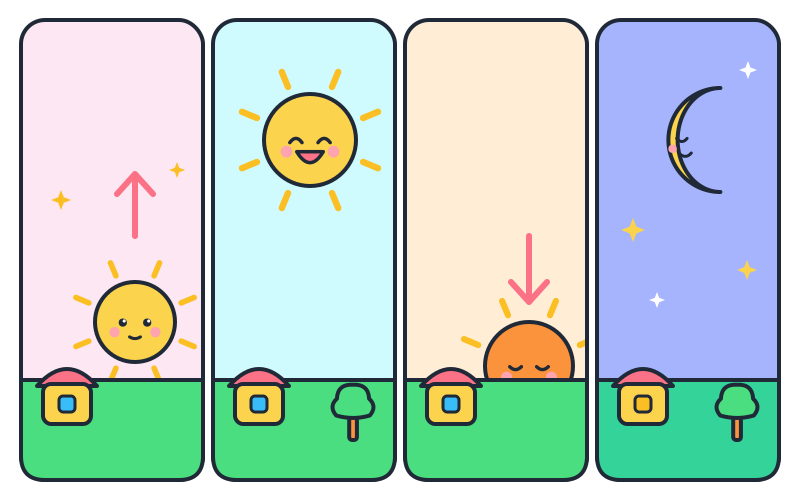
Morning, midday, evening, bedtime. 你好 nǐ hǎo covers midday and every other hour; 晚安 wǎn’ān is only for going to bed or parting late at night.
| Hanzi | Pinyin | English |
|---|---|---|
| zǎoshang hǎo | good morning | |
| wǎnshang hǎo | good evening | |
| wǎn'ān | good night |
(wǎn'ān) is good night: said at bedtime, or when you part late at night, never as a daytime goodbye. (wǎnshang hǎo) is real but a touch formal, the greeting of a host or a hotel desk; friends just say .
For every ordinary parting, (zàijiàn) is the standard goodbye, literally "again see": ! (Míngtiān jiàn!) - See you tomorrow! The other ways to say hello are in how to say hello in Mandarin, and the other goodbyes in how to say goodbye in Mandarin.
Courtesies
| Hanzi | Pinyin | English | When |
|---|---|---|---|
| xièxie | thank you | often; it costs nothing | |
| bú kèqi | you're welcome | the reply to | |
| qǐng | please | at the front | |
| duìbuqǐ | sorry | a real apology | |
| bù hǎoyìsi | excuse me | a small sorry | |
| méi guānxi | it's OK | the reply to either |

- !
- !
The customer pays and says 谢谢 xièxie; the baker answers 不客气 bú kèqi.
(qǐng) goes at the front of the request, the way a waiter says 。 (Qǐng zuò.) - Please sit down. is roughly "don't be polite", and is literally "no connection".
The two apologies differ in weight:
- 不好意思 bù hǎoyìsi
- 对不起 duìbuqǐ
,。(Bù hǎoyìsi, wǒ tīng bu dǒng.) - Sorry, I don't understand.!(Duìbuqǐ!) - I'm so sorry! (you trod on a foot)
To get a stranger's attention before a question, (qǐngwèn, may I ask) is the polite opener. More ways to thank are in how to say thank you in Mandarin.
Going further: Getting by and the rest of the guide, when you want them. This lesson does not need them.
Practice
Practise this lesson
9-question session
One question at a time, mixed across the exercises in this lesson. Miss one and it comes back round before the end.
New words in this lesson
 你好nǐ hǎohello, how are you
 您好nín hǎohello (polite), how do you do
 谢谢xiè xiethank you
- 不客气bú kè qiyou are welcome, don't mention it
 再见zài jiàngoodbye, farewell
 对不起duì bu qǐsorry, excuse me
 不好意思bù hǎo yì siexcuse me, sorry (mild); to feel embarrassed
 没关系méi guān xiit doesn't matter, never mind, that's OK
 晚上好wǎn shang hǎogood evening
Mandarin · Free printables
Worksheets for this lesson
Worksheets with answer keys built in. Open any one to view, print or save.
Lesson 5 of 15 in this chapter