
Ch 1 · Lesson 9Mandarin · Chapter 1 · Lesson 9 · Grammar primer
也 (yě): also, too, and where it goes
goes after the subject and straight before the verb, never at the end like English 'too': , I am going too. With it is 'not ... either'.
The short version
。Wǒ yě xiǎng qù Zhōngguó.
Why?Hide
English puts 'too' at the end of the sentence, so learners write (wǒ xǐhuan kāfēi yě). It is wrong: (yě) is an adverb, and Mandarin adverbs sit after the subject and straight before the verb. If there is a (xiǎng) or (yào), (yě) goes in front of that.
Mandarin 也 (yě) and 都 (dōu)
English puts "too" at the end of a sentence and "all" more or less wherever it likes. Mandarin is stricter and simpler: (yě, also) and (dōu, all) are adverbs, and both live in one fixed slot, after the subject and straight before the verb. Learn the slot once and both words are done.
The whole system on one screen
| Word | Pinyin | Means | Slot |
|---|---|---|---|
| yě | also, too, either | subject + + verb | |
| dōu | all, both | group + + verb | |
| yě dōu | all ... too | group + + verb | |
| yě bù | not ... either | subject + + verb | |
| dōu bù | none of | group + + verb |
The colours below stay the same all page long: (yě) in one colour, (dōu) in another, and (bù) in a third.
| Hanzi | Pinyin | English |
|---|---|---|
。 | Wǒ yě qù. | I am going too. |
。 | Wǒmen dōu qù. | We are all going. |
。 | Wǒmen yě dōu qù. | We are all going too. |
One slot: after the subject, before the verb
Mandarin adverbs go before the verb they describe, and (yě) and (dōu) follow that rule without exception. Here is the slot, three times:
If something else stands in front of the main verb, such as (xiǎng, want to), (yào, want, will) or (gēn, with), the adverb goes in front of the whole chain.
| Hanzi | Pinyin | English |
|---|---|---|
。 | Wǒ yě xiǎng qù Zhōngguó. | I want to go to China too. |
。 | Tā yě yào kāfēi. | He wants coffee too. |
。 | Tā yě gēn nǐ qù. | She is going with you too. |
。 | Wǒmen dōu zài zhèlǐ. | We are all here. |
。 | Wǒmen míngtiān dōu qù. | We are all going tomorrow. |
A time word such as (míngtiān, tomorrow) normally comes before the adverb, as in the last row: the adverb wants to be the last thing before the verb phrase.
也 (yě): also, too, and "not ... either"
(yě) adds one more person or thing to something already said. It attaches to the verb, not to a noun, so there has to be a verb (or an adjective such as ) for it to sit in front of.
| Hanzi | Pinyin | English |
|---|---|---|
,。 | Tā shì lǎoshī, wǒ yě shì lǎoshī. | He is a teacher; I am one too. |
,。 | Tā xǐhuan kāfēi, wǒ yě xǐhuan. | He likes coffee; I do too. |
。 | Kāfēi yě zhēnde hěn hǎo. | The coffee is really good too. |
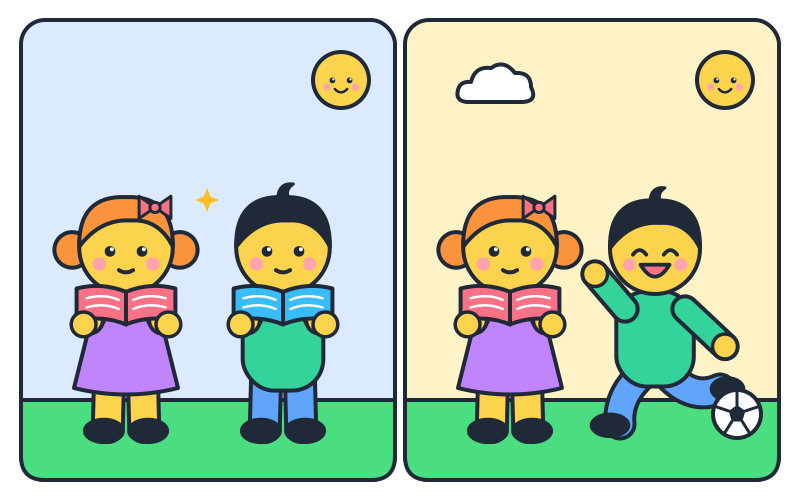
On the left he reads too, so 也 yě goes before his verb. On the right he plays football instead: nothing is shared, so no 也.
Two things the table cannot show:
- usually comes before other adverbs, so the rest of the phrase follows it unchanged:
。(Kāfēi yě zhēnde hěn hǎo.), the coffee is really good too. - English "either" is just with a negative. There is no separate word:
。(Wǒ yě bú qù.), I am not going either.
For things that did not happen, (yě méi) does the same job: 。 (Wǒ yě méi qù.) - I didn't go either.
Going further: 都 (dōu): all, both, and it looks left and the rest of the guide, when you want them. This lesson does not need them.
Practice
Practise this lesson
9-question session
One question at a time, mixed across the exercises in this lesson. Miss one and it comes back round before the end.
Mandarin · Free printables
Worksheets for this lesson
Worksheets with answer keys built in. Open any one to view, print or save.
Lesson 9 of 15 in this chapter