
Greetings in Brazilian Portuguese: Oi, Bom Dia and Tudo Bem
By Michael McGettrickUpdated 11 October 2026
You can hold your first conversation in Brazilian Portuguese today, before you learn a single verb ending. Greetings are fixed phrases: learn them whole and use them at once. There are two small traps, and both are flagged below.
Quick check
Three quick questions on what you have just read. The full practice is further down.
Pick the right one
0/3Pick the right phrase for each situation.
It is three in the afternoon and you walk into a shop.
It is nine at night and you arrive at a friend's party.
A man wants to say thank you to a woman.
The whole system on one screen
Learn the left column; the rest of the page shows when to use each one.
| Say this | It means | Use it |
|---|---|---|
| hi, hello | anyone, any time |
| hello | a touch more formal |
| good morning | until about midday |
| good afternoon | midday until dark |
| good evening, good night | after dark |
? | how are you? | almost every hello |
| bye | almost every goodbye |
| see you later | when you will meet again |
| see you tomorrow | colleagues, neighbours |
| thank you | man / woman speaking |
| please | asking for something |
| excuse me | to get past or interrupt |
| sorry | after a mistake |
| you're welcome | reply to thanks |
... | my name is... | introducing yourself |
This page teaches Brazilian Portuguese. Where says something different, it is labelled EP.
- E aí?what’s up? (friends)
- Oihi (anyone)
- Oláhello (emails, TV)
- Bom diagood morning (shops, work)
- Como vai o senhor?how are you, sir?
Oi and olá: hello
is the everyday Brazilian hello: friends, neighbours, shop staff, strangers, any hour. Brazilians often stack it with a time-of-day greeting.
, ?- Hi, how are you?, !- Hi, good morning!
is a touch more formal. In Brazil it lives in writing, emails and television more than across a shop counter.
| Situation | Natural choice | English |
|---|---|---|
| friend in street | ! | Hi! |
| start of email | , Ana. | Hello, Ana. |
| stranger in lift | , ! | Hi, good morning |
has one more job. Said as a question, it answers someone who calls your name, or asks them to repeat:
?- Yes? / Sorry, what?
EP: in is the everyday hello and sounds Brazilian: , ?
Bom dia, boa tarde, boa noite
These three are the polite hellos, chosen by the clock. In Brazil you say one when you walk into a shop, a lift or a waiting room: ! to the room is ordinary manners.
Waking up to noonBom dia
good morning
Noon to darkBoa tarde
good afternoon
Dark to bedtimeBoa noite
good evening, and good night
does double duty: hello when you arrive after dark, and goodbye when you leave or go to bed.
! , .- Good evening! A table, please., !- Good night, see you tomorrow!
In most of Brazil it is dark by about six, so starts early.
Why bom but boa?
The adjective agrees with the noun. is masculine, and are feminine.
| Greeting | Noun's gender | English |
|---|---|---|
| masculine | good morning |
| feminine | good afternoon |
| feminine | good night |
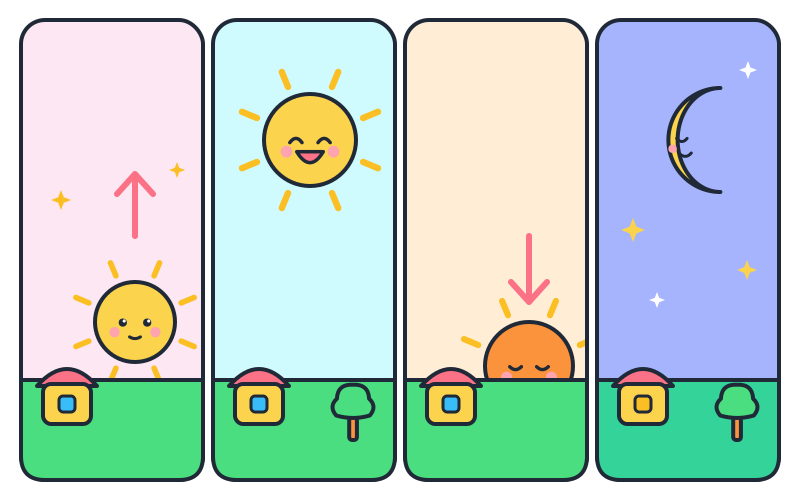
Bom dia until about midday, boa tarde until dark, boa noite after dark. Dia is masculine, so bom; tarde and noite are feminine, so boa.
Tudo bem? How are you, Brazilian style
? means literally all well?, and it follows almost every hello. The usual answer repeats the words and hands the question back.
| Question | Answer | English |
|---|---|---|
? | , ? | Fine, and you? |
? | , ? | Fine, and you? |
? | , . | Great, thanks. |
? | , . | Well, thanks. |
Like English how are you?, it is a greeting more than an enquiry: the expected answer is short and positive. ? is a little more formal, good with older people or at work. Among friends you will also hear ?, roughly what's up?
has a second meaning, that's OK:
! - .- Sorry! - That's OK.
EP: says ? too, but ? (how are you?) is more common with anyone you do not know well.
Saying goodbye: tchau, até logo, até amanhã
is the everyday goodbye. The phrases mean until... and say when you will meet again.
| Goodbye | Literally | Means |
|---|---|---|
| (from ciao) | bye |
| until soon | see you later |
| until more | see you |
| until tomorrow | see you tomorrow |
A typical Brazilian goodbye stacks two:
, !- Bye, see you tomorrow!
sounds final in Brazil, a farewell to someone you may never see again.
EP: in is an ordinary goodbye: , !
Obrigado or obrigada: it depends on who is speaking
literally means obliged, so it agrees with the person who feels obliged: the speaker. Who you thank makes no difference.
| Speaker | Says | English |
|---|---|---|
| a man | . | Thank you. |
| a woman | . | Thank you. |
| a man | . | Thank you very much. |

- !
- .
The customer is a woman, so she says obrigada, whoever she is thanking. The baker answers de nada.
The reply is , literally of nothing. Brazilians also say !, roughly don't mention it.
! - .- Thank you! - You're welcome.
Por favor, com licença, desculpa
English excuse me does two jobs, and Portuguese splits them. Ask: am I asking permission before, or apologising after?
| Phrase | When | Example |
|---|---|---|
| asking for something | , . |
| before: getting past | , ? |
| after: apologising | , . |
| the same, more polite | , . |
The examples: a coffee, please; excuse me, can I get past?; sorry, I didn't mean it; sorry, madam.
is the one for strangers, older people and work; is everyday and friendly. From a beginner, either is fine.
Your name: eu me chamo, meu nome é
Two ways to say your name, both natural in Brazil:
| Portuguese | Literally | English |
|---|---|---|
Ana. | I call myself Ana | My name is Ana. |
Ana. | my name is Ana | My name is Ana. |
And the two matching questions:
?- What's your name? (literally how do you call yourself?)?- What is your name?
With someone much older, or a customer, Brazilians replace with (to a man) or (to a woman):
?- What is your name, sir?
Once introduced, say or just , nice to meet you. The reply is , the pleasure is mine.
EP: puts the after the verb and keeps the article: - Ana. and Ana.
A first conversation, start to finish
Tom knocks on his new neighbour's door at about ten in the morning.
| Who | Portuguese | English |
|---|---|---|
| Tom | , ! | Hi, good morning! |
| Ana | ! ? | Good morning! How are you? |
| Tom | , ? | Fine, and you? |
| Ana | . Ana. | Great. My name is Ana. |
| Tom | Tom. . | My name is Tom. Nice to meet you |
| Ana | , Tom! . | Nice to meet you! Thanks for coming |
| Tom | . , ! | You're welcome. Bye, see you later! |
| Ana | , ! | Bye, see you tomorrow! |
Ana says because she is a woman, whoever she is thanking. Tom would say .
Mistakes English speakers make
| Wrong | Right | Why |
|---|---|---|
| | |
| | |
| at 9 p.m. | | after dark, hello or goodbye |
| man says | | the speaker's gender decides |
| , after | | |
| to a colleague | | in Brazil |
| Ana | Ana | a name takes |
What to do next
- Start the Portuguese course and use
,?andin every lesson. - Read a gente, the Brazilian everyday we.
- Then ser and estar, the two verbs to be.