
Portuguese Prepositions and Their Contractions: do, da, no, na
By Michael McGettrickUpdated 12 October 2026
A Portuguese preposition cannot meet the article without the two merging into one word:
Quick check
Three quick questions on what you have just read. The full practice is further down.
Spot the mistake
0/3Tap the mistake.
+ o).- The book is on the table. (+ a)
There is no unfused version to fall back on: is not formal Portuguese, it is wrong.
The whole system on one screen
Four prepositions fuse with the four forms of the:
| Preposition | + o, + a | + os, + as |
|---|---|---|
| | |
| | |
| | |
| | |
Every other preposition stays separate on the page: , , . (Brazilian speech squeezes into , which comes later.)
How the chart works
Three patterns carry the whole chart:
And plus gives : the grave accent is all that is left of the second word.
| Pieces | Portuguese | English |
|---|---|---|
| + o | . | My father's house. |
| + a | . | The book is on the table. |
| + a | . | The bus goes through the city. |
| a + a | . | I'm going to school. |
Careful writing keeps apart when the article belongs to the subject of a following infinitive, (before the film starts), but many Brazilians fuse even that.
The Portuguese prepositions list
| Word | English | Example |
|---|---|---|
| of, from | . I'm from London. |
| in, on, at | . I'm at home. |
| to | . I'm going to school. |
| for, to | . It's for you. |
| by, through, for | . Thanks for everything. |
| with | coffee with milk |
| without | coffee without milk |
| until, up to | . See you tomorrow. |
| about, on | a book about music |
| between | between us |
| since | since yesterday |
| against | against the wall |
and can both mean for, and choosing between them is a topic of its own: por vs para.
The optional ones: num, numa, dum
and can also fuse with and , but here the fusion is a choice:
| Pieces | Fused | Also written |
|---|---|---|
| | |
| | |
| dum | |
| duma | |
.- He lives in a big house.
Say them fused; write them either way. Brazilian writing often keeps them apart, and is far more common on the page than dum.
Pronouns and demonstratives fuse too
The same welding happens with , and the demonstratives, and here too the fused form is the normal one:
| Pieces | Fused | English |
|---|---|---|
| | his, of him |
| | her, of her |
| | in him, in it |
| | of this |
| | in that |
| | in that, on that |
.- I don't think about that.
and are how Brazilians say his and her: see Portuguese possessives.
Em: one word for in, on and at
English splits location three ways. Portuguese mostly does not:
| Portuguese | English |
|---|---|
| in the car |
| on the table |
| at school |
When you need to be exact about the position, other words take over, each with and its article:
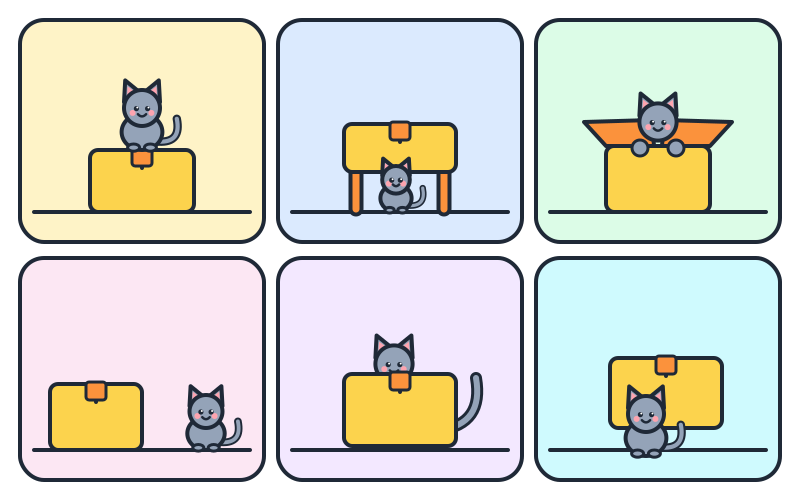
Em cima da caixa (on the box), embaixo da caixa (under the box), na caixa (in the box), ao lado da caixa (beside the box), atrás da caixa (behind the box), na frente da caixa (in front of the box). Portugal says em frente da (or à) caixa for in front of.
The real decision with is whether the place takes an article:
| Place | Example | English |
|---|---|---|
| most cities: no | | in London |
| most countries: yes | | in Brazil |
| : no | | in |
| : yes | | in |
| home: no | | at home |
takes the article because it is literally the river. And is not at home: it means in the house, the building.
De: of, from, and by car
is the everyday of and from, and it also does the job of the English apostrophe s:
Ana- Ana's car (literally the car of the Ana)
Much of Brazil puts the article before a first name, hence Ana; the north-east often says Ana. More jobs, with one exception to watch:
| Job | Example | English |
|---|---|---|
| transport | | by car |
| transport | | by bus |
| on foot: not | | on foot |
| part of the day | | in the morning |
| what it is about | | a music book |
Transport takes plain with no article. means inside the car, not by car.
A and à: going somewhere, and telling the time
The bare means to. In Brazilian speech it has a strong rival, , shortened to :
| Where | Portuguese | English |
|---|---|---|
| written | . | I'm going to school. |
| Brazil, spoken | . | I'm going to school. |
| written | . | I'm going to the doctor. |
| Brazil, spoken | . | I'm going to the doctor. |
is plus . These are genuine spoken forms, fine in messages and dialogue, not in formal writing. In is normal in speech too, though is common there as well.
Where holds its ground is clock time and parts of the day:
has the accent because the hours are feminine and plural, : plus gives .
Verbs that bring their own preposition
Some everyday verbs come with a preposition attached, where English uses another one or none at all:
| Verb | Example | English |
|---|---|---|
| . | I like coffee. |
| . | I need help. |
| . | I think about you. |
| . | He lives in . |
| . | I believe you. |
| ? | Do you remember me? |
The preposition fuses like any other: , I like Brazil. Grammars prefer ?, and you will see that in writing; most Brazilians say it without .
Mistakes English speakers make
| Wrong | Right | Why |
|---|---|---|
| o | | + o must fuse |
| . | . | takes |
| takes the article | |
| no | | takes none |
| à . | . | is masculine: no à |
| no (= by car) | | transport takes |
What to do next
- Chant the chart:
, , ,;, , ,;, , ,;, , ,. - Unpick every contraction in the next Portuguese sentence you read.
- Do the drill below, then see Portuguese possessives.