
Ch 1 · Lesson 15Russian · Chapter 1 · Lesson 15 · Grammar primer
И and а: two words for and
Russian has two words for and. adds; sets two things side by side ( , ). Get them right and you sound like you know what you are doing.
The short version
Comparing two things? That and is a, not i
, . (Ya lyublyu chay, a ona lyubit kofe.)
Why?Hide
I adds one thing to another. A sets two different things side by side to contrast them, so mama doma, a papa na rabote needs a: Mum is at home and Dad is at work. With i it sounds like two unconnected facts. And after a negative, not X but Y, the but is always a: eto ne kofe, a chay.
Russian has two words where English has and: (i) adds, (a) compares. Then (no) is but, and (ili) is or. The line between and does not fall where English puts it, and swapping them changes what you mean.
| Word | Job | Example |
|---|---|---|
| adds: both true, no clash | . |
| compares two things | , . |
| not X but Y | , . |
| but: against expectation | , . |
| or | ? |
In order: Mum and Dad are at home. Mum is at home and Dad is at work. It's not coffee, it's tea. It's difficult but interesting. Tea or coffee?
и: plain addition
И adds. Both things are true, and the second sits alongside or follows on from the first:
.- Mum and Dad are at home., .- He arrived and we went home., .- I know him and he knows me.
It is also the too in me too, and doubled it gives both... and:
!- Me too!, .- He both speaks and writes.
Nothing here surprises an English speaker. The surprise is how much of English and it does not cover.
а: contrast without contradiction
А is the word English lacks. It sets two different things side by side so you notice the difference, but neither cancels the other. The nearest English is whereas or while; in speech English just says and with a bit of stress:
, .- Mum is at home and Dad is at work., .- I like tea and she likes coffee., .- My brother is at home and my sister is at school.
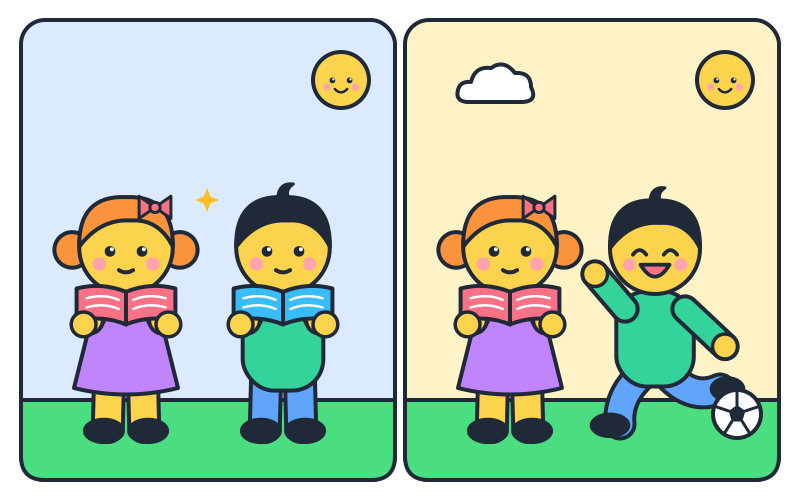
- ,
- .
- ,
- .
On the left both are reading, so и: he does the same. On the right she reads and he plays football: two people, two different things, so а.
Each sentence says something about two different people and sets them against each other. That is the signal for . With instead, a Russian hears two unconnected facts read off a list.
also does three everyday jobs that English does not do with and at all:
| Job | Example | English |
|---|---|---|
| turning it back | А́нна, ? | My name's Anna, and yours? |
| not X but Y | , . | He's not my brother, he's my friend. |
| opening a question | ? | And where's Dad? |
After not X, the correction is always , never . On its own, ? is and you?, the reply when someone asks how you are.
Going further: но: but, against expectation and the rest of the guide, when you want them. This lesson does not need them.
Practice
Practise this lesson
9-question session
One question at a time, mixed across the exercises in this lesson. Miss one and it comes back round before the end.




Russian · Free printables
Worksheets for this lesson
Worksheets with answer keys built in. Open any one to view, print or save.
Lesson 15 of 43 in this chapter