
Ch 7 · Lesson 15Spanish · Chapter 7 · Lesson 15 · Grammar primer
Estoy hablando: what is happening right now
plus the gerund (, , ) for what is going on as you speak, and why Spanish does not use it for plans the way English does.
The short version
The gerund: -ando for -ar, -iendo for -er and -ir
.
Why?Hide
Drop the infinitive ending and add -ando to -ar verbs and -iendo to -er and -ir verbs: , , . After a vowel the i is written y: , . Stem-changing -ir verbs change e to i or o to u: , . Only changes for the person.
The progressive never does the future
Madrid .
Why?Hide
English says 'I'm flying to Madrid tomorrow'. Translate that word for word and you get wrong Spanish, because plus gerund describes only what is already under way. For a planned future use the plain present, or a plus infinitive. Rule of thumb: if the action has not started, the progressive is wrong.
Forming the gerund
Drop the infinitive ending and add the gerund ending:
| Verb type | Infinitive | Gerund |
|---|---|---|
| -ar | | |
| -er | | |
| - | | |
That covers most verbs. Two groups bend the rule.
After a vowel: -yendo
When the stem of an -er or -ir verb ends in a vowel, the i of -iendo is written y:
| Infinitive | Gerund | English |
|---|---|---|
| | reading |
| | hearing |
| | bringing |
| | building |
Stem-changing -ir verbs
The -ir verbs that change their stem in the present also change it in the gerund: e becomes i, o becomes u.
| Infinitive | Gerund | English |
|---|---|---|
| | asking |
| | saying |
| | coming |
| | sleeping |
| | dying |
| | being able |
is the one -er verb that does this. The -ar and -er stem-changers keep a regular gerund: , . And has the one truly irregular gerund, .
When Spanish actually uses the progressive
Spanish uses the progressive for an action under way as you speak, or across a current stretch of time:
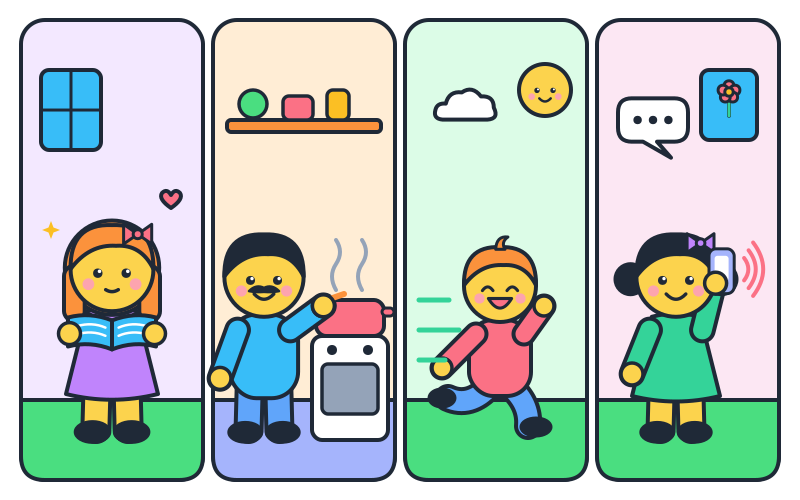
- .
- .
- .
- .
She's reading, he's cooking, he's running, she's talking on the phone: each one is in the middle of the action, so estar + gerund.
For habits, general truths and timetables, it uses the plain present, where English often says "-ing":
| Meaning | Spanish | English |
|---|---|---|
| right now | , . | I can't talk, I'm driving. |
| this month | . | This month I'm studying a lot. |
| a settled fact | . | I work in a bank. |
| a habit | ¿ ? | What do you do at weekends? |
The plain present can describe the moment too: ¿ ? and ¿ ? both ask "what are you doing?". The progressive just underlines "right now".
The future trap: no progressive for plans
English uses "-ing" for plans: I'm flying to Madrid tomorrow. The Spanish progressive only covers what has already started, so a plan takes the plain present or + infinitive:
Estoy comiendo: under way now
Vuelo a Madrid mañana: a plan, not started
Timeline from past to future, with now marked.
- Wrong:
. Madrid .- I'm flying to Madrid tomorrow.Madrid .- I'm going to fly to Madrid tomorrow.
Rule of thumb: if the action has not started, the progressive is wrong.
Going further: The present progressive at a glance and the rest of the guide, when you want them. This lesson does not need them.
Practice
Practise this lesson
10-question session
One question at a time, mixed across the exercises in this lesson. Miss one and it comes back round before the end.
Spanish · Free printables
Worksheets for this lesson
Worksheets with answer keys built in. Open any one to view, print or save.
Free for members
The printable worksheets, infographics and PDFs are free with an account. Start a free week and download as many as you like.
Start your free weekLesson 15 of 25 in this chapter