
Spanish Informal Register: Slang, Texting and Fillers
By Michael McGettrick and Sergio Linares-HernandesUpdated 12 October 2026
Real Spanish shortens words in speech and in chat, and Spain and Latin America each have their own slang. Learn it to understand it; keep the standard yourself, and never use any of it in an exam.
Quick check
Three quick questions on what you have just read. The full practice is further down.
Fill in the blank
0/3Write the standard Spanish for each informal form, with its accent.
Chat: no vengo xq trabajo. Standard: no vengo trabajo. (because) (one word, no accent)
Accents count here
Chat: yo tb voy. Standard: yo voy. (the word for also)
Accents count here
Chat: dnd estás? Standard: ¿ estás? (the question word for a place)
Accents count here
' .- I'm off home. (speech: pa' is)xq .- I'm not coming because I'm working. (chat: xq is)
Informal Spanish at a glance
The forms you will meet most, with the standard word each one stands for:
| Informal | Standard | English | Where |
|---|---|---|---|
' | | to, for | speech |
' | | nothing | speech |
cansao | | tired | speech |
q | | that, what | chat |
xq | | because, why | chat |
tb | | also | chat |
finde | | weekend | chat, speech |
jaja | (laughter) | haha | chat |
| | I mean | speech |
| | like | speech, Spain |
| (to a friend) | mate | speech, Spain |
| | cool | Spain |
| | speech, mostly Spain |
Register is a scale, not a switch. The same greeting, from friends in Spain to a stranger:
- ¿Qué pasa, tío?
- ¿Qué tal?
- Buenos días, ¿cómo está usted?
Fast speech: what the mouth drops
Relaxed Spanish swallows sounds the spelling keeps. You hear these more than you read them:
| Standard | You hear | Example |
|---|---|---|
| ' | ' . I'm off home. |
| ' | '. It's nothing. |
| cansao | cansao. I'm tired. |
| pescao | pescao. I like fish. |
| helao | helao, . An ice cream, please. |
Pa' is heard all over the Spanish-speaking world. The lost d of -ado (cansao) is strongest in Spain and the Caribbean; Mexico keeps the d far more. In Andalusia, the Canaries, the Caribbean and much of coastal Latin America a final s often fades to a breath or disappears, so can sound like " do".
Chat and texting shorthand
Chat spelling comes from the keyboard, not the accent, so it is much the same from Madrid to Mexico City. Vowels go, and signs stand in for sounds:
| Chat | Standard | English |
|---|---|---|
q, k | | that, what |
xq, pq | | because, why |
xfa, pf | | please |
tb, tp | | also, neither |
dnd | | where |
salu2 | | greetings |
bss | | love (kisses) |
tqm | | love you lots |
The x is the multiplication sign, which Spanish reads as ( , two times three); the 2 in salu2 is . Laughter is jaja, because the j sounds like an English h. A real message, and what it says:
finde, xfa- See you at the weekend, please don't be late.. , .- the same in standard Spanish.
Fillers: o sea, en plan, pues
Spoken Spanish is held together by small words that mean little alone and carry the rhythm. These are the ones you will hear on a loop:
| Filler | Roughly | Example |
|---|---|---|
| well... | . Well, I don't know. |
| well, | , . OK, let's go. |
| I mean | , , carísimo. It's dear, I mean, really dear. |
| the thing is | . The thing is, I've no time. |
| like (Spain, young) | . He/she was, like, weird. |
| um (Latin America) | ... . Um... I don't know. |
¿? | you know? | , ¿? It's hard, you know? |
¿? | right? | , ¿? You're coming tomorrow, right? |
¿? | ? (Spain) | , ¿? I'll call you later, OK? |
| come on; bye (Spain) | , . Right, see you later. |
Four exclamations that carry the tone of a whole sentence:
¡ !- Good grief!¡!- No way! (Spain)¡!- Wow! or Oh dear!, depending on the voice.¡Uf!- Phew!
Spain slang and its Latin American cousins
Everything in the first table is Spain. A Mexican or an Argentine understands much of it from films and series, but says something else.
| Spain | English | Example |
|---|---|---|
| mate, guy; girl | ¿ , ? What's up, mate? |
| cool | ¡ ! How cool! |
| it's cool, I love it | . This song is great. |
currar | to work | Curro . I work Saturdays. |
flipar | to be amazed | ¡Flipo! I can't believe it! |
| to get, to catch | ¿ ? Do you get it? |
majo, maja | nice (a person) | maja. Your sister is really nice. |
pasta | money | pasta. I've got no money. |
| , . OK, see you. |
The same four ideas across the map:
| English | Spain | Mexico | Argentina |
|---|---|---|---|
| cool | | chido, ¡ padre! | copado |
| to work | currar | chambear | laburar |
| money | pasta | lana | guita, |
| mate | | compa | |
Who gets ? Only friends. The same woman greets three people three ways:
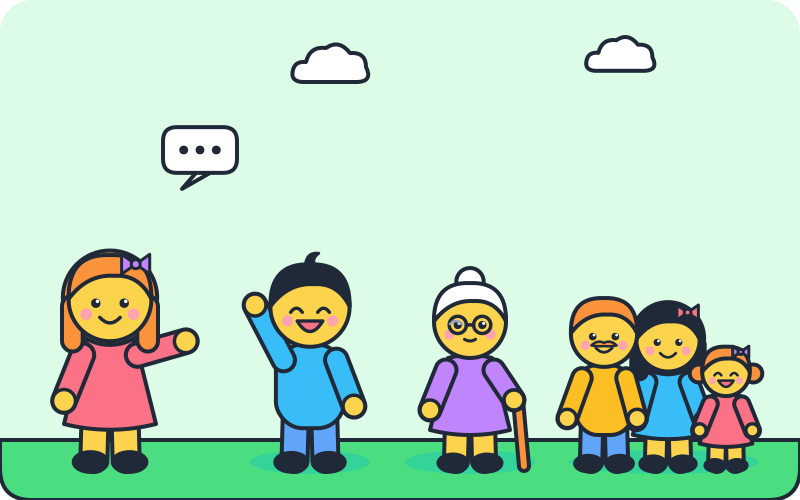
- ¿ , ?
- , .
- .
To her friend: ¿Qué pasa, tío? (What's up, mate?). To the older woman: Buenos días, señora (Good morning, madam). To the family: Hola a todos (Hi, everyone). Tío is for friends only.
Minced oaths: jo and jolín
Spain swears cheerfully, and you do not need any of it. You do need the polite stand-ins, which dodge a stronger word the way English says "sugar" or "flip":
| Minced oath | Roughly | Where |
|---|---|---|
jolín | oh no, gosh | Spain |
| blimey, wow | Spain |
| good heavens | everywhere |
¡, !- Oh no, what bad luck!¡, !- Blimey, look how late it is!
Mistakes English speakers make
| Wrong | Right | Why |
|---|---|---|
| pa' (exam) | | pa' is speech only |
| xq (exam) | | xq is chat spelling |
| (to a teacher) | , . | is for friends |
| curra (exam) | | currar is slang |
| (exam) | | is slang |
What to do next
- Watch a Spanish series with Spanish subtitles and spot five forms from the first table.
- Do the sort and spot-the-
drills below. - Then the other end of the scale: register and formality, and the regional word map in Spain vs Latin America vocabulary.